Al-Alimi urges Houthis to disarm and enter Yemen’s political process
 Yemen Herald News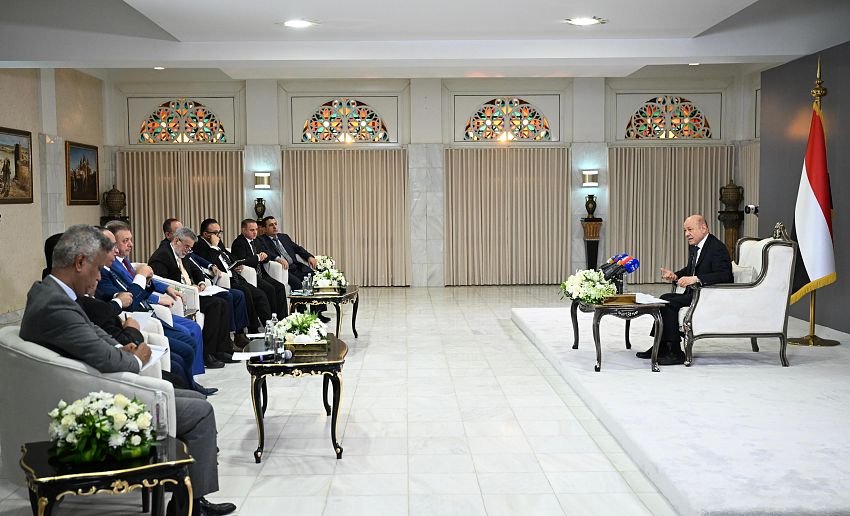
President Rashad al-Alimi, chairman of Yemen’s Presidential Leadership Council and supreme commander of the armed forces, has renewed his call for the Houthi movement to give up its weapons and take part in a political settlement, telling an audience of senior officials and media figures that the government is better prepared than at any point in the war to defend Yemenis and protect the country’s interests. He framed the appeal as an open invitation rather than a concession, saying the group would be free to compete politically alongside other Yemenis once it abandoned armed force.
Al-Alimi said the armed forces now operate under a single unified command, a change he described as substantially improving their readiness to meet any Houthi advance. He argued that the record of earlier truces justified caution, saying the group had repeatedly used periods of calm to rebuild and expand its military capabilities rather than to advance negotiations. Durable peace, he said, requires a state that holds a monopoly on the legitimate use of force, guarantees equal citizenship and runs institutions that serve the public rather than a faction.
The remarks land in the middle of a sharp military escalation. On 10 August the Houthis struck the Red Sea port of al-Mokha, on Yemen’s west coast, with ballistic missiles and drones. Briefing ambassadors from the countries sponsoring the peace process at a meeting in Riyadh, al-Alimi said the strike hit civilian and service infrastructure rather than a military position, and that those killed included women and children.
He told the envoys the government did not start the escalation or seek it, and traced the current round to a Houthi attempt to operate flights for Iran’s Revolutionary Guard Corps through Sanaa International Airport. That was followed, he said, by attacks on commercial shipping and on civilian sites inside neighbouring Saudi Arabia. The government had kept airports and seaports functioning and goods moving, and had cooperated with United Nations peace efforts despite the political and economic cost, he added.
Al-Alimi said the political and military picture had now changed, and that the Houthis must recognise that the phase of carrying out attacks without consequences is over. He asked the international community for an explicit political position condemning strikes on ports and civilians, and for recognition of the government’s right under international law to protect its population and institutions. International silence, he warned, would be read by the group as licence to continue rather than as an incentive to stop.
Economic recovery featured prominently in his remarks. Al-Alimi pressed the case for resuming oil and gas exports, which he described as essential to rebuilding state revenue and restoring public services. Crude shipments have been largely suspended since late 2022, when drone attacks on southern export terminals halted loadings, stripping the government of what had been its single largest source of hard currency. He also pointed to measures against smuggling networks and to what he said were improved security conditions in areas outside Houthi control.
On southern Yemen, al-Alimi acknowledged the legitimacy of southern grievances and called for a peaceful resolution through a South-South dialogue facilitated by Saudi Arabia. He linked that process to a fairer distribution of resources, singling out Hadramout, and to greater transparency in how revenues are managed. That is an implicit answer to long-standing complaints in southern and eastern governorates that locally produced wealth does not translate into local services.
He credited Saudi Arabia with sustained political, economic and humanitarian backing through the conflict, and urged international partners to work towards ending the war rather than managing its consequences, a distinction Yemeni officials have drawn repeatedly to argue that humanitarian funding cannot substitute for a political settlement.
Whether the disarmament appeal finds any traction is doubtful. The Houthis, who seized Sanaa in 2014 and control the most populous parts of northern Yemen, have shown no public willingness to surrender their weapons, and no election timetable exists. Yemen has not held a national vote since 2003, and the constitutional, administrative and security groundwork for one is absent across much of the country. The group had not responded publicly to al-Alimi’s remarks at the time of writing.
The humanitarian backdrop is severe and deteriorating. The United Nations estimates that 22.3 million Yemenis will need humanitarian assistance and protection during 2026, up from 19.5 million a year earlier, among them 5.2 million internally displaced people. Some 18.3 million face acute food insecurity, and more than 2.2 million children under the age of five are affected by malnutrition. Aid agencies have appealed for 2.16 billion dollars to reach 12 million people this year, with 9.4 million prioritised by severity of need.
The conflict’s consequences also reach well beyond Yemen’s borders. The Red Sea and the Bab al-Mandab strait carry a substantial share of global seaborne trade, and attacks on shipping have pushed carriers onto longer routes around southern Africa, raising freight costs and insurance premiums. That exposure is one reason Yemen’s internal war continues to command the attention of governments with no direct stake in its outcome.
For al-Alimi, the immediate test is narrower than the peace he described. He must hold the coalition of factions inside the Presidential Leadership Council together while responding to attacks on the coast, and convert promises of institutional reform into services that Yemenis can see. His government’s argument is that credibility on both fronts is the precondition for any negotiation worth having.
About the Author