Al-Aradah urges decisive international action on Houthi attacks in talks with French ambassador
 Yemen Herald News
Sultan Ali al-Aradah, deputy chairman of Yemen’s Presidential Leadership Council and governor of Marib, has called on the international community to respond decisively to a renewed wave of Houthi missile and drone attacks, warning that a muted reaction has emboldened the group and pushed an already fragile humanitarian situation closer to collapse.
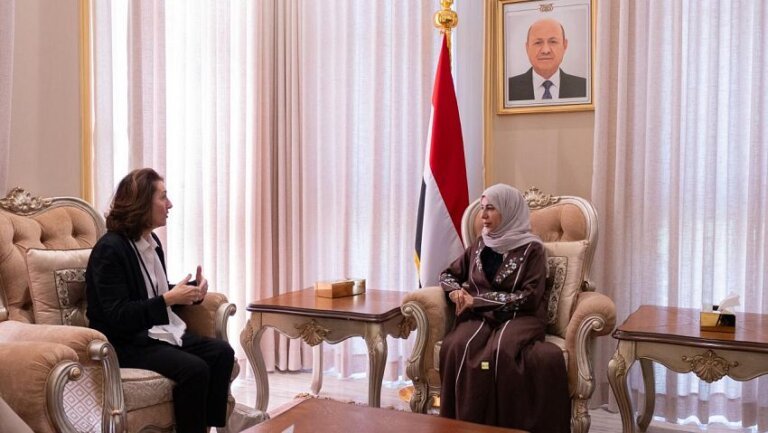
Al-Aradah made the appeal during a video call with Catherine Corm-Kammoun, France’s ambassador to Yemen. According to the Yemeni government’s account of the conversation, the two officials focused on the recent escalation in ballistic missile and drone strikes attributed to the Houthis, the damage those strikes have caused to civilian and economic infrastructure, and the role European governments could play in stabilising the country.
Al-Aradah has served as governor of Marib since 2012 and was appointed to the Presidential Leadership Council when the eight-member body was formed in April 2022, subsequently serving as its deputy chairman. Marib, in Yemen’s central highlands, is the internationally recognised government’s most important remaining stronghold in the north and sits alongside the country’s principal oil and gas fields. It also hosts one of the largest concentrations of internally displaced people anywhere in Yemen, a burden al-Aradah has raised repeatedly with visiting envoys and donor governments.
The government says the latest attacks have struck both military positions and civilian facilities. It has not published a comprehensive damage assessment, and independent verification of individual strikes inside Yemen remains difficult for journalists and monitoring bodies alike. What is not in dispute is the scale of the wider emergency. United Nations agencies estimate that well over half of Yemen’s population needs some form of humanitarian assistance, and that millions of people remain displaced after more than a decade of war. Cholera and measles have returned in successive waves in areas where water, sanitation and health systems have broken down.
Al-Aradah argued that statements of condemnation have not changed Houthi behaviour, and that the absence of tangible consequences allows the group to continue attacks with little cost. He urged governments with influence in the region to move from expressions of concern towards coordinated pressure, and to pair that pressure with a substantial increase in humanitarian and development funding for the areas under government control.
The maritime dimension of the conflict formed a significant part of the exchange. The Bab al-Mandab strait, the narrow channel separating Yemen from the Horn of Africa, carries a large share of the traffic moving between Asia and Europe through the Suez Canal, and attacks on shipping there have consequences far beyond Yemen’s coastline. The most recent illustration came on 11 August, when a small cargo vessel was struck off Yemen’s coast in the Bab al-Mandab area. Yemeni coastguard officials said six people were killed, among them crew members and rescuers who had gone to their aid.
Earlier the same month, Yemeni forces on the Red Sea coast reported intercepting explosive-laden boats near Mokha, in Taiz governorate, including one vessel they said was heading for the commercial pier of Mokha port. Those operations have been presented by the government as evidence that the threat to shipping originates from Yemeni waters and requires a response inside Yemen, not only naval patrols in international waters.
The economic consequences fall heaviest on Yemenis themselves. The country imports the overwhelming majority of its food and fuel by sea, so higher freight and insurance costs on Red Sea routes translate directly into higher prices in Yemeni markets. Shipping lines that reroute around the Cape of Good Hope add substantial time and expense to each voyage, and vessels calling at Yemeni ports face a risk premium few operators are willing to absorb. Against a backdrop of currency depreciation in government-held areas and irregular public-sector salaries, those added costs compound an affordability crisis that predates the current escalation.
For its part, France reaffirmed its commitment to supporting security and stability in Yemen and the surrounding region. Paris carries weight in the discussion for reasons beyond its bilateral aid programme: it holds a permanent seat on the United Nations Security Council and helps shape European Union policy towards the Gulf and the Red Sea. Ambassador Corm-Kammoun has previously linked the expansion of French development support to progress in Yemen’s negotiations with the International Monetary Fund, a signal that donors increasingly want economic reform to accompany assistance.
The Houthis, who control the capital Sanaa and much of Yemen’s densely populated north-west, have been widely reported to receive weapons and technical assistance from Iran, an allegation Tehran denies. Whatever the precise supply relationship, the group’s demonstrated reach with drones, anti-ship missiles and uncrewed surface vessels has expanded significantly over the course of the war, and that capability is now the central obstacle cited by government officials when they discuss the prospects for a settlement.
Al-Aradah’s message to the French ambassador was consistent with the argument he has made to other envoys: that Yemen’s political, economic and humanitarian problems cannot be separated, and that international engagement addressing only one of them will not hold. Whether that argument produces a shift in European policy remains to be seen. For the residents of Marib and the displaced families sheltering there, the more immediate question is whether the next round of attacks will be met with anything more substantial than another statement.
About the Author