Yemen Tells Security Council It Will Not Cede Control Over War and Peace Decisions
 Yemen Herald News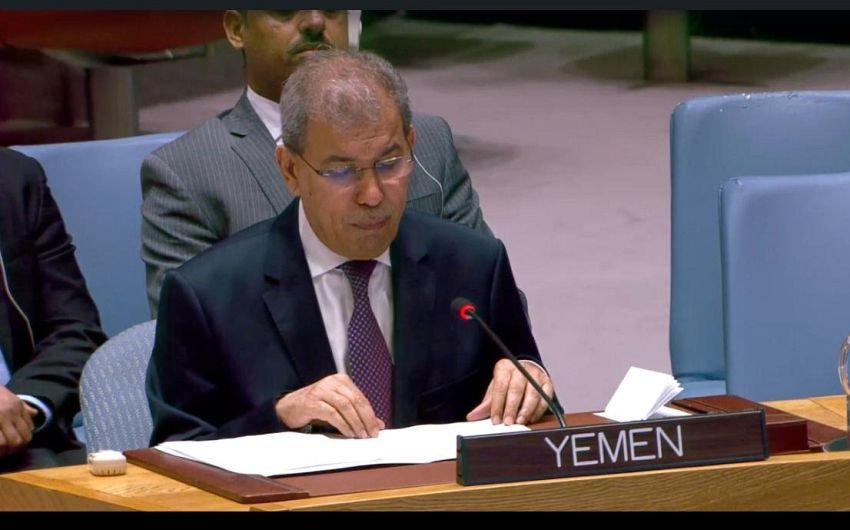
Yemen’s Permanent Representative to the United Nations, Ambassador Abdullah Ali Fadhel al-Saadi, has told the Security Council that his government will not surrender control over decisions of war and peace, rejecting what he described as continuous blackmail and intimidation aimed at forcing concessions from the internationally recognised authorities.
Addressing the Council during its periodic session on Yemen, al-Saadi argued that stability in the country is not a domestic matter alone. He said the security of international shipping and trade routes, the integrity of supply chains, efforts against terrorism and organised crime, and the management of irregular migration all depend in part on whether the Yemeni state can function. Respect for national sovereignty, he added, underpins the principles of international law on which those efforts rest.
The ambassador set out conditions that the government regards as non-negotiable in any settlement. Chief among them is that no group should operate outside the authority of the state or retain weapons beyond the control of state institutions. He said the government would not accept claims to political, religious or tribal privilege that override the will of citizens or the rule of law, a formulation directed at the Houthi movement’s assertion of a hereditary right to rule.
At the same time, al-Saadi restated the government’s willingness to engage with any serious effort to reach a just and durable peace. Yemeni officials have made that offer repeatedly while insisting that talks cannot amount to ratifying territorial gains made by force. Restoring the functioning of state institutions, the ambassador said, is a precondition for delivering services rather than a reward to be granted at the end of a process.
The Council session followed a period of renewed fighting on several fronts and continued attacks on shipping in the Red Sea and the Bab al-Mandab Strait. Yemeni diplomats have used successive Council meetings to press for the Houthi movement to be designated a terrorist organisation, for its financing to be cut off, and for what they describe as Iranian interference in Yemen to be curtailed. Those requests have not so far produced a change in the Council’s formal position.
Yemen’s representatives have also credited external backing for keeping the state solvent. Al-Saadi has told the Council on previous occasions that sustained political, economic and humanitarian support from Saudi Arabia has been essential to keeping institutions running, at a time when the government has lost the oil export revenues that once funded much of the budget. Crude shipments from southern terminals stopped after attacks on those facilities, removing the single largest source of state income.
The economic consequences have been severe. The central bank has been split between Aden and Sanaa, leaving the country with competing monetary authorities and two divergent exchange rates. Public sector salaries have gone unpaid or been paid irregularly across large parts of the country. Officials in Aden argue that donor support directed at institutions and salaries, rather than at emergency relief alone, is what would allow the government to demonstrate that it can govern.
The humanitarian backdrop to the Council’s deliberations remains among the most severe anywhere. The United Nations Office for the Coordination of Humanitarian Affairs estimates that 22.3 million people in Yemen, more than two-thirds of the population, will need humanitarian assistance or protection services during 2026. That total includes 5.2 million internally displaced people. Acute food insecurity affects an estimated 18.3 million.
Nutrition and health indicators tell a similar story. OCHA reports that more than 2.2 million children under five are acutely malnourished, of whom more than half a million are severely acutely malnourished. Nearly 40 per cent of health facilities are only partially functional or entirely out of service, and 14.4 million people need water, sanitation and hygiene support. The United Nations and its partners have appealed for 2.16 billion dollars to reach 12 million people this year.
The positions al-Saadi advanced are those of one party to a conflict that has continued for more than a decade, and they are contested. The Houthi authorities in Sanaa reject the description of their movement as terrorist and present their operations in the Red Sea as pressure connected to the war in Gaza. Iran acknowledges political sympathy with the movement while denying that it directs its military decisions. The Council itself remains divided on how to characterise the conflict and on what measures to authorise.
United Nations mediation has continued through the office of the Special Envoy for Yemen, which has sought agreement on a nationwide ceasefire, the reopening of roads, the payment of salaries and the resumption of a political process. A truce brokered in 2022 delivered the longest sustained reduction in fighting of the war but lapsed without renewal, and subsequent efforts to convert it into a broader framework have not concluded.
Yemen has held a seat at the centre of Council attention for a decade, and the Council remains formally seized of the matter under a series of resolutions that impose an arms embargo and targeted sanctions on named individuals.
No new Council decision followed the session. Yemen’s government continues to argue that international attention has drifted, and that the cost of leaving the conflict unresolved is measured not only in Yemeni lives but in the security of one of the world’s most heavily used maritime corridors, which runs directly past the country’s coastline.
About the Author