Al-Zouba and Algeria’s Ahmed Attaf discuss Yemen and Red Sea navigation at UN General Assembly
 Yemen Herald News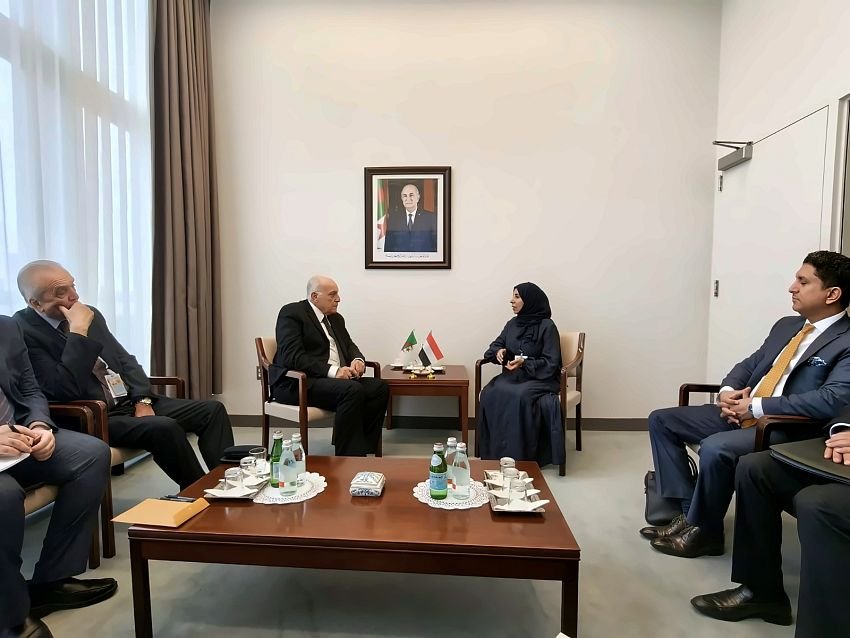
NEW YORK, United States — Yemen’s foreign minister, Afrah al-Zouba, met her Algerian counterpart, Ahmed Attaf, in New York to discuss bilateral cooperation and security in the Red Sea.
The talks took place on the sidelines of the 81st session of the United Nations General Assembly, according to Saba, Yemen’s state news agency.
Attaf holds the title of state minister and minister of foreign affairs, national community abroad and African affairs.
The two ministers reviewed relations between their countries, Saba said.
They also discussed developments in Yemen and what Saba described as their humanitarian, economic and security repercussions, with particular attention to navigation security in the Red Sea.
Al-Zouba expressed Yemen’s appreciation for Algeria’s positions on Arab issues and for its backing of Yemen in international forums, the agency reported.
Attaf affirmed Algeria’s support for Yemen’s constitutional legitimacy, unity, sovereignty, independence and territorial integrity, according to the same account.
He also backed efforts aimed at achieving security, stability and peace, Saba said.
The Algerian account of the meeting was broadly similar. L’Echo d’Algerie reported that Attaf reaffirmed Algeria’s solidarity with Yemen and its readiness to support peaceful initiatives.
The Algerian outlet gave the Yemeni minister’s name in full as Afrah Abdulaziz al-Zouba.
The two accounts differ on the day. Saba filed early Sunday and described the meeting as having taken place that day. L’Echo d’Algerie, publishing on Sunday, placed it a day earlier. New York is seven hours behind Yemen, which would put a Saturday evening meeting in New York in the early hours of Sunday in Aden.
Attaf met several counterparts during the same week. L’Echo d’Algerie reported that he also held talks with Saudi Arabia’s foreign minister, Prince Faisal bin Farhan bin Abdullah Al Saud.
Algerian media reported that he met his Iranian counterpart during the session. Algerie Presse Service said he had held talks on Wednesday with the foreign ministers of Zimbabwe, Somalia and Benin.
The general debate of the 81st session ran from Sept. 22 to Sept. 28. The session opened on Sept. 8, with Khalilur Rahman of Bangladesh serving as president of the assembly.
Al-Zouba has used the session’s margins for a series of meetings. Saba reported that she discussed Red Sea navigation with Germany’s foreign minister, Johann Wadephul, and that she called for the Houthis to be disarmed at a ministerial dialogue on Sept. 22.
Al-Zouba travelled to New York with a delegation led by Abdullah al-Alimi Ba Wazir, a member of Yemen’s Presidential Leadership Council, Yemen Monitor reported. The delegation arrived on Sept. 22 and was received by Yemen’s permanent representative to the United Nations.
Yemen Monitor reported that Ba Wazir was due to address the assembly on political, security, economic and humanitarian developments, and to seek international backing for the government and its institutions. It said the delegation’s aims included protecting Yemen’s territorial waters and raising Houthi attacks on shipping in the Red Sea.
She was appointed foreign minister on July 23. Al Jazeera reported at the time that she was the first woman to hold the post, and the first appointed to any of Yemen’s most prominent cabinet positions.
Al-Zouba is from al-Bayda in central Yemen.
She holds a bachelor’s degree in pharmacy from Sanaa University, a master’s in community health and health economics from Malaysia, and an MBA from Yemen’s University of Science and Technology.
She worked for more than 25 years in development and peacebuilding before entering government, including with the Yemeni organisation SOUL for Development and on USAID governance programmes.
She became an adviser to then prime minister Maeen Abdulmalik in 2019 and was appointed minister of planning and international cooperation in February. She had previously headed the Executive Bureau for Accelerating Aid Absorption.
Between 2013 and 2015 she served as first deputy secretary-general of the National Dialogue Conference, the body created to negotiate a political settlement after Yemen’s 2011 uprising.
Algeria’s engagement on Yemen has run partly through the Security Council. It held a non-permanent seat for the 2024-2025 term and took the council presidency during that term.
Algeria’s foreign ministry has called on all parties in Yemen to end military escalation and to address what it called the true causes of the crisis. The communique setting out that position carries no date.
Navigation in the Red Sea, which both ministers raised, has been disrupted for much of the past two years. Al Jazeera and Euronews reported this month that Houthi forces had seized a Yemeni island in the Bab al-Mandab, and described the group as having taken control of the strait. The Houthis’ opponents in Yemen’s government dispute the group’s account of its position there.
The humanitarian file the ministers discussed is set out in the United Nations humanitarian needs and response plan for Yemen for 2026. It puts the number of people needing assistance at more than 22 million, and the number who are acutely food insecure at 18.3 million.
The plan records more than 2.2 million children under five as acutely malnourished, of whom 516,157 are severely malnourished, and 5.2 million people as internally displaced. It seeks 2.16 billion dollars to reach 12 million people.
Yemen’s ambassador to Algeria is Ali al-Yazedi. Yemen’s foreign ministry said in October 2024 that he had discussed broadening bilateral cooperation with the Algerian foreign ministry official Nour al-Din Khandodi.
About the Author