Bahrain Arrests Four Nationals Accused of Spying for Iran’s Revolutionary Guard
 Yemen Herald News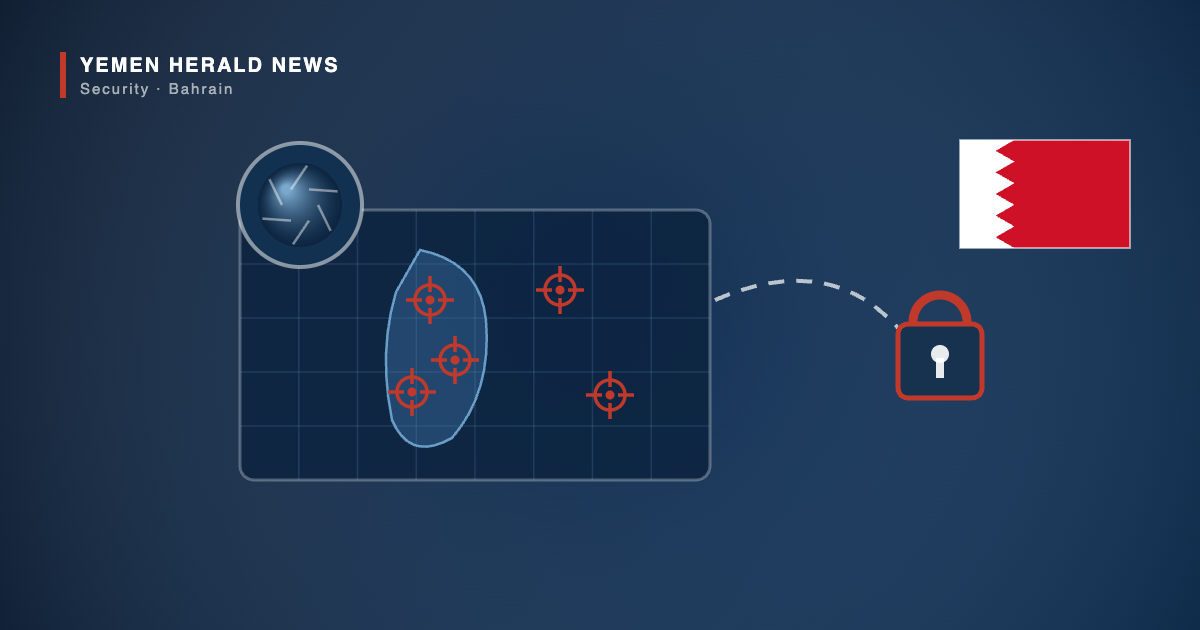
Bahrain’s Ministry of Interior announced on 12 March 2026 that four Bahraini nationals had been arrested on suspicion of spying for Iran’s Islamic Revolutionary Guard Corps. The arrests were made by the General Directorate of Criminal Investigation and Forensic Evidence, which said a fifth suspect in the same case was outside the country and had not been detained.
According to the ministry, those held were three men and one woman, aged between 22 and 36; the fifth suspect, also in his twenties, remained at large abroad. The ministry published the names and ages of all five. None of the accusations has been tested in court, and the ministry’s account is the only detailed version of events on the public record.
The directorate said its investigation found that the suspects had photographed vital and sensitive sites in the kingdom and recorded their coordinates using high-precision imaging equipment, then transmitted the material to the Revolutionary Guard through encrypted applications. The ministry said legal proceedings had begun and that the case had been referred to the Public Prosecution.
The announcement came at a point of acute tension. Bahrain had been under near-daily Iranian missile and drone attack since 28 February 2026, when Iran began retaliating across the Gulf for joint United States and Israeli strikes on its territory. On the same day as the arrests, an Iranian strike on a fuel depot in Muharraq Governorate, close to Bahrain International Airport, set off a large fire.
Also on 12 March, the Bahrain Defence Force said its air defences had intercepted 112 ballistic missiles and 186 drones since the start of the war. That figure rose to 125 missiles and 211 drones by 15 March, and to 174 missiles and 391 drones by the end of the month. The counts were the Defence Force’s own and were not independently verified.
The espionage case did not stand alone. On 15 March, three days after the first announcement, Bahraini authorities said five more suspects had been arrested for collecting and passing sensitive information to the Revolutionary Guard, the second such round of arrests within a week. The crackdown continued over the following weeks, and by early May the authorities said they had detained 41 people they described as linked to the IRGC.
The ministry did not say how the alleged network was detected, whether the suspects were believed to have been recruited before or during the war, or what specific sites it said had been photographed.
Espionage allegations of this kind have a long history in Bahrain, where the government has for years accused Iran of cultivating networks among the country’s population. Iran has consistently denied running agents in the kingdom or directing unrest there. Human rights organisations have separately raised concerns over the handling of security cases in Bahrain, including questions about access to counsel and the treatment of detainees, and those concerns apply to this case as much as to earlier ones. Neither the ministry’s account nor the criticisms of it can be independently confirmed from outside.
What distinguished the March 2026 arrests from earlier cases was the wartime context. The material the ministry described — imagery and precise coordinates of sensitive locations — is the kind of information that has direct value to a force conducting a missile and drone campaign. Bahraini officials made that connection explicitly, presenting the alleged network as part of the same effort as the strikes themselves rather than as ordinary intelligence gathering.
Bahrain’s strategic position explains much of the interest. Naval Support Activity Bahrain in Manama has hosted the headquarters of the United States Navy’s Fifth Fleet for decades, and the base was among the targets struck in the opening Iranian salvo on 28 February. British and Canadian personnel were also present in the country. Iranian statements through the campaign described American military sites as the intended targets, while Bahraini officials pointed to the civilian buildings, ports, refineries and utilities that were hit.
The physical damage accumulated quickly. A shipyard worker was killed at Mina Salman Port on 2 March by debris from an intercepted missile. On 9 March an explosion near Manama injured at least 32 people close to a petroleum refinery, prompting the state oil company Bapco to declare force majeure on its operations. On 10 March a 29-year-old Bahraini woman was killed by debris from a drone attack on an office tower in the Seef District. Gulf Air moved its aircraft to airports in Saudi Arabia.
Bahrain pursued the matter diplomatically alongside the security response. On 26 March it joined Saudi Arabia, Kuwait, the United Arab Emirates, Qatar and Jordan in a statement condemning attacks by Iran and allied armed groups in Iraq on regional states and infrastructure. Holding the rotating presidency of the United Nations Security Council, Bahrain put forward a resolution on shipping through the Strait of Hormuz; after an initial draft was rejected, a softened version was vetoed by Russia and China on 7 April by a vote of 11 to 2. Bahrain’s courts have not published verdicts in the case, and the ministry has not issued a further statement on its progress.
By 11 June 2026 the kingdom had recorded three deaths and more than 51 injuries since the start of the war. No public outcome of the March espionage prosecutions had been reported at that point.
About the Author