New Lines report says UAE exit and Saudi command shift preceded Yemen’s west coast collapse
 Yemen Herald News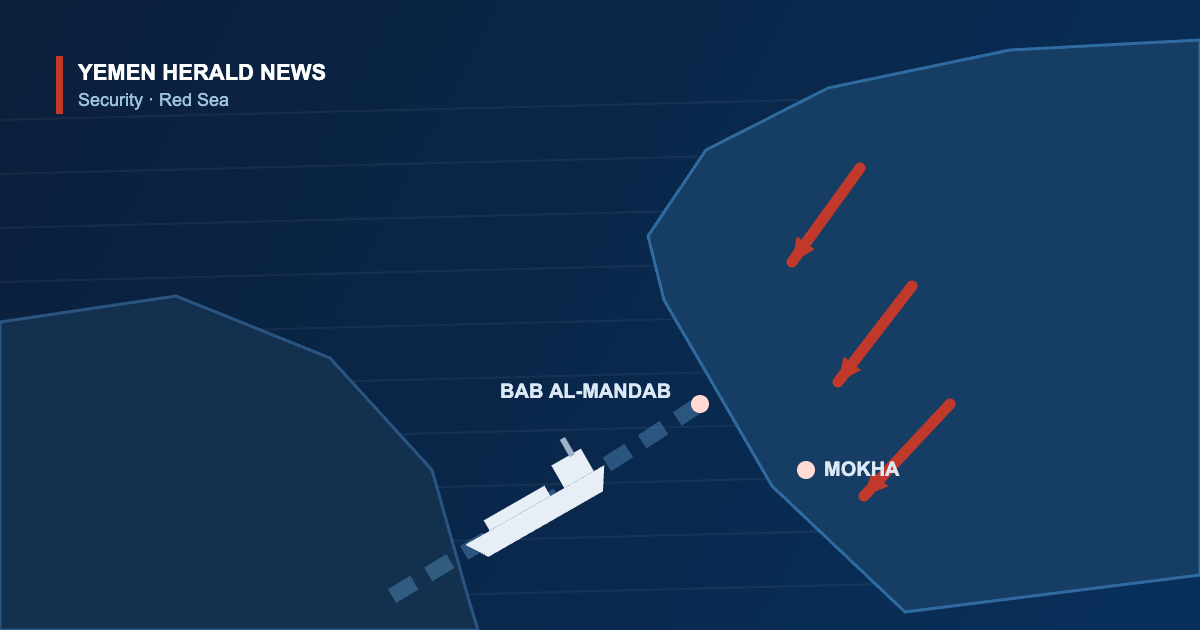
ADEN, Yemen — A report by the US-based New Lines Magazine says the United Arab Emirates’ withdrawal from Yemen and Saudi Arabia’s assumption of sole command preceded the west coast front’s collapse.
The report was published on Sept. 21. It was written by Mohammed Al-Qadhi, a Yemeni journalist and political analyst.
It traces the week in which Houthi forces took the Red Sea port of Mokha and reached the approaches to the Bab al-Mandab strait.
The offensive opened on Sept. 3, according to the report, with Houthi columns moving through Hays and Khawkha. Government forces withdrew at dawn on Sept. 10.
The Guardian reported on Sept. 10 that Houthi units had seized Mokha. Reuters reported the following day that they had taken Dhubab and reached Perim Island in the strait.
The Greater and Lesser Hanish islands followed as government forces pulled back.
Mokha lies in Taiz governorate. It had been the government’s main foothold on the Red Sea coast.
The report sets that week against January 2017. Forces then receiving direct Emirati support opened Operation Golden Arrow on Jan. 7, and Mokha was declared recaptured on Jan. 23, about 16 days later.
The Houthis reversed much of the same ground in roughly seven days, the report says.
The Emirati departure it describes is documented outside the report. A Saudi-led coalition strike hit two ships at the port of Mukalla in Hadramawt on Dec. 31, 2025.
Al-Rayyan base lies near Mukalla, the Hadramawt coastal city where that strike took place.
Coalition spokesman Maj. Gen. Turki al-Maliki said the ships carried more than 80 vehicles and containers of weapons and ammunition, Al Jazeera reported at the time.
Saudi Arabia said the UAE had moved vehicles, containers and Emirati personnel to al-Rayyan base without informing it. It said any threat to its national security was a red line.
The Emirati defence ministry announced the same day that it would end its counterterrorism deployment in Yemen. It said the shipments carried no weapons, and were destined for Emirati forces rather than for the Southern Transitional Council.
Yemen’s Presidential Leadership Council, headed by Rashad al-Alimi, gave Emirati forces 24 hours to leave, according to Al Jazeera. Al-Alimi also declared a no-fly zone and a 72-hour closure of ports and crossings.
The Southern Transitional Council announced its own dissolution in Riyadh in January. Figures within it disputed that announcement.
The dispute had been building for weeks. Yemeni separatists accused Saudi Arabia of striking Southern Transitional Council forces in Hadramawt on Dec. 26, 2025, Al Jazeera reported.
The following day Saudi Arabia said it would back Yemen’s government militarily against the separatists.
The council refused on Jan. 1 to withdraw from provinces bordering Saudi Arabia.
The Times of Israel also reported the Saudi strikes on UAE-backed separatists, and the Emirati statement that its forces had withdrawn.
The council had seized territory in Hadramawt in early December 2025, according to an assessment published by the Middle East Research and Information Project on July 8.
Its author, Susanne Dahlgren, wrote that Saudi Arabia demanded the Emirati withdrawal on Dec. 30, 2025, and that the UAE complied and removed its military forces while keeping commercial and political interests in the country.
Riyadh then moved to consolidate control over areas outside Houthi hands, militarily and politically, she wrote.
Dahlgren described the resulting alignment as fractured. She wrote that Saudi Arabia was relying on long-standing local allies, particularly in Hadramawt, to counterbalance southern unity efforts.
Writing in Responsible Statecraft on Sept. 17, Elfadil Ibrahim said Riyadh had forced Emirati forces out of Yemen late last year in reaction to an offensive by UAE-backed southern separatists.
What followed, the New Lines report argues, was not a unified command but the same formations under a new patron.
It names three. The National Resistance Forces, the Giants Brigades, which was formed with Emirati support, and the Nation’s Shield Forces, which Saudi Arabia built.
Each kept its own command structure and loyalties rather than operating under a single field command, the report says.
Tareq Saleh commands the National Resistance Forces and sits on the Presidential Leadership Council as its deputy chairman. He is a nephew of former president Ali Abdullah Saleh.
The report says former Emirati allies, Saleh among them, realigned within an arrangement led by Riyadh after the UAE stepped back.
Its judgement is that the difficulty lay in how those forces were organised rather than in what they were able to do. Yemen Herald could not independently test that conclusion.
The report names three senior Houthi commanders it says directed the offensive: Mohammed Alattifi, Yousef al-Madani and Abdullatif Almahdi.
Neither Saudi Arabia nor the UAE has responded publicly to the report’s account of the command handover.
Displacement figures for that week came from other outlets. Al Jazeera reported on Sept. 10 that more than 20,000 people had been displaced across Taiz and Hodeidah.
The Guardian put the number at nearly 50,000 two days later.
The report carries battlefield death tolls for both sides. Yemen Herald found no second independent origin for those figures and does not repeat them here.
Perim Island sits in the Bab al-Mandab strait, the channel through which shipping passes between the Gulf of Aden and the Red Sea.
About the Author