Yemeni government says warplanes struck Houthi positions in Marib, Hodeidah and al-Jawf
 Yemen Herald News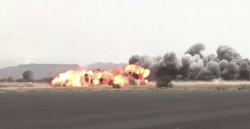
ADEN, Yemen — Yemeni government forces said their warplanes struck Houthi positions in Marib, Hodeidah and al-Jawf late Sunday, extending an air campaign opened three days earlier.
The military said its aircraft targeted Houthi positions in al-Barah, south of Hodeidah, and on the western outskirts of Marib.
The same statement said raids hit sites and gatherings of the group in al-Lubnat, al-Alam and the centre of al-Jawf governorate.
It said the strikes inflicted heavy loss of life and equipment on the group.
The Houthis have published no casualty figure for those raids. Yemen Herald could not verify the military’s claim.
The news agency AFP reported the statement, and Al Jazeera carried the account on Monday.
Yahya Saree, the Houthi military spokesman, said on Monday that his forces had shot down three Saudi drones in the previous 24 hours.
Saree said a Saudi CH-4 armed reconnaissance drone came down over al-Jawf while flying what he described as hostile activities.
He said later that a Saudi-owned Wing Loong II armed reconnaissance drone had been shot down in al-Bayda governorate.
Saudi Arabia did not immediately comment on the claims.
The air raids run alongside ground fighting that resumed on 3 September, breaking a truce that had largely held since 2022.
The Houthis opened simultaneous attacks that week on government lines in southern Hodeidah and in districts west of Taiz.
They pushed toward al-Makha and the Bab al-Mandab Strait. The government answered with airstrikes on Friday, Al Jazeera reported.
Government forces said on 6 September that they had taken the Hais district in southern Hodeidah.
Al Jazeera reported on 5 September that at least four civilians were killed in a Houthi missile strike near Taiz.
An AFP tally put the death toll from the fighting in the south-west above 300 by 8 September.
Arab News reported more than 120 killed between Thursday and the weekend, citing unnamed sources.
The two sides are fighting for the Bab al-Mandab Strait, the channel between Yemen and the Horn of Africa at the southern end of the Red Sea.
The strait has carried a larger share of Saudi oil exports since Iran closed the Strait of Hormuz in February, according to Al Jazeera.
Iran acted in response to the war the United States and Israel opened against it that month.
The Houthis declared a naval blockade of Saudi Arabia in July and have attacked Saudi shipping in the strait since.
On Monday the group fired missiles and drones at cities in southern Saudi Arabia. Saudi authorities said 73 people were wounded.
Saree said those attacks answered Saudi strikes on the group inside Yemen.
Displacement has followed the front lines. The United Nations said 1,790 families were displaced in two days as the fighting spread.
The UN Population Fund said its emergency teams had reached 8,365 newly displaced people in Taiz and on Yemen’s west coast.
Hans Grundberg, the UN special envoy for Yemen, said Houthi attacks risk widening the war.
Marib, one of the provinces named in Sunday’s statement, holds camps for people displaced in earlier rounds of the conflict.
Rights groups said a Houthi missile strike on a camp in the province killed two children.
The Houthis hold Sanaa and much of Yemen’s north-west. The internationally recognised government is seated in Aden.
Government aircraft had struck Houthi positions in Taiz and Hodeidah on 4 September, in what the military counted as at least 15 raids.
Rashad al-Alimi, chairman of the Presidential Leadership Council, saluted what he called the armed forces’ victories in al-Jawf, al-Bayda, Taiz and Hodeidah, Saba reported.
He said the state would press on in extending its authority over all Yemeni territory, according to the same agency.
The Taiz axis command said forces retook the areas of al-Makazima and al-Mihal on the al-Kadha front, Saba reported.
Yemen Herald found no independent report of that advance. The Houthis dispute government accounts of territorial gains.
Yemen’s House of Representatives condemned the Houthi attacks on Saudi Arabia, Saba said.
Jasem Albudaiwi, secretary-general of the Gulf Cooperation Council, said the attacks deliberately targeted civilians and civilian sites.
Spain condemned the attacks and restated its support for the Presidential Leadership Council, according to Saba.
The United States said Yemen’s government has the right to defend its people and backed Saudi efforts to protect Saudi territory, the agency reported.
The Arab League’s ministerial council renewed its backing for the council and approved an Arab fund for Yemen’s development needs plan, Saba said.
The United Nations humanitarian plan published in March put more than 22 million people in Yemen in need of aid.
It recorded 18.3 million people as acutely food insecure and 5.2 million as internally displaced.
The plan sought 2.16 billion dollars to reach 12 million people this year.
It also counted more than 2.2 million children under five as acutely malnourished, 516,157 of them severely.
The Houthis reported an attack on a Saudi ship on 24 August, weeks before the ground fighting resumed.
Saree said the targets of Monday’s attack included industrial plants at Jazan and Aramco sites at Najran and Abha.
He also named King Khalid Air Base at Khamis Mushait. Several energy facilities near the Yemeni border halted operations afterwards.
Al Jazeera reported on 4 September that Houthi attacks in Taiz had set off a new wave of displacement.
The CH-4 and the Wing Loong II are both Chinese-built armed reconnaissance aircraft.
About the Author