Oil minister Mohammed Bamaqa discusses resuming crude exports with US chargé d’affaires in Riyadh
 Yemen Herald News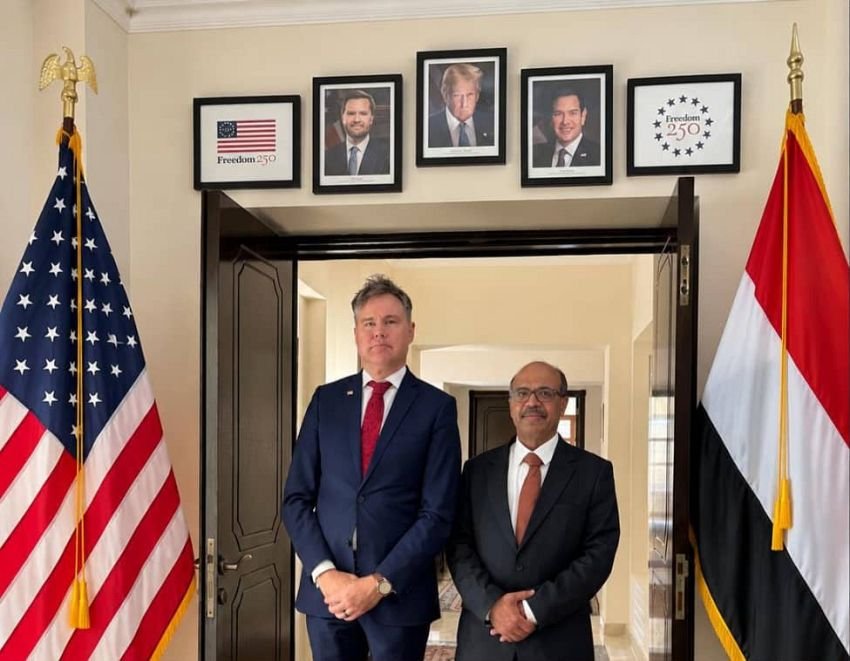
RIYADH, Saudi Arabia — Yemen’s oil minister met the acting United States ambassador in Riyadh on Tuesday to discuss cooperation in oil, gas and minerals, the state news agency Saba said.
Saba named the minister as Mohammed Bamaqa and the American official as Neil Hopp. The U.S. Mission to Yemen renders the name Neil Hop.
The two sides said resuming crude oil exports mattered for boosting the country’s resources, according to the agency.
Saba said exports would let the government carry out its policies and economic plans.
The American official confirmed Washington’s support for the Yemeni government, the agency said.
He expressed a willingness to provide facilitation and to support efforts to advance the oil and mineral sectors, according to Saba.
The account of the meeting rests on Saba, the news agency of Yemen’s internationally recognised government. No independent confirmation of it has been published.
Hopp arrived as chargé d’affaires for the U.S. Mission to Yemen on 5 August, the mission said.
He is a career member of the Senior Foreign Service with the rank of counselor and has served more than 24 years in State Department and interagency posts.
His Washington assignments included director of the Office of Israel and Palestinian Affairs and acting deputy assistant secretary for Pakistan.
He also served as senior adviser for technology diplomacy in the Bureau of Cyberspace and Digital Policy, and as political counselor at the U.S. embassy in Riyadh.
The mission said his priorities include protecting freedom of navigation in the Red Sea and the security of U.S. partners.
Yemen’s oil exports have been almost entirely suspended since October 2022.
Houthi attacks that month on the al-Dhabba terminal in Hadramout and the al-Nashima terminal in Shabwa halted loadings.
Oil accounts for about 70 percent of the state budget, according to Asharq Al-Awsat.
Rashad al-Alimi, chairman of the Presidential Leadership Council, announced in July that exports would resume from 20 July.
Bamaqa told Asharq Al-Awsat that month that an emergency meeting had been held with security and military authorities named by al-Alimi, together with the company holding the export contract.
He said a security plan had been drawn up for threats in the Bab al-Mandab Strait, particularly those posed by the Houthis.
The Supreme Committee for the Sale and Marketing of Crude Oil met under Prime Minister Shaya al-Zindani and approved a time-bound implementation mechanism, he said.
Bamaqa said the ministry had instructed its units and partner companies to draw up plans covering technical, financial and administrative work.
He said restoring operational status is a technical step required after facilities stand idle and pipelines are emptied.
“We are currently reactivating the system and are ready to begin exports as soon as we receive official notification from the contracted company in the coming days,” he said in July.
He said the suspension disrupted salary payments, widened the budget deficit and cut public services, with some suspended altogether.
The ministry submitted projected revenue estimates to the Ministry of Finance, he said.
He said the money was intended for essential services and the regular payment of public-sector salaries.
Bamaqa credited the Saudi Development and Reconstruction Program for Yemen, headed by Ambassador Mohammed Al Jaber, with financial help that sustained salaries and fuel supplies for power plants.
Estimates of the revenue lost to the shutdown vary. The Media Line put the figure above 2 billion dollars.
Other estimates place losses at about 7.5 billion dollars between October 2022 and the middle of 2025.
Tuesday’s meeting took place as fighting between government forces and the Houthis spread across several provinces.
The Houthis declared a naval blockade of Saudi Arabia in July and have attacked shipping in the Bab al-Mandab Strait.
Yemen’s foreign ministry has said security in the Red Sea, Bab al-Mandab and the Gulf of Aden is a pillar of Arab national security, Saba reported.
Bamaqa said in July that he was ready to travel to Saudi Arabia once the relevant authorities set a date.
Al-Alimi said in a televised address that the government would work to resume oil exports by all available means.
Exports later resumed from Hadramout province in eastern Yemen, the news site Debriefer reported.
The Turkish outlet Yeni Safak reported that the restart ended a suspension of close to four years.
The al-Dhabba terminal sits on Yemen’s Arabian Sea coast in Hadramout. The al-Nashima terminal lies to its west, in Shabwa.
Saba’s account of Tuesday’s meeting did not say whether shipments were running at the time it was held.
The U.S. Mission also lists preventing the region from serving as an incubator or exporter of terrorism among its priorities.
It said Hopp leads the mission’s interagency country team in carrying out pillars of the U.S. national security strategy covering Yemen and the region.
Yemen’s government has held a series of contacts with U.S. officials in recent weeks on the economy and on Red Sea security.
Bamaqa has served as minister of oil and minerals in the government seated in Aden.
The Presidential Leadership Council has headed the internationally recognised side of the conflict since April 2022.
Al-Zindani chairs the crude oil committee in his capacity as its general supervisor, Bamaqa said in July.
The ministry’s directorates were told to hold their readiness at the highest level, he added.
Asharq Al-Awsat renders the minister’s name Mohammed Bamqaa.
About the Author