Emirates Global Aluminium Reported Major Damage at Its Al Taweelah Site After Strikes on Abu Dhabi
 Yemen Herald News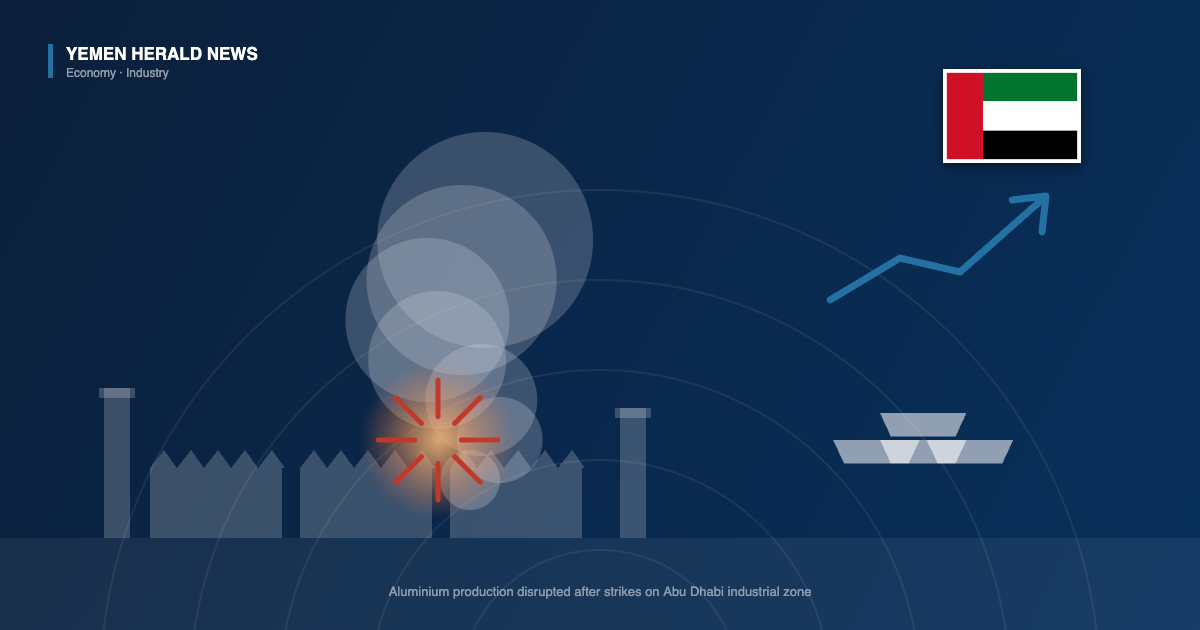
Emirates Global Aluminium said its Al Taweelah site had sustained damage following missile and drone strikes on the Khalifa Economic Zone Abu Dhabi, announcing the incident on Saturday 28 March 2026 and beginning an assessment of the extent of the destruction. The company reported that several employees had been hurt, with injuries described at the time as ranging from minor to moderate and none classified as life-threatening.
Iran’s Islamic Revolutionary Guard Corps claimed responsibility for the attack, saying it had struck EGA’s plant and the Aluminium Bahrain facility in retaliation for a joint United States and Israeli operation against two Iranian steel plants. The claim placed the strike within the wider exchange that had begun on 28 February 2026, when Iran started firing at Gulf states hosting American military assets, but it marked a distinct shift: from military and energy targets toward heavy manufacturing.
Chief Executive Abdulnasser Bin Kalban said the safety and security of the company’s people was its highest priority at all times. He described himself as deeply disturbed by an attack on a workforce drawn from more than 40 nations who were, in his words, simply doing their jobs, and said the company was grateful that nobody had received life-threatening injuries and that those hurt were recovering well.
Al Taweelah is not a marginal industrial site. It produced 1.6 million tonnes of cast metal in 2025 and forms one of the world’s largest integrated aluminium complexes, combining an alumina refinery with primary smelting capacity. Bin Kalban characterised it as a foundation of the global economy and a significant contributor to global supply, saying the incident was damaging to industries and prosperity worldwide and that the company would do its best to support customers through the period.
The immediate operational response involved evacuating the facility and executing an emergency shutdown across production units. Molten metal operations of this kind are unusually unforgiving of interruption, since electrolytic reduction cells that cool below operating temperature can freeze and require extensive rebuilding rather than a simple restart, which is a large part of why the recovery timeline that emerged over the following days was measured in months rather than weeks.
On 3 April the company set out that timeline publicly, warning that fully restoring primary aluminium production could take up to twelve months. Bin Kalban said at the time that all opportunities to accelerate the schedule were being explored and that the company intended to emerge stronger. The alumina refinery recovered considerably faster; EGA later restarted production there, aiming to reach half of plant capacity within days and a full return to alumina output by the end of 2026.
The consequences were felt well beyond Abu Dhabi. Aluminium prices rose sharply on the announcement, with the metal climbing around 6 per cent on the London Metal Exchange in early trading the following Monday. Gulf Cooperation Council states supply roughly 9 per cent of the world’s primary aluminium, and the United States draws about 21 per cent of its imported primary aluminium from the UAE and Bahrain, having taken some 584,000 tonnes of crude metal and alloys from the two countries in the first eleven months of 2025. Damage to two of the region’s largest smelters therefore translated quickly into a global supply question.
Aluminium Bahrain, struck in the same claimed operation, reported two employees injured along with significant structural damage. The company was already operating under strain: on 15 March it had cut production by 19 per cent of its 1.6 million tonne annual capacity as a continuity measure amid supply disruption linked to the closure of the Strait of Hormuz. For an industry that depends on uninterrupted power, imported raw materials and open shipping lanes, the combination of blocked exports and damaged capacity proved more disruptive than either factor alone.
The strike also illustrated how thoroughly the conflict had drawn in parties with no role in the underlying dispute. The people injured at Al Taweelah were industrial workers on shift at a commercial plant, and the workforce EGA describes spans more than 40 nationalities. Across the campaign more broadly, casualty lists published by Gulf defence ministries were dominated by expatriate residents from South Asia, East Africa and the Arab world.
For the UAE, the attack complicated a diplomatic position it had held since the opening days of the war. A joint statement issued through the Ministry of Foreign Affairs on 2 March had condemned the missile and drone attacks across the region, and Emirati officials had consistently argued that Gulf states were absorbing the consequences of a confrontation between other powers. A publicly claimed strike on a flagship industrial asset, justified as retaliation for actions taken by third countries, made that argument harder to sustain in practice even as it strengthened it in principle.
Reported at the end of March 2026, the Al Taweelah incident stands as one of the clearest instances in the conflict of military action against civilian industry producing measurable global economic effect. Its legacy was recorded not in interception tallies but in a twelve-month repair estimate, a step change in world aluminium prices, and the durable lesson that concentrated industrial capacity in a contested region carries a strategic exposure that markets had not previously priced.
About the Author