EU naval mission says it escorted a fifth Red Sea convoy this month
 Yemen Herald News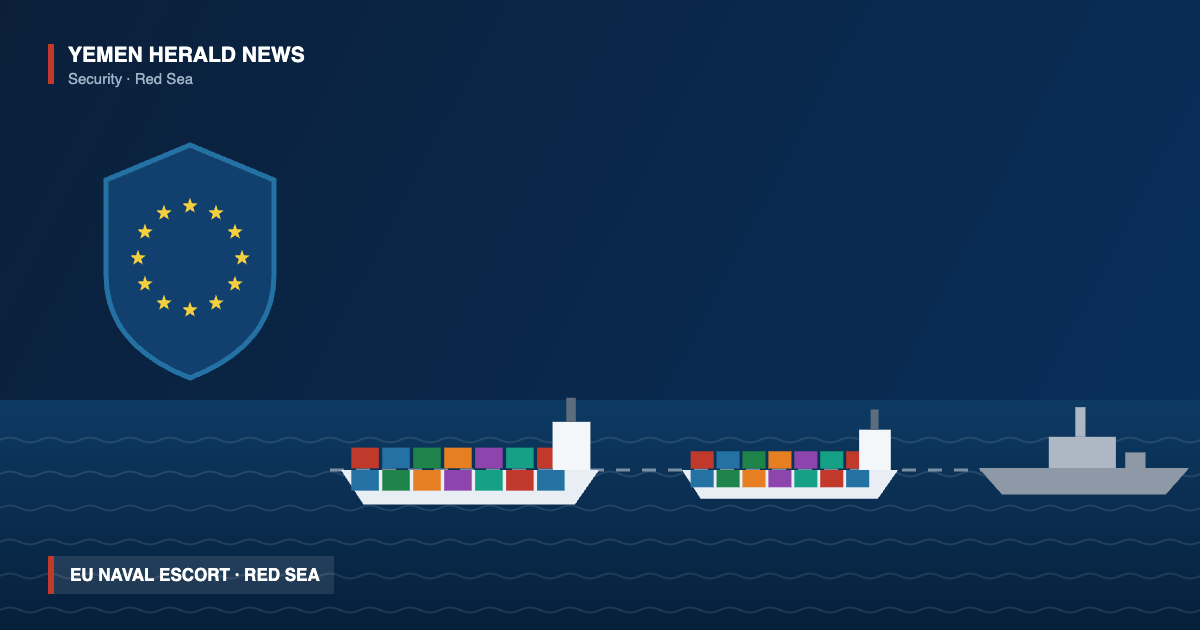
BRUSSELS, Belgium — The European Union’s naval operation in the Red Sea said it had escorted a fifth convoy of merchant ships through the waterway this month.
EUNAVFOR Aspides said the vessels completed the passage safely under the protection of European warships. It did not name the ships or their flags.
The mission’s count of five convoys since the start of August rests on its own statement. No independent account of the tally has been published.
Aspides describes its mandate as wholly defensive. It provides maritime situational awareness, accompanies vessels and protects them against attacks at sea.
The operation covers the Red Sea, the Gulf of Aden, the Arabian Sea, the Sea of Oman, the Gulf and the north-western Indian Ocean.
It was launched on Feb. 19, 2024 with an initial mandate of one year. The Council of the European Union extended that mandate on Feb. 23, 2026, and it now runs to the end of February 2027.
The mission marked 30 months since its launch on Aug. 19.
Its naval units have given close protection to more than 1,790 commercial ships crossing the southern Red Sea since the operation began, according to figures the mission has published.
Requests for protection rose 39 per cent from February 2026, the force commander, Rear Adm. Vasileios Gryparis, has said.
Gryparis also said marine traffic in the Red Sea rose by about 60 per cent after Houthi forces narrowed the range of ships they were targeting.
Italian frigates have carried much of the escort work this year. The Bergamini and the Luigi Rizzo have both accompanied merchant vessels through the corridor during 2026.
The operation is run from an operational headquarters at Larissa in central Greece.
Member states contribute warships on rotation rather than permanently. Italy, Greece, France and Germany have all assigned vessels to the mission since its launch.
The German navy has listed the deployment as one of its standing overseas commitments.
Aspides works in the same waters as two other multinational efforts. The United States-led Operation Prosperity Guardian was set up in December 2023, and the European Union’s counter-piracy operation Atalanta has run in the region since 2008.
The three keep separate chains of command. Aspides has said its own remit does not extend beyond the protection of shipping.
The route matters far beyond Yemen. The Suez and Red Sea corridor carries roughly 12 per cent of global trade.
Ships entering it from the south pass the Bab al-Mandab Strait, which runs along Yemen’s south-western coast and separates the Arabian Peninsula from the Horn of Africa.
Traffic has not returned to the levels recorded before the crisis. Lloyd’s List Intelligence counted 275 transits at the northern chokepoint between July 27 and Aug. 2, and 273 the week before that.
Transits fell to 269 in the week beginning July 20. That compares with 354 in the week of July 13 to 19, before the Houthis declared a blockade of Saudi ports.
The Houthis announced that ban on vessels calling at Saudi terminals with effect from July 20 at 12:00 GMT. They warned that such ships could be targeted anywhere within their reach.
The movement had paused its attacks after the Gaza ceasefire of October 2025. It declared a renewed ban on Israeli-linked shipping in June 2026.
Tanker traffic has held closer to normal than container traffic. Transits by very large crude carriers have quadrupled, with some lightening their loads to pass through the canal.
Several have partly discharged at Ain Sukhna in Egypt before continuing, according to market analysts.
Houthi forces began attacking merchant shipping in the Red Sea in November 2023, saying the campaign was tied to the war in Gaza.
Dozens of vessels have been struck since. The mission assisted the tanker MV Sounion after it was attacked and set alight in August 2024.
Yemen’s war has run since 2015. Houthi forces hold Sanaa and much of the north and west, while the internationally recognised government operates from Aden.
Piracy has also returned to the Gulf of Aden and the waters off Somalia after years of decline, adding a second threat for crews on the same route.
The government has pressed foreign partners for help with maritime security. Its transport minister has called for a national maritime security committee.
Aden has also asked Japan for support in training, surveillance and rescue for its coast guard, according to statements issued after talks in Riyadh this month.
The European Union has kept its naval contribution separate from the wider conflict on land. Aspides does not conduct strikes ashore.
A separate United States and British air campaign against Houthi targets in Yemen has run at intervals since January 2024. The two efforts are not connected.
The relief operation inside Yemen continues alongside the shipping crisis. More than 22 million people need aid, according to the United Nations humanitarian needs and response plan published in March.
That plan lists 18.3 million people as acutely food insecure and 5.2 million as internally displaced. It seeks $2.16 billion to reach 12 million people.
Yemen imports most of its food and fuel by sea. Higher freight and insurance costs on the route feed into prices in both Houthi-held and government-held areas.
The mission does not routinely publish the dates of individual escorts. It said only that the latest group had completed its transit.
About the Author