Foreign Minister Afrah al-Zouba asks OIC states to designate the Houthis a terrorist organisation
 Yemen Herald News
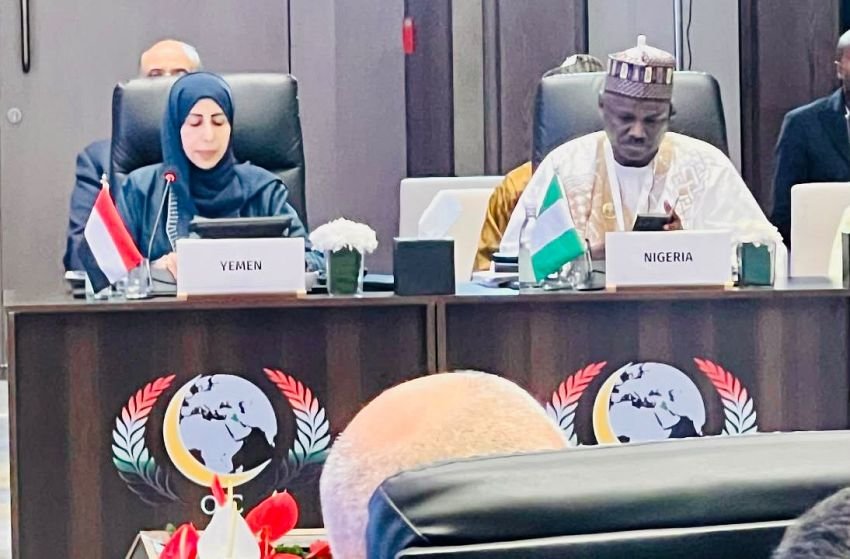
BAGHDAD, Iraq — Yemen asked the Organisation of Islamic Cooperation on Saturday to designate the Houthi movement a terrorist organisation and cut off its funding and weapons.
Foreign Minister Afrah al-Zouba made the request in a speech to the 52nd session of the OIC Council of Foreign Ministers in the Iraqi capital, the state news agency Saba reported.
She asked member states to classify what she called the Houthi militias as a terrorist organisation, cut their sources of funding and stop the flow of weapons and military expertise to them, according to the agency.
The account of the speech rests on Saba, which is run by the internationally recognised government. Yemen Herald found no independent report of what al-Zouba told the session, although the session itself was covered by international media.
Al-Zouba said the government had held to the choice of peace for twelve years, Saba reported.
It would not accept peace becoming a cover that legitimised the coup and weapons held outside the framework of the state, she said.
A fair and permanent peace rested on respect for Yemen’s sovereignty, unity and territorial integrity, the restoration of state institutions and adherence to Security Council Resolution 2216, she said.
The council adopted that resolution in April 2015. It demands that the Houthis withdraw from areas they seized, including Sanaa, and give up weapons taken from state institutions, and it imposed an arms embargo on the movement’s leaders.
The vote was 14 in favour. Russia abstained.
Al-Zouba accused Iran of supplying military and technical support to the Houthis, the agency said.
That support prolonged the conflict and threatened regional security and international trade routes, she said.
She said Iranian offers to mediate contradicted Tehran’s arming of the movement, and called the Houthi takeover an armed militia coup against a member state of the organisation, according to Saba.
Iran’s foreign minister, Abbas Araghchi, addressed the same session and gave a different account.
He said Tehran supported “an inclusive and comprehensive political process as the only practical and sustainable way to resolve the issue”, and repeated an Iranian offer to mediate between Saudi Arabia and the Houthis.
Tehran denied any link to recent Houthi attacks on Friday, after Saudi Arabia accused it of encouraging the escalation.
Deputy Foreign Minister Saeed Khatibzadeh said before the session that Riyadh had not responded to the mediation offer.
Araghchi also told the meeting that states would either build security together or endure insecurity together.
The 52nd session opened in Baghdad on Saturday and was scheduled to run for two days.
Iraqi Prime Minister Ali Al Zaidi opened the meeting. The OIC secretary general, Ismail Ould Cheikh Ahmed, also addressed it.
Ministers took up Israel’s attacks on Gaza, Houthi strikes on Saudi Arabia and economic cooperation among member states, The National reported.
Al Zaidi announced an initiative to link energy grids, railways, transport and digital communications across member states.
The agenda in Baghdad also covered the war with Iran and other crisis zones across the Islamic world, according to The National.
Araghchi met his Turkish and Egyptian counterparts, Hakan Fidan and Badr Abdelatty, on the sidelines.
Saturday’s appeal followed a cabinet decision in Aden a week earlier.
Yemen’s cabinet approved a draft law on 11 October designating the Houthis a terrorist organisation and criminalising the group’s activities and financing.
Prime Minister Shaya al-Zindani chaired that meeting, according to his office. Officials were told to complete the constitutional and legal procedures needed for ratification.
The Houthis had not commented on the proposed law in the hours after it was approved.
Yemen’s war reignited in July, Agence France-Presse reported. A Saudi-led coalition backs the government against the Houthis.
The movement has since struck Saudi oil facilities, tankers and transport hubs, including King Khalid International Airport in Riyadh, the agency said.
President Donald Trump said this month that he was considering joining the Saudi strikes. He said on 12 October that the Houthis were behaving very badly.
Mohammed Al Bukhaiti, a member of the Houthi political bureau, told Agence France-Presse on 12 October that the movement would deliver a swift and painful response if the United States joined Saudi strikes on Yemen.
He said Saudi oil facilities and airports were legitimate targets and warned their staff to stay away.
Al-Zouba is Yemen’s first female foreign minister. A republican decree appointed her in July, according to the foreign ministry, which gives her name as Afrah Abdulaziz al-Zouba.
She succeeded Shaya al-Zindani at the ministry in a cabinet reshuffle announced on 24 July. Al-Zindani became prime minister.
The Houthis took control of Sanaa in 2014. The government has since operated from Aden and from Saudi Arabia.
The United Nations says more than 22 million people in Yemen need humanitarian assistance.
Its March plan put the number of acutely food insecure at 18.3 million and recorded 5.2 million displaced people.
More than 2.2 million children under five are acutely malnourished, 516,157 of them severely, according to the plan. It sought $2.16 billion to reach 12 million people.
The OIC was founded in 1969 and has its headquarters in Jeddah, Saudi Arabia. It groups 57 member states and its Council of Foreign Ministers meets once a year.
Saba timed its report of the speech at 6.02 a.m.
About the Author