Yemen holds mass funeral in Shabwa for security recruits killed in missile strike
 Yemen Herald News
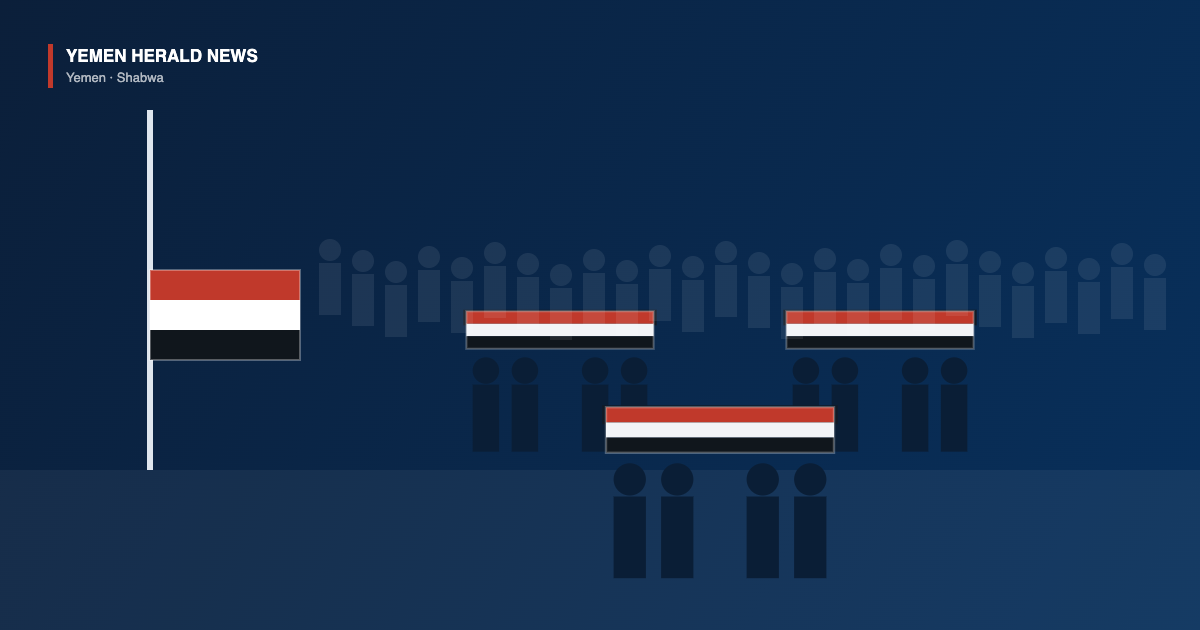
ATAQ, Yemen — Yemen’s military held a mass funeral in Shabwa province on Wednesday for security recruits killed in a ballistic missile strike on their training camp.
The service was held at the Nasser al-Khulaifi Stadium in Ataq, the provincial capital, according to accounts of the ceremony.
Troops and security forces carried the coffins. Senior government and military officials, tribal leaders and mourners attended.
Shabwa’s governor, Awad bin al-Wazir, led the procession with senior commanders, those accounts said. The bodies were taken to a cemetery in Ataq for burial.
Accounts of the toll differ, and no authority has published a final count.
Local authorities said on the day of the strike that more than 50 security personnel had been killed and about 200 wounded.
The Shabwa province media office gave a preliminary assessment of 53 dead and more than 200 injured.
Local authorities put the toll at more than 70 killed and over 200 wounded in remarks published the following day.
Reports of the funeral put the number of dead at 73 and at 75. Yemen Herald could not reconcile the figures.
The recruits were aged 18 to 20, according to accounts of the funeral.
Three ballistic missiles hit the camp near Ataq on Monday, October 19.
The Shabwa province media office named the site the Martyr Ahmed al-Sulaimani Training Centre. A spokesman for the Yemeni armed forces called it al-Alam camp.
The centre was training recruits drawn from several provinces to join the internal security forces and the police, officials said.
The recruits were lining up for a training session when the missiles struck, according to accounts of the attack.
Fahd al-Khulaifi, Shabwa’s first deputy governor, told Agence France-Presse that hospitals were overwhelmed.
He said the most seriously wounded had been moved to Hadramout and Aden, and that some were in a critical condition.
Al-Khulaifi called on the Saudi-led coalition to supply counter-drone equipment and ground-based air defences against ballistic missiles.
He also said local authorities had information indicating Houthi cooperation with al-Qaeda and the Islamic State group, which he linked to attacks on security forces and to explosive devices planted on roads.
Al-Khulaifi said the governor had presented evidence of that cooperation. The Houthis did not respond to the allegation, and Yemen Herald could not verify it.
Rashad al-Alimi, chairman of the Presidential Leadership Council, condemned what he called a “criminal attack” and promised a “firm response”.
Al-Alimi also ordered financial support for the families of those killed, according to accounts of the response.
Al-Alimi was briefed on the attack by the governor by telephone, according to the account of that call.
He ordered medical treatment for the wounded, care for the families of the dead and the completion of entitlement procedures.
Al-Alimi said the Houthis resort to attacks when they face pressure or setbacks, and said the deaths would not go unanswered.
Shabwa’s local authorities held the Houthis responsible and called the targeting of recruits during training an “extremely serious military escalation”.
They said the dead would be recognised as having died in the line of duty, with salaries allocated to their families, and that the wounded would receive their entitlements and medical care.
They called for urgent measures to protect military and security sites.
Information Minister Moammar al-Eryani said the attack was a war crime because the training centre was not a military target.
Al-Eryani accused the Houthis of trying to manufacture a media victory and to conceal setbacks on the battlefield.
A spokesman for the armed forces attributed the launch to the Houthis.
Yahya Saree, the Houthi military spokesman, said the missiles had targeted “Saudi enemy” forces at al-Alam camp, which he said was run by Saudi officers.
He described the targets as “Saudi enemy concentrations”. Saudi authorities made no immediate comment on that account.
Major General Adel bin Ali al-Musabi, commander of the Ataq military axis, spoke at the funeral.
“This incident today only strengthens our determination, resolve and strength in Shabwah Governorate,” al-Musabi said.
A tribal sheikh, Awad Mohammed Awad, called the strike “an atrocity unlike anything we have ever witnessed”.
Tribal elders at the ceremony condemned the attack and called on southern communities to unite against continued bombardment.
Shabwa’s governor said in a statement after the funeral that the province would increase its efforts to defend itself.
He said those behind the strike would be pursued and held to account.
The governor said the recruits were being trained to provide security inside Shabwa, not for combat operations.
Shabwa is held by the internationally recognised government. It is an oil-producing province in the south-east of the country.
Fighting escalated last month, when Houthi forces took territory on Yemen’s Red Sea coast.
Government forces backed by Saudi Arabia then launched an offensive they call Operation Dawn of Yemen, which they say aims to retake ground including Sanaa.
The Houthis have held Sanaa since 2014.
The United Nations said in its 2026 humanitarian response plan for Yemen that more than 22 million people in the country need assistance.
The plan recorded 18.3 million people as acutely food insecure and 5.2 million displaced inside Yemen. It sought 2.16 billion dollars to reach 12 million people.
The training centre sits on the outskirts of Ataq, the provincial capital.
About the Author