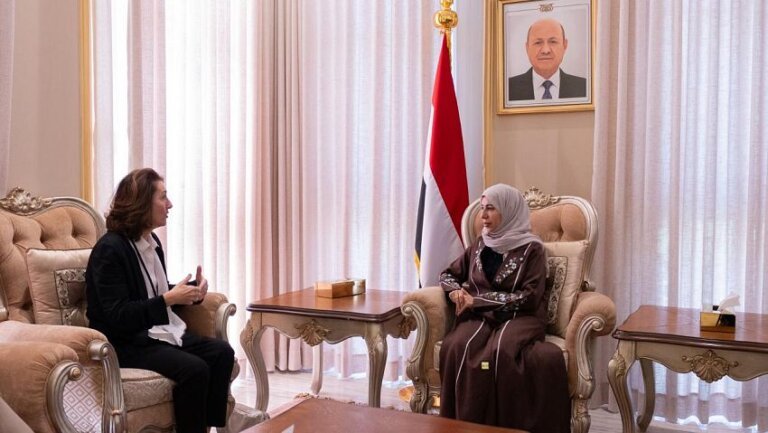
Yemen and Jordan sign cultural heritage agreement covering archives and digital preservation
 Yemen Herald News

AMMAN, Jordan — Yemen and Jordan signed an agreement on Wednesday to cooperate on culture and heritage, including the digitisation of archives and manuscripts.
Jalal Faqira, Yemen’s ambassador to Jordan, signed for Yemen, the state news agency Saba reported.
Nidal al-Ahmad, secretary-general of Jordan’s Ministry of Culture, signed for Jordan.
The memorandum covers cooperation in cultural, creative and heritage fields, Saba said.
It provides for an exchange of expertise in digitising archives, manuscripts and elements of cultural heritage.
The two sides agreed to develop joint digital platforms for cultural content, according to the agency.
The memorandum also covers the use of virtual reality, augmented reality and artificial intelligence to preserve and manage cultural data.
It provides for joint programmes sending cultural and artistic delegations and experts between the two countries.
The two sides agreed to hold reciprocal cultural weeks.
Saba did not report the memorandum’s duration, its funding, the bodies that will implement it, or any timetable.
The account of the signing rests on Saba, Yemen’s state news agency. No independent confirmation of the signing or of the memorandum’s contents has been published, and Yemen Herald found no separate account from Jordan’s Ministry of Culture.
Yemen’s cultural heritage has been damaged repeatedly during the war.
The country has five properties on the UNESCO World Heritage list.
The Old Walled City of Shibam was inscribed in 1982 and the Old City of Sana’a in 1986.
The Historic Town of Zabid followed in 1993, and the Socotra Archipelago, a natural site, in 2008.
The World Heritage Committee placed the Old City of Sana’a and the Old Walled City of Shibam on the List of World Heritage in Danger on July 2, 2015, at its session in Bonn.
The committee cited damage from the armed conflict in Sana’a, particularly in the al-Qasimi neighbourhood and around the 12th-century al-Mahdi Mosque.
It found Shibam under potential threat from the fighting, alongside existing problems with safeguarding and management.
All three of Yemen’s cultural World Heritage properties of that era, Zabid included, are on the danger list, according to UNESCO.
The Landmarks of the Ancient Kingdom of Saba, in Marib, were inscribed in 2023 and placed on the danger list the same year.
The property is a serial site of seven archaeological locations spanning the first millennium BCE to the arrival of Islam around 630.
It covers about 375 hectares, with a buffer zone of nearly 26,000 hectares, according to UNESCO.
The sites include the walled capital of Ma’rib and the fortified city of Sirwah, about 40 kilometres to the west.
They also include monumental temples at Harunum, Awam and Bar’an, linked by a processional route.
The Ma’rib Dam and its canals supported what UNESCO describes as the largest artificial oasis in ancient Arabia.
Four of Yemen’s five World Heritage properties are on the danger list. Socotra, inscribed for its natural value, is the exception.
UNESCO announced an Emergency Action Plan for the Safeguarding of Yemen’s Cultural Heritage on July 16, 2015.
Irina Bokova, then the organisation’s director-general, announced it at the close of a two-day expert meeting at UNESCO headquarters.
The plan was developed with the organisation’s institutional partners and Yemeni national institutions.
It set out three areas of work: awareness-raising and advocacy, information gathering and coordination, and technical assistance.
The technical assistance strand covers risk mitigation on the ground and capacity building.
Bokova said at the time that the plan had to be funded to succeed.
UNESCO described the conflict as a threat to Yemen’s tangible and intangible heritage alike.
Shelling had damaged the Old City of Sana’a and the old centre of Saada, the organisation said when it announced the plan.
The Citadel of Taez, the pre-Islamic walled city of Baraqish, archaeological sites at Marib and the Great Dam of Marib had also been harmed.
The Dhamar Museum, which held 12,500 artefacts, was destroyed in May 2015.
Ancient tombs in Hadramout were deliberately destroyed the previous year, according to UNESCO.
The agreement was signed while fighting continues in Yemen.
More than 250,000 people were displaced inside Yemen between the start of August and Oct. 17, the UN refugee agency said.
Taiz governorate accounts for 76% of the newly displaced and hosts 52% of them. Lahj hosts 23% and Aden 13%.
Volker Türk, the UN high commissioner for human rights, said on Oct. 20 that he was alarmed by the encirclement of Taiz and called for aid to be let in immediately.
His office recorded 32 civilians killed across Taiz governorate between Aug. 1 and Oct. 19, and 115 injured over the same period.
Access to Taiz city and governorate is essentially blocked, UN agencies said this week.
More than 3,800 Yemenis have reached Djibouti since August and more than 240 have reached Somalia.
Aid agencies appealed in March for $2.16 billion to reach 12 million people in Yemen this year, the UN Office for the Coordination of Humanitarian Affairs said.
That plan counted 22.3 million people in need of assistance and protection.
Fighting resumed after a period of calm that followed a truce agreed in 2022.
Yemen’s internationally recognised government is based in Aden.
Saba filed its account of the signing from Amman on Wednesday.
About the Author