GCC secretary-general and UN envoy Grundberg discuss Yemen in Riyadh
 Yemen Herald News
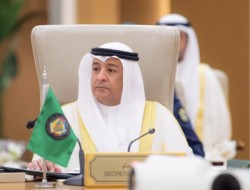
RIYADH, Saudi Arabia — The Gulf Cooperation Council’s secretary-general met the United Nations envoy for Yemen in the Saudi capital on Monday to review the war and efforts to end it.
Jasem Mohamed Albudaiwi received Hans Grundberg at the GCC General Secretariat headquarters, the council said.
Grundberg is the UN secretary-general’s special envoy for Yemen.
The two went over the latest political and humanitarian developments in the country, according to the council’s account of the meeting.
They reviewed regional and international initiatives aimed at a comprehensive political solution, it said.
Albudaiwi restated the council’s support for Yemen’s security, stability, sovereignty and territorial integrity.
He also backed continued coordination with the UN-led peace process, the same account said.
The newspaper Asharq Al-Awsat reported that both men reaffirmed their condemnation of continued Houthi attacks on Saudi Arabia. That detail does not appear in the version carried by other outlets.
This account rests on the Gulf Cooperation Council’s announcement of its own meeting, relayed by regional media. No independent account of what was said has been published, and neither side released a transcript.
The meeting came as fighting intensified in southern Yemen.
Houthi forces had advanced to within 80 kilometres of Aden, Reuters reported on Monday, citing four military sources. That is the closest they have come to the city since the early months of the war that began in 2015.
The push threatens positions along the main road linking Aden with Taiz, The National reported. Taiz has a population of about one million and is under siege.
The wider offensive began in September, when Houthi forces moved down the Red Sea coast and took territory near the Bab al-Mandab strait, the newspaper said.
Government troops had pushed Houthi fighters out of that area weeks earlier.
The escalation has broken a truce the United Nations brokered in 2022, The National said.
Tom Fletcher, the UN humanitarian chief, said on Monday that nearly 300,000 people had been displaced since August. He said aid partners had reached nearly 260,000 of them.
Water production in Taiz has halved and food prices have risen by at least 50 percent, Fletcher said. Roads into the city have been closed.
“Open the roads and let them through. Civilians cannot be held hostage by the fighting,” he said.
Fletcher said about 70 UN staff and dozens of other humanitarian workers were being held. “They are not bargaining chips. Release them,” he said.
He condemned the death of Mohammad El Shami, a colleague at the UN Human Rights Office, in Houthi custody.
The envoy’s office issued a statement on Taiz on Oct. 1. “I am alarmed by developments in Taiz governorate, where fighting has significantly intensified,” it said.
It said military operations by Ansar Allah in the area “pose grave risks to the civilian population.” Ansar Allah is the Houthi movement’s formal name.
That statement described Taiz as “the third largest city of Yemen” and said the governorate was hosting most of the Yemenis newly displaced by fighting elsewhere.
“I repeat my call on Ansar Allah to halt its military offensive,” the statement said.
Grundberg told the Security Council that escalating fighting was deepening the crisis in Taiz, Yemen Monitor reported on Oct. 10. That report said he had held talks over the previous month in Riyadh, Muscat, Cairo and Washington.
It said the Houthis had released one UN staff member and that 72 UN personnel remained in detention at that point.
Grundberg finished a visit to Berlin on Oct. 16 and one to London on Oct. 20, his office said. He completed a visit to Moscow on Oct. 28, meeting Russian Deputy Foreign Minister Alexander Alimov.
On Oct. 11 he condemned continuing attacks on civilian infrastructure in Saudi Arabia. His office pointed to an attack the previous day on King Khalid International Airport in Riyadh.
The UN secretary-general said that attack reportedly killed 12 people and injured hundreds.
Albudaiwi and Grundberg last met in Manama on Oct. 31, 2025, on the sidelines of the 21st Manama Dialogue, the council said at the time.
That meeting covered the Gulf Initiative, the outcomes of the Comprehensive National Dialogue Conference and Security Council Resolution 2216, according to the council.
The council also cited the final statement of its Supreme Council’s 45th session, held in Kuwait in December 2024, which backed the Presidential Leadership Council headed by Rashad al-Alimi.
The two men had met in Riyadh on May 20, 2024, the Saudi Press Agency reported at the time.
Yemen’s government named three new ministers a day after the Riyadh meeting. Salem al-Awlaki took the information portfolio, replacing Moammar al-Eryani, who had held it since 2016.
Judge Akram Naseeb Ahmed al-Amiri was named minister of civil service and insurance, and Ahmed al-Awlaki minister of local administration, the state news agency Saba said.
Al-Eryani said on X that he would move to the Ministry of Foreign Affairs and Expatriates as an ambassador under a decree issued by al-Alimi.
Afrah al-Zouba is Yemen’s foreign minister.
The Gulf Cooperation Council groups Saudi Arabia, the United Arab Emirates, Kuwait, Qatar, Bahrain and Oman. Its secretariat sits in Riyadh. Yemen is not a member.
In July 2024 Albudaiwi welcomed Grundberg’s announcement of an agreement between the Yemeni government and the Houthis on steps to de-escalate a dispute over the banking sector and airlines.
About the Author


 Adel Haddad