Yemen joins Arab information ministers’ preparatory session in Cairo
 Yemen Herald News
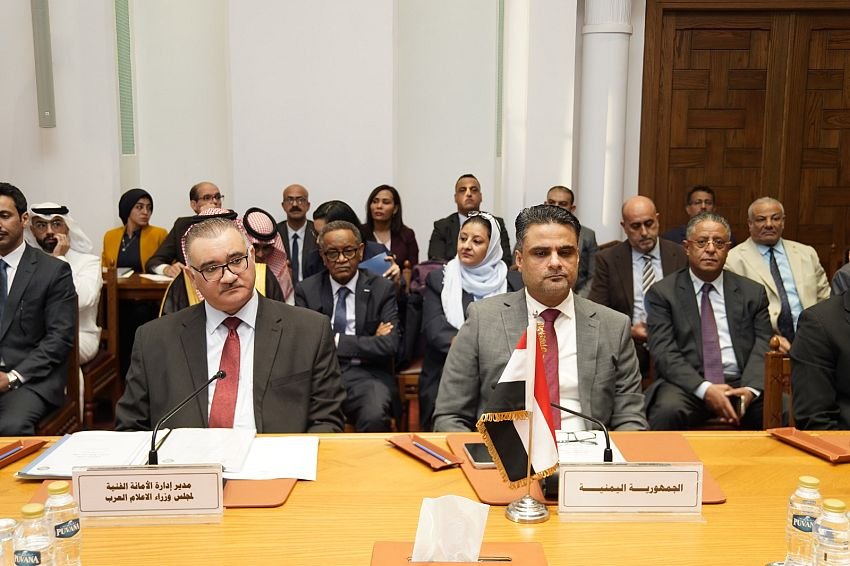
CAIRO, Egypt — Yemen’s deputy information minister led his country’s delegation to a meeting of Arab information officials at the Arab League headquarters on Wednesday.
Salah al-Aqel headed the delegation to the 23rd regular session of the Executive Bureau of the Council of Arab Information Ministers, the state news agency Saba said.
The bureau prepares the ground for the council, the Arab League’s ministerial forum on media policy.
Its sessions review the draft resolutions and recommendations that ministers take up later.
Wednesday’s meeting went through those draft texts ahead of the council’s 56th session, Saba said. Neither the date nor the venue of that ministerial meeting was announced.
The agenda covered the Palestinian cause, according to the agency.
It also took in the establishment of an Arab media observatory, the development of digital media, and a unified Arab strategy for dealing with international media companies and platforms.
Combating terrorism and misinformation was listed among the items, Saba said.
Yemen Television, which also reported the session, named two further agenda items. They were an Arab media action plan abroad and an Arab media map tied to the 2030 sustainable development agenda.
The broadcaster said participants pressed for closer coordination among Arab media institutions. It said they raised countering misinformation and incitement.
Al-Aqel restated Yemen’s commitment to developing its media sector, Saba reported.
He pointed to efforts to approve a draft electronic media law intended to regulate the country’s digital media environment, the agency said.
Yemen Television put the same remark differently. It reported him as saying Yemen was working on approving an electronic media project.
He praised the work of the Executive Bureau and of the Permanent Committee for Arab Media, the broadcaster said.
Neither report named the official who chaired the session. Neither identified any other country’s delegation.
This account rests on Yemeni state media. Saba is the government’s news agency and Yemen Television is state-run, and no independent confirmation of the delegation’s participation or of al-Aqel’s remarks has been published.
Saba filed its account early on Wednesday. Yemen Television published its own report later the same morning.
The delegation travelled as the ministry it represents changed hands.
Three Yemeni ministers took the constitutional oath before Rashad al-Alimi, chairman of the Presidential Leadership Council, in Riyadh on Wednesday.
Salem Abubakr Mohammed Thabit al-Awlaki was sworn in as minister of information, Saba said.
He replaced Moammar al-Eryani, who had held the portfolio since 2016, The National reported.
Al-Eryani said on X that he would become an ambassador at the Ministry of Foreign Affairs and Expatriates under a decree issued by al-Alimi.
Judge Akram Naseeb Ahmed al-Amri was sworn in as minister of civil service and pensions.
Ahmed Saleh Ahmed al-Awlaqi took the oath as minister of local administration.
The decrees behind the appointments were announced on Monday, Arab News reported.
The ministry’s brief covers a press sector that outside monitors rank among the world’s most constrained.
Reporters Without Borders placed Yemen 164th of 180 countries in its 2026 World Press Freedom Index, with a score of 27.89.
The group ranked the country 154th a year earlier, on a score of 31.45.
The index scored Yemen lowest on economic and security conditions for the press, ranking it 172nd and 171st on those measures. It placed the country 145th on political conditions, 147th on its legal framework and 158th on the social indicator.
Reporters Without Borders says journalists in Yemen are subject to abduction by both the Houthis and the government.
The group’s running tally recorded two journalists killed in Yemen since the start of 2026, and two held in detention. That barometer is updated continuously.
Human Rights Watch set out three cases in a dispatch published on July 26.
The dispatch was written by Niku Jafarnia, the organisation’s researcher for Yemen and Bahrain.
It said Mohammed Aydah, who had reported for Al Arabiya and Al Hadath since 2019, was killed in Mukalla, in eastern Yemen, on June 24 by an explosive device planted in his car.
The Yemeni Journalists Syndicate condemned the killing, according to the dispatch.
Human Rights Watch said Marib security forces detained the journalist Hamoud Haza on June 27 while he covered a public event.
Haza told the organisation he was held incommunicado and released two days later, after signing a pledge not to criticise the internationally recognised government and its information minister.
The group also said Houthi forces abducted the journalist Salah al-Deen al-Rawhani from his home in Sanaa in March, and that he had not been heard from since. It cited the International Federation of Journalists for that case.
Human Rights Watch quoted the National Organization of Yemeni Reporters as saying more than 90 journalists and media workers have been killed since the conflict began in 2015. That count is the reporters’ organisation’s, not the rights group’s.
A Human Rights Watch report published in September 2025 found that all parties to the conflict had committed serious abuses against journalists with impunity. It named the Houthis, the Southern Transitional Council and the Yemeni government.
That report was titled “We Pray to God by Torturing Journalists.”
Spellings of the killed journalist’s name differ between accounts. Reporters Without Borders rendered it Mohammed Aida.
About the Author


 Adel Haddad