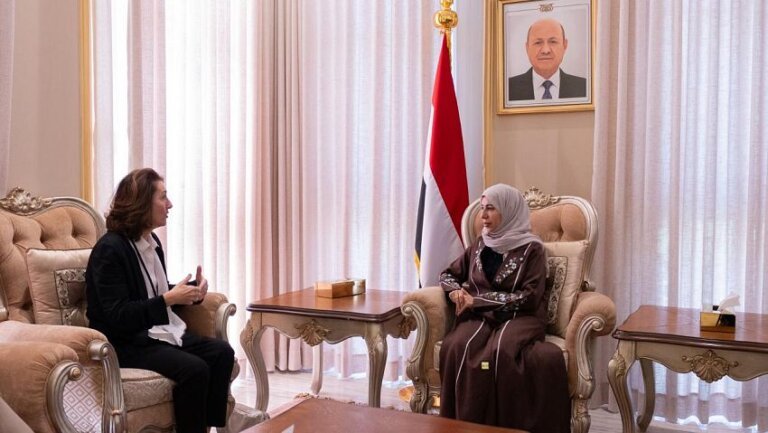
Hadramout governor Salem al-Khanbashi praises UNDP projects in meeting with deputy representative
 Yemen Herald News
MUKALLA, Yemen — Hadramout’s governor praised the UN Development Programme’s work in his governorate at a meeting with the agency’s deputy representative on Sunday.
Salem al-Khanbashi, a member of Yemen’s Presidential Leadership Council and governor of Hadramout, said the programme’s projects had helped deliver development and service work across the governorate, the state news agency Saba reported.
He credited the agency with supporting key sectors, widening development opportunities and improving the services residents receive, according to Saba.
Al-Khanbashi met UNDP Deputy Resident Representative Nadia Alawamleh and members of her team, the agency said.
The two sides reviewed the programme’s interventions in Hadramout and progress on projects in several sectors, Saba said. They also discussed the governorate’s development needs and its priorities for future work.
Saba, which the internationally recognised government runs, was the only outlet to report the meeting. Yemen Herald found no independent confirmation of what was discussed.
Alawamleh is the agency’s deputy resident representative for programmes in Yemen. Noura Hamladji heads the country office as resident representative.
UNDP has run service and recovery work in Hadramout for years.
It rehabilitated the Al-Hami fishery landing site in the governorate and handed it over in September 2025. The upgrade covered a refurbished auction yard, new administration buildings, improved sanitation and drainage, and repaired boat off-loading ramps, the agency said.
More than 1,560 fishermen and 382 boats use the site, according to UNDP.
Al-Hami is one of nine landing sites being rebuilt under the Sustainable Fisheries Development in the Red Sea and Gulf of Aden project, which the World Bank funds.
UNDP said on Nov. 21, 2025 that three of the nine were finished. The other two were at Bab al-Mandab in Taiz governorate, handed over in October 2025, and the Dockyard site in Aden, handed over the month after.
Water supply has been another strand. The agency said a solar-powered desalination plant in the Burr area of Seiyun began operating in late September 2022.
The plant produces 18 to 20 cubic metres of drinking water an hour and serves about 20,000 people, UNDP said. It was built with the Ministry of Water and Environment, the General Authority of Rural Water Project and residents of Burr.
Earlier work focused on waste collection in Mukalla.
UNDP said in November 2020 that it had delivered 12 refuse trucks to the city’s Cleaning and Improvement Fund and repaired 13 vehicles that had stopped running. Japan paid for that project.
The restored fleet would serve more than 300,000 people, the agency said at the time.
Mukalla was then collecting about 40 percent of the roughly 500 tons of solid waste it produced each day, according to UNDP. It said about 60 percent of the city’s waste management assets had been damaged or destroyed.
The agency signed a local governance agreement with the European Union this month.
UNDP and the EU delegation to Yemen announced the package on Oct. 8. It is worth 9 million euros, or about $10.4 million.
The money funds a programme called Mobilizing Area Solutions for Action and Recovery, known as MASAR, which covers seven governorates and more than 25 districts. UNDP did not name them.
MASAR works on local authority planning, budgeting, resource mobilisation and service delivery, and on transparency in public financial management and procurement, the agency said. It runs alongside governorate offices, the Ministry of Local Administration and the Ministry of Planning and International Cooperation.
Patrick Simonnet, the EU ambassador to Yemen, and Hamladji signed the agreement.
“Local authorities are at the frontline of service delivery in Yemen,” Hamladji said.
MASAR follows an earlier EU-funded programme, SIERY. UNDP said that project delivered 177 public service projects and reached more than 7 million people.
The wider relief effort remains short of money. The UN humanitarian response plan published in March 2026 said more than 22 million Yemenis needed assistance.
It put the number facing acute food insecurity at 18.3 million, and said more than 2.2 million children under five were acutely malnourished, 516,157 of them severely.
The plan recorded 5.2 million internally displaced people. It sought $2.16 billion to reach 12 million of those in need.
Hadramout is Yemen’s largest governorate by area and holds much of the country’s onshore oil production.
Al-Khanbashi told Asharq Al-Awsat in an interview published in February that electricity was the governorate’s first priority, with shortages worst in summer. He said planning covered 300 megawatts on the coast alongside projects in the valley.
He named tourism, real estate, minerals and fisheries as areas open to investment, and urged Hadrami businessmen to put money into the governorate.
In the same interview he said Hadramout “has room for all” and warned against what he called incitement, pointing to gatherings in Seiyun in early February. He said a state of emergency remained in force in the governorate.
He also backed a planned meeting of Hadrami figures in Saudi Arabia, intended to produce a unified position for the governorate.
Al-Khanbashi has separately pressed for the Hadramawt Protection Forces, a locally raised force, to be folded into the national army and security services, Yemen Monitor reported.
Al-Khanbashi commanded the National Shield Forces in Hadramout before taking the governorship.
About the Author