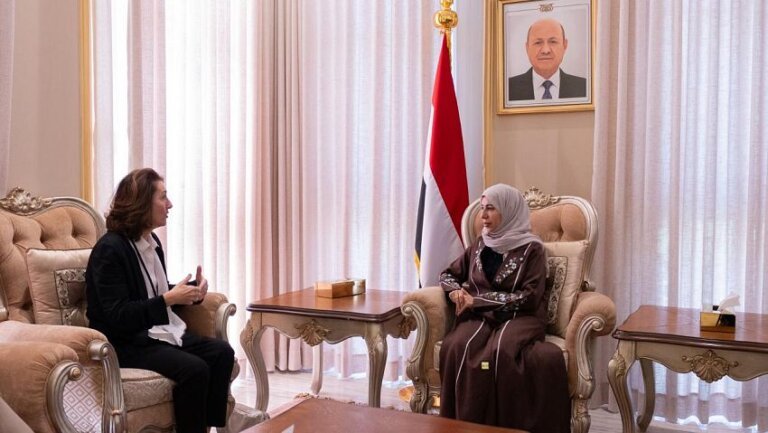
Iraqi Prime Minister Ali al-Zaidi meets Foreign Minister Afrah al-Zouba in Baghdad
 Yemen Herald News
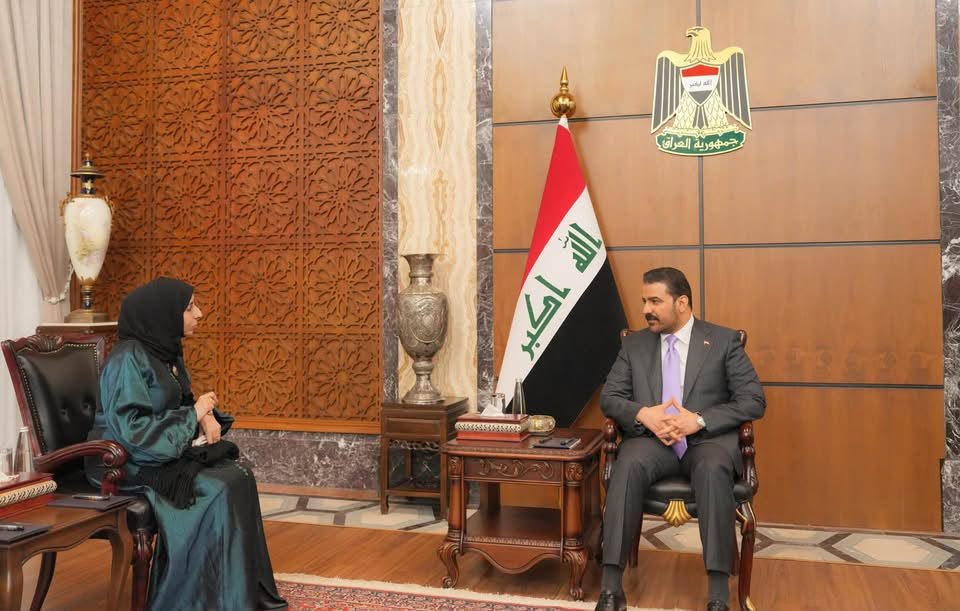
BAGHDAD, Iraq — Iraq’s prime minister met Yemen’s foreign minister in Baghdad on Sunday on the sidelines of a meeting of Islamic Cooperation foreign ministers, Yemen’s state news agency said.
Ali al-Zaidi received Afrah al-Zouba, the minister of foreign affairs and expatriates, the agency, Saba, reported.
The two discussed relations between Yemen and Iraq and ways to widen cooperation, according to Saba.
They also discussed developments in Yemen, the agency said.
Saba said those included military escalation by Houthi forces and the government’s efforts to restore state institutions and security.
The account of the meeting rests on Saba, which is run by the internationally recognised government. No independent confirmation of the bilateral talks has been published, and Yemen Herald could not verify them.
The session around which the meeting took place is more widely documented.
The 52nd session of the Organisation of Islamic Cooperation’s Council of Foreign Ministers opened in Baghdad on Oct. 17, the Saudi Press Agency reported.
Al-Zaidi attended the opening, with delegations from member states and representatives of international organisations, the agency said.
The chairmanship of the council passed from Turkiye to Iraq for the session, according to the same report.
The agenda is led by the Palestinian cause and developments in the Gaza Strip, the Saudi agency said.
Ministers are also reviewing draft resolutions on political, economic, social, humanitarian and development matters, it said.
The Organisation of Islamic Cooperation groups 57 member states and keeps its headquarters in Jeddah. It was founded in 1969.
One of those drafts concerns Yemen, and it has drawn an objection.
Iran’s foreign minister, Abbas Araghchi, said on Sunday that Tehran might not endorse the proposed resolution unless the final text reflected “fairness and balance”, the Anadolu news agency reported.
Araghchi, speaking on the sidelines of the session, said the text had not been finalised.
If it failed to meet that standard, he said, “the Islamic Republic of Iran cannot join this resolution.”
He said Saudi Arabia and other states had set out their positions, and that a bloc of members held views close to Riyadh’s.
Tehran had consulted widely with other member states and wanted a balanced outcome, he said.
Iran has backed the Houthis politically, and Western governments and United Nations sanctions experts say it has supplied them with weapons. Tehran denies arming the movement.
Yemen has used the session to press a specific demand.
Al-Zouba asked the council on Saturday to designate the Houthi movement a terrorist organisation and to cut off its funding and weapons, Saba reported.
Al-Zouba had arrived in Baghdad before the session to take part in the meetings, Yemen TV reported.
The government has made the same request elsewhere this month. Saba said Presidential Leadership Council chairman Rashad al-Alimi put it to UN Secretary-General Antonio Guterres in a telephone call.
The Security Council has not listed the movement as a terrorist organisation.
The council imposed a targeted arms embargo on Houthi leaders in 2015 under resolution 2216. It extended the embargo to the movement as a whole in 2022 under resolution 2624.
The United States has. The State Department designated Ansar Allah, the movement’s formal name, a foreign terrorist organisation with effect from March 2025.
A foreign terrorist organisation listing makes it a crime under US law to provide the group with material support.
The Houthis, who hold Sanaa and much of northern Yemen, have rejected the designation campaign.
Al-Zouba is the first woman to hold Yemen’s foreign ministry. A republican decree appointed her in July.
Al-Zaidi’s government is newer still. Iraq’s parliament approved his cabinet on Oct. 16, two days before the meeting with al-Zouba.
Yemen’s Presidential Leadership Council, which al-Alimi chairs, was formed in April 2022, when Abed Rabbo Mansour Hadi transferred his powers to it.
Houthi forces have encircled much of Taiz since 2015. The government describes the city as under siege, an account the Houthis reject.
The war has produced one of the region’s largest relief operations. The UN Office for the Coordination of Humanitarian Affairs said in its plan for this year that more than 22 million people in Yemen need assistance.
Of those, 18.3 million are acutely food insecure, the office said. More than 2.2 million children under five are acutely malnourished, including 516,157 severe cases.
OCHA counted 5.2 million displaced people. Its appeal sought 2.16 billion dollars to reach 12 million of them.
Aid work has also been disrupted by detentions. Human Rights Watch said on Oct. 6 that 72 UN staff remained in Houthi detention as of the previous day, all of them Yemeni nationals.
Human Rights Watch said more than 100 UN and civil society staff had been arbitrarily detained since May 31, 2024. Raids that day took 13 UN staff and at least 50 civil society workers.
The group said the Houthis had referred at least eight UN and civil society workers for prosecution since Aug. 18, on charges of espionage and aiding the enemy.
Guterres called in March for the immediate release of 118 detained UN staff. The United Nations said last week that one staff member had been freed.
Iraq and Yemen are both founding members of the Arab League, which was established in 1945.
About the Author