Hadramout governor Salem al-Khanbashi reviews work of Yemen’s passports authority
 Yemen Herald News
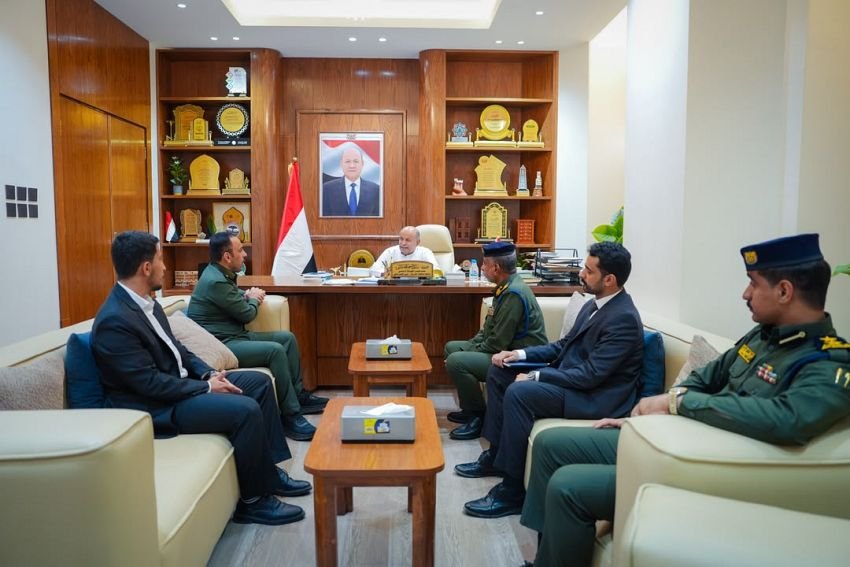
MUKALLA, Yemen — Presidential Leadership Council member and Hadramout governor Salem al-Khanbashi reviewed the performance and needs of Yemen’s immigration and passports authority on Sunday, the government said.
He met Maj. Gen. Tariq al-Nasi, president of the Immigration, Passports and Nationality Authority, in Mukalla, the state news agency Saba reported.
Brigadier Fahmi Balkudish, who directs the authority’s Coastal Hadramout branch, attended.
The account of the meeting rests on the Yemeni government’s own announcement, relayed by Saba. Yemen Herald found no independent record of it.
The two men reviewed the state of the authority’s branches in Coastal Hadramout and Wadi Hadramout, according to Saba.
They discussed ways to improve services for citizens and measures to speed up the processing of applications.
The meeting also covered the authority’s work at border crossings, procedures for issuing visas, and the difficulties affecting its branches.
Among the items discussed was a Saudi decision to regularize the status of Yemenis living in the kingdom, Saba said.
Saudi Arabia’s Interior Ministry announced that decision on October 5. It said the status of all Yemeni nationals residing irregularly in the kingdom would be officially regularized.
The ministry said it was acting on the directives of King Salman bin Abdulaziz Al Saud and at the request of Rashad al-Alimi, chairman of the Presidential Leadership Council.
It described the step as part of the kingdom’s humanitarian support for the Yemeni people.
The ministry said it was carrying out the measure with the foreign ministry, the Ministry of Human Resources and Social Development and the Saudi Data and AI Authority.
A valid Yemeni passport is an essential prerequisite for regularizing legal status, the ministry said.
Saudi Arabia’s General Directorate of Passports began the process on Sunday, October 11, according to the Saudi Press Agency. It is to run for two months and cover every region of the kingdom.
The directorate published the eligible categories on its account on the social platform X. The process covers four groups of Yemeni nationals.
Yemenis holding no Yemeni identity documents or passport are to receive a free six-month visit visa. They must book through the Absher platform, choose a correction center and bring proof of Yemeni nationality, such as a passport or a travel document issued by their embassy.
Holders of expired visitor identity cards or visit visas whose biometric data is already registered are to have their visas extended electronically for six months, without visiting a passport office. A valid passport is required.
Residents whose permits have expired but whose travel documents remain valid may transfer to another employer through Absher, through Qiwa for professional workers or through Musaned for domestic workers, without attending a government office.
Those in that group who prefer to leave may obtain a final exit visa, with no restriction preventing a later return.
Workers reported absent from their jobs who hold valid travel documents will have the absence report cancelled and may move to another employer through the same platforms.
Yemen’s embassy in Riyadh opened online preliminary registration on Sunday.
The embassy said appointments and registration were free and did not require intermediaries or agents.
Applicants may book through Absher or through a registration link on the embassy’s website, and an Absher account is not required, it said.
The embassy said registration was only a first step to collect the details of people who needed travel documents, and was not an approval.
Applicants still have to complete verification and obtain documents before following the instructions Saudi authorities issue for their category, the embassy said.
Accounts of the number of correction centers differ. The Saudi Press Agency put the figure at 23 and listed four in Riyadh, three each in Aseer and the Eastern Region, two each in Makkah, Jazan and al-Jouf, and one each in Najran, Madinah, al-Baha, the Northern Borders region, Tabuk, Qassim and Hail. Arab News listed 16.
Neither the Saudi agency nor the ministry published a figure for how many Yemenis in Saudi Arabia the measure may reach.
About 1.9 million Yemenis live in Saudi Arabia, according to The National.
Saudi Arabia accounts for about 62 per cent of the remittances sent to Yemen, the largest single source of money Yemenis abroad send home.
Saudi authorities recorded 11,819 residency, labour and border-security violations between September 24 and 30, among them 5,793 residency violations.
Ahmed Obaid bin Dagher, chairman of Yemen’s Shura Council, welcomed the Saudi decision. He said it would have “a significant impact on the lives of thousands of Yemenis and their families” and called it a “humanitarian gesture.”
The measure echoes a programme Saudi Arabia introduced in 2015, when it began its military intervention in Yemen.
The Interior Ministry’s announcement came a day after al-Alimi declared all-out war on the Houthis, and he announced operations to retake Houthi-held territory the following Sunday.
Al-Khanbashi kept the Hadramout governorship after joining the Presidential Leadership Council, Al Arabiya reported at the time of his appointment.
The council, which al-Alimi chairs, was formed in April 2022 and is the executive body of Yemen’s internationally recognized government.
The government administers Hadramout from Mukalla, on the Arabian Sea coast.
Saba did not say whether the meeting produced decisions or a timetable for the authority’s branches in the governorate.
About the Author