Landmine casualties in Yemen persist as clearance teams pass half a million devices
 Yemen Herald News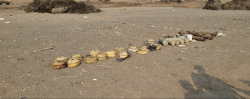
ADEN, Yemen — Landmine and explosive incidents killed 1,367 civilians in Yemen and wounded 1,622 more between 2018 and March 2026, monitoring data shows.
Children accounted for 30.44 percent of those casualties, according to the same data.
Yemen remains among the five countries worst affected by landmines and unexploded ordnance, Human Rights Watch said in its World Report 2026.
The organisation wrote that landmines and explosive remnants of war continue to cause civilian casualties and to drive displacement.
A study circulated through ReliefWeb under the title “Fields of Death” documented 537 mine incidents across 14 governorates between January 2016 and March 2024.
It named Hodeidah as the governorate with the heaviest contamination.
The study attributed 512 of those 537 incidents, or about 96 percent, to Ansar Allah, the formal name of the Houthi movement.
No response from the Houthi authorities appears in the published version of that report.
The same study counted 1,469 civilian casualties from mines and other war remnants over a five-year period.
A separate estimate is materially higher and has not been independently corroborated.
The Mokha Center for Strategic Studies puts the number of civilians affected since September 2014 at 11,807, comprising 4,262 deaths and 7,491 injuries, and says the count covers documented incidents only because large areas remain inaccessible.
That figure is roughly eight times the casualty totals recorded by the other monitoring sources cited here, and Yemen Herald found no second origin for it.
Readers should treat it as the centre’s own estimate rather than an established count.
The Yemeni organisation WCYS reported an explosion in al-Dhalea that killed five children and injured eight others.
Deaths continue to be recorded. The Shohood Organization documented the deaths of a father and his teenage son on 10 August, killed while herding sheep in Harib.
Clearance work is running in parallel. The Saudi-funded Yemen Mine Action Project, known as MASAM, said its teams had removed 568,961 landmines, items of unexploded ordnance and improvised explosive devices between June 2018 and 19 June 2026.
MASAM said the same teams had cleared more than 81.7 million square metres of Yemeni territory over that period.
Project Masam has argued that landmines have become the largest single cause of civilian casualties in Yemen and has called for faster clearance.
The truce years did not end the problem. Al Jazeera reported in April 2026 that Yemen’s landmine crisis had endured despite the pause in large-scale fighting and despite demining operations.
Devices laid during active fighting remain in place after front lines move. Farmland, grazing land, roads and paths around abandoned positions are among the areas affected.
Human Rights Watch published findings in May 2024 under the heading that Houthi landmines were claiming lives and livelihoods.
The organisation has documented mines laid in agricultural areas, which it said kept farmers off their land and cut household income.
A UN figure relayed by Xinhua recorded 20 civilian casualties from landmines and explosives in Hodeidah during a single month.
A separate rights group tally, reported by Yemen Online, put the number of civilians killed or injured by mines and explosives at close to 3,000.
Contamination is not confined to former front lines. Devices have been found on farmland, on grazing routes and along paths used to reach water points.
Deminers classify the hazard by device type, since anti-vehicle mines, anti-personnel mines and improvised devices each require different clearance methods.
Mine action in Yemen is split across authorities. The internationally recognised government runs clearance in the areas it holds, and MASAM operates alongside it with Saudi funding.
Clearance in Houthi-administered areas is handled separately, and comprehensive national figures are not published by a single body.
The differing totals reflect different time windows, different geographies and different definitions of what counts as a casualty.
Human Rights Watch has urged parties to the conflict to halt the use of antipersonnel mines and to support clearance work.
That division is one reason casualty counts differ between organisations. Each documents what it can reach.
Yemen is not a party to the same reporting mechanisms as many states in the region, and no single audited national database of incidents exists.
The wider humanitarian picture compounds the risk. The UN response plan issued in March 2026 counts more than 22 million people in need across Yemen.
It records 18.3 million people as acutely food insecure and 5.2 million as internally displaced.
Displaced families returning to land they left are among those most exposed to devices laid in their absence.
The plan records more than 2.2 million children under five as acutely malnourished, 516,157 of them severely, and seeks 2.16 billion dollars to reach 12 million people.
Conflict resumed at scale in Yemen in late 2014, when the Houthi group took Sanaa and much of the north. A Saudi-led coalition intervened the following year.
Front lines have shifted repeatedly since, leaving successive belts of contamination behind them.
MASAM publishes its clearance totals periodically rather than continuously.
The Carnegie Endowment published an assessment of Yemen’s mine contamination in 2022.
An August 2026 feature described mines as a continuing danger to Yemeni children.
The Fields of Death study covers incidents up to March 2024 and does not extend into the current year.
About the Author