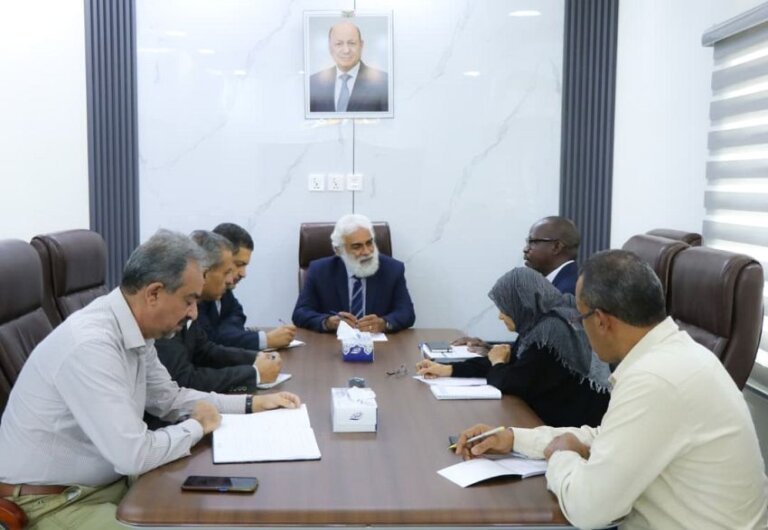
Yemeni doctor held more than 800 days appears before Houthi court in Sanaa
 Yemen Herald News
SANAA, Yemen — A Yemeni doctor held for more than 800 days has appeared before a Houthi-run court in Sanaa without being told the charges against him.
Ali Ahmed al-Mudhwahi was brought before the Specialized Criminal Court without prior notification of the charges or of the legal basis for his detention, Khabar Agency reported on Saturday.
The account comes from a brief telephone call al-Mudhwahi made to his family, which the agency relayed. Khabar Agency’s report is the only published account of the hearing, and no independent confirmation has appeared.
Al-Mudhwahi said he asked for legal representation at the hearing, according to the agency.
He proposed two Houthi figures, Shams al-Din Muhammad Sharaf al-Din and Muhammad Muftah, as his defence counsel, and invoked religious texts in asking for impartial treatment, the agency said.
He described his confinement as including extended periods of solitary isolation and psychological and physical pressure, according to the same account.
He said he had been coerced into false confessions, and that those statements were legally void and without factual basis.
Al-Mudhwahi said the authorities targeted him over his work maintaining childhood vaccination and immunisation programmes. He said that work was driven by professional and ethical obligation.
Neither the court nor the Houthi authorities has published a response to his account.
The agency did not say what charges, if any, were read at the hearing, or whether the court set a further date.
The detention itself is documented separately. The Gulf Centre for Human Rights records that al-Mudhwahi was detained on 8 June 2024, when members of the Security and Intelligence Service stormed his office in Sanaa.
The centre describes him as a Yemen-based medical consultant, poet, writer, media professional and unionist, and says he remains held by the Houthi authorities.
It places his arrest within a campaign targeting employees of international organisations.
The 800-day figure in the report dates the detention to early June 2024, consistent with the centre’s record.
His wife, the internet activist Safia Mohammed, has said publicly that he has been held for more than a year and that the family has repeatedly asked for his release.
The June 2024 wave was broad. Houthi security and intelligence officers carried out simultaneous raids in Sanaa, Hodeidah, Saada and Amran, targeting Yemeni employees of the United Nations and international aid organisations.
Rights groups counted at least 13 UN staff among those taken, along with employees of international and local non-governmental organisations.
The Houthi authorities accused at least some of those detained of spying for Israel, without presenting evidence.
UN Secretary-General Antonio Guterres called at the time for the immediate release of all United Nations staff held by the Houthi authorities.
UN staff taken in the June 2024 raids were still held a year later, according to reporting published on the anniversary.
Further detentions followed. At least eight UN staff were taken between 23 and 25 January 2025, and Houthi forces raided UN premises in Sanaa that year.
The UN Security Council has issued a press statement on the detention of UN and international non-governmental organisation workers, and members have repeatedly condemned the practice.
Human Rights Watch reported in January 2026 that the detentions were halting aid delivery in Yemen.
In its World Report 2026, the organisation wrote that parties to the conflict, including the Houthis, the Southern Transitional Council and the Yemeni government, continued arbitrary detention and enforced disappearance with impunity.
The Sana’a Center for Strategic Studies has written that the detentions left aid organisations facing stark operational choices.
The Foundation for Defense of Democracies published analysis in September 2025 arguing that the United Nations had left its Yemeni staff exposed to detention.
The Specialized Criminal Court in Sanaa handles security cases, including espionage charges. It has issued rulings in cases involving alleged spy cells and in criminal matters unrelated to the conflict.
Yemeni rights organisations dispute its standing. The Abductees’ Mothers Association has described the court as null and void.
A separate report circulated through ReliefWeb argued that the judiciary in Houthi-held areas has sentenced Yemenis to death without due process.
Those characterisations are contested. The Houthi authorities present the court as a functioning part of the judiciary in the areas they administer.
The United Nations has continued to press for the release of detained staff, renewing that call this month alongside a report that aid had reached 3.4 million people in Yemen.
Yemen’s detention files sit inside a wider humanitarian picture. The UN response plan issued in March 2026 counts more than 22 million people in need.
The plan seeks 2.16 billion dollars to reach 12 million people, and counts 5.2 million people as internally displaced.
It records 18.3 million people as acutely food insecure and more than 2.2 million children under five as acutely malnourished, 516,157 of them severely.
Routine immunisation is among the health services disrupted by the conflict, and international organisations have supported Yemen’s vaccination programme throughout it.
Khabar Agency published its report in the English section of its site on 22 August.
Al-Mudhwahi’s case file is maintained by the Gulf Centre for Human Rights among its records on detained defenders.
Al-Mudhwahi’s family said the telephone call was brief.
About the Author