Houthi Blockade and a Collapsing Truce Pull Yemen Back to the Centre of the Widening Iran War
 Yemen Herald News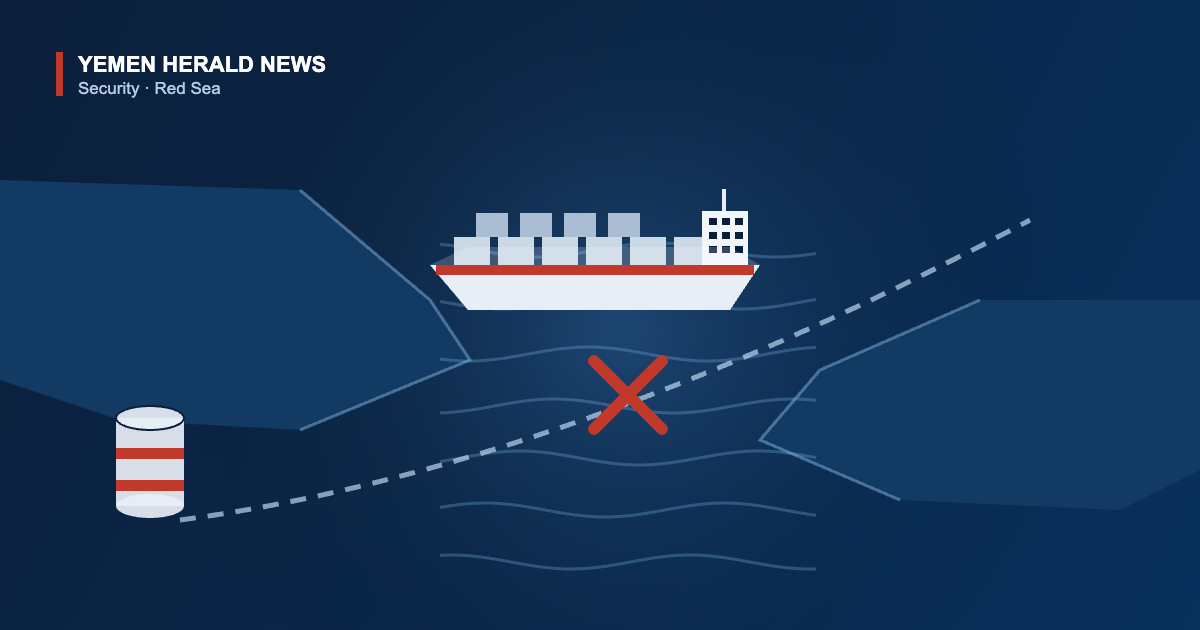
Yemen Herald editorial illustration
Yemen has moved from the margins of the war between the United States and Iran to one of its most consequential fronts. Five months after American and Israeli strikes opened the conflict on 28 February 2026, the fighting has spread into Iraq, across the Gulf states and onto the Red Sea. The Houthi movement that controls northern Yemen and the capital, Sanaa, now sits astride the shipping lanes and alignments that will determine how much further the war travels.
The latest escalation came in Iraq. Saudi Arabia and US Central Command said in late July that joint air strikes had hit Iran-backed militias they hold responsible for attacks on American forces and on Saudi energy infrastructure. The Popular Mobilisation Forces, the umbrella of mainly Shia factions formally attached to Iraq’s security establishment, said at least 20 of its fighters were killed and 32 wounded. President Donald Trump said the operation had been coordinated with Baghdad. The Iraqi government denied it, saying it neither authorised the strikes nor had prior knowledge of them, and its Ministerial Council for National Security condemned them as a violation of Iraqi sovereignty. Iraq’s military demanded evidence that attacks had been launched from its territory, saying none had been produced.
The Saudi role is the more significant change. Riyadh spent much of the past decade trying to avoid direct confrontation with Tehran, and has now flown offensive missions alongside American aircraft. The decision followed repeated drone and missile attacks on Saudi oil installations, but it strips away the ambiguity the kingdom relied on. Baghdad, which has spent two decades balancing obligations to Washington and Tehran, finds that space narrowed further.
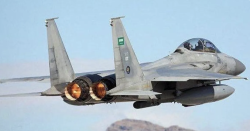
Yemen re-entered the war along a different path. On 13 July, air strikes hit Sanaa International Airport to stop an Iranian Mahan Air flight from landing with a Houthi delegation returning from Tehran. Yemen’s internationally recognised government said its forces carried out the attack; the Houthis blamed Saudi Arabia. The consequence was the same either way. The Houthi military spokesman, Yahya Saree, declared the period of de-escalation over, the group struck Abha International Airport in southern Saudi Arabia and warned that Saudi airports and other assets would be targeted if Riyadh moved against it again.
That ended, in practice, the informal understanding that had held since the United Nations brokered a truce in April 2022. It was never a peace agreement and never resolved the questions of territory, revenue and governance that keep Yemen divided, but it had largely stopped cross-border fire for nearly four years. Its collapse has restored the Houthis to a position they had not held since the earlier phases of the Yemen war: able to shape events far beyond their own borders.
On 20 July the group announced a naval blockade of Saudi Arabia, presenting it as retaliation for years of Saudi military action. The effect on shipping was immediate. Two tankers, the Rodos and the Xin Long Yang, carrying a combined 2.8 million barrels of Saudi crude bound for Asia, turned north in the Red Sea rather than continue to Bab al-Mandab.
The timing is what makes this dangerous rather than merely disruptive. Saudi Arabia had been relying on its Red Sea terminal at Yanbu precisely to avoid the Strait of Hormuz, which the war has rendered unreliable. The port handled roughly 4.1 million barrels a day in June, about 64 per cent of the crude that would normally have left through Hormuz, according to the tanker-tracking firm Kpler. A threat to Bab al-Mandab therefore closes the workaround at the moment the main route is already compromised, leaving Asian refiners dependent on longer and costlier voyages and pushing more traffic onto the Suez Canal.
Riyadh’s answer has been diplomatic as well as military. It is seeking to assemble an international coalition to protect navigation in the Red Sea, though what such a force would add is unclear: several multinational naval missions already operate there, and earlier campaigns against Houthi anti-shipping attacks showed how hard mobile coastal launchers are to suppress from the sea.
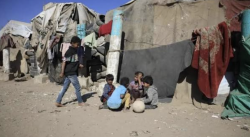
For Yemenis, the return of open conflict reopens a chapter the country has not recovered from. The Saudi-led intervention that began in 2015 produced one of the world’s worst humanitarian emergencies, and United Nations research put the cumulative death toll at roughly 377,000 by the end of 2021, most of it from hunger, disease and the collapse of health services rather than combat. Aid access, public salaries and food imports have remained fragile since, and a blockade disrupting Red Sea shipping reaches Yemeni ports as surely as Saudi ones.
The alignments driving the war were built over more than a decade. Iraq’s Popular Mobilisation Forces grew out of the mass recruitment that followed the advance of the Islamic State group in 2014 and drew heavy support from Tehran, and the American killing of the Iranian commander Qassem Suleimani in Baghdad in 2020 hardened those ties. Iran’s ties to the Houthis followed a similar arc, deepening whenever military pressure was applied.
None of the parties appears to have an exit. Iran can still act through allies from Iraq to the Red Sea, Saudi Arabia has committed itself far more openly than it intended, and the Houthis have found that a blockade costs them little while imposing real costs on everyone else. Any durable settlement in Yemen now depends on a wider regional de-escalation that no participant is currently pursuing.
About the Author