‘I Am Hungry’ Report Records 761 Houthi Rights Violations in Sana’a in 2025
 Yemen Herald News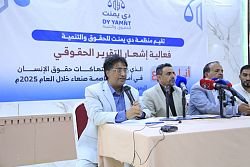
A new human rights report has documented 761 violations attributed to the Houthi movement in the Yemeni capital, Sana’a, and its surrounding districts during 2025, painting a detailed picture of life under the group’s control. The report was issued by D-Yemen for Rights and Development under the title “I Am Hungry”, a phrase chosen to capture what the organisation described as a deliberate squeezing of citizens’ basic needs alongside the suppression of their freedoms. According to the document, the recorded total represented an increase of roughly ten per cent on the previous year, suggesting a worsening environment for residents of the capital.
Arbitrary arrest emerged as the single most common abuse, with the report listing 162 such cases over the course of the year. The organisation framed these detentions as part of a broader campaign to intimidate the population and silence potential opposition, arguing that the threat of being seized without charge has become a defining feature of daily life. Alongside these arrests, the report catalogued attacks on private property and the private sector, violations of the right to life, sectarian indoctrination, politically motivated trials and torture in detention, as well as abuses touching on education, employment, religious freedom and expression.
The timing of the violations followed a discernible pattern. The report identified September as the worst month, with 107 incidents recorded, and linked the spike to a crackdown on people marking the anniversary of the 26 September Revolution, a date of considerable symbolic importance in Yemen’s modern history. The concentration of abuses around that commemoration was presented as evidence that the authorities in Sana’a regard expressions of rival political memory as a threat to be managed through force, targeting those who sought to celebrate a milestone associated with the founding of the modern republic.
Among the most serious findings was the scale of abuses directed at humanitarian organisations and United Nations personnel, with the report recording 129 separate incidents. These were said to include the detention of dozens of aid workers and the enforced disappearance of others, actions the report argued were intended to tighten control over the flow of assistance and the agencies that deliver it. The targeting of aid staff has been a recurring concern for international organisations operating in Houthi-held areas, where access and the safety of personnel have repeatedly come under pressure.
The report tied these patterns together as a systematic strategy rather than a series of isolated incidents. It described what it called a campaign of deprivation, in which control over food, employment and movement is used as a lever of political control, leaving citizens dependent and vulnerable. By denying people both material security and the space to dissent, the organisation argued, the authorities reinforce their grip while deepening the hardship already produced by years of war. The choice of title, “I Am Hungry”, was meant to encapsulate this fusion of economic pressure and political repression.
On the basis of its findings, D-Yemen for Rights and Development directed a series of appeals to the international community. It called on the United Nations and the Security Council to move beyond statements of concern towards concrete measures, including the establishment of an independent international body empowered to help halt ongoing abuses, pursue accountability for those responsible and strengthen protection for humanitarian workers operating in the country. The organisation argued that sustained external attention was essential if documentation was to translate into meaningful consequences for perpetrators.
The report also pressed for practical steps to reduce the dangers facing civilians, among them the removal of military assets from residential areas. Rights groups have long warned that the placement of weapons and fighters within populated neighbourhoods exposes ordinary people to grave risk and blurs the distinction between combatants and civilians that international humanitarian law is designed to preserve. Ensuring accountability for past violations, the organisation argued, is inseparable from preventing future ones, and it urged that protection of civilians be treated as an immediate priority rather than a long-term aspiration.
The findings sit within the wider context of a conflict that escalated sharply in 2015 and has since produced one of the world’s most severe humanitarian emergencies. United Nations agencies have estimated that a large proportion of Yemen’s population requires some form of assistance and that millions have been displaced from their homes. The Houthi authorities control Sana’a and much of the north, while the internationally recognised government operates from elsewhere in the country, a division that has entrenched parallel systems of authority and complicated efforts to monitor conditions on the ground.
The geographic scope of the documentation, covering Sana’a and the districts around it, was intended to give a comprehensive view of conditions in an area firmly under the movement’s authority. By compiling cases month by month and categorising them by type, the report sought to move beyond anecdote towards a structured account that could withstand scrutiny and be compared across time, allowing trends such as the year-on-year increase to be identified. That methodical approach, the organisation suggested, was designed to make the findings harder to dismiss and more useful for any future accountability process.
For the residents of the capital, the report’s catalogue of abuses translates into the texture of daily life: the fear of arbitrary detention, the difficulty of speaking freely and the uncertainty that comes with depending on aid that can be disrupted at any moment. Documentation of this kind is intended to ensure that such experiences are recorded rather than forgotten, and to build a body of evidence that could support future efforts at accountability. Whether that evidence leads to action, however, will depend on the willingness of international actors to respond to the report’s appeals.
About the Author