Houthi strikes shut Yemen’s Mokha port, costing 1,500 workers their jobs
 Yemen Herald News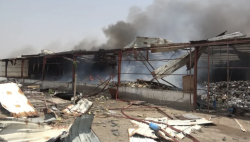
MOKHA, Yemen — Yemen’s Mokha port has been out of operation since mid-August after repeated Houthi missile and drone strikes, its director says.
More than 1,500 port workers lost their jobs when operations stopped, Abdulmalik al-Sharabi, the port’s director, told Al Jazeera. He said 16 people were killed and 22 injured in the attacks on the facility and the areas around it.
The port sits on Yemen’s Red Sea coast in Taiz province, a short distance from the Bab al-Mandab Strait.
At least six merchant vessels carrying commercial cargo have been struck since the escalation began, al-Sharabi said. Strikes hit commercial and service areas, workshops, equipment and the pier, he said, destroying it to the point that the port ceased operations.
Work at 30 shipping and customs clearance agencies has stopped.
The escalation began on Aug. 9. Al Jazeera reported that strikes on the port that day killed at least seven people and wounded 30.
Government military media put the toll at four soldiers and three civilians killed and 15 wounded, Asharq Al-Awsat reported the following day. That account said 11 Houthi drones were shot down.
Two days later the Houthis struck a vessel at the port. Al Jazeera reported three Pakistani crew members killed and eight other seamen injured. Human Rights Watch, in an Aug. 26 briefing, said the attack on the ship Tihama reportedly killed four crew members and injured many others.
Two cargo ships were hit three days after that, damaging what infrastructure remained. Operations were suspended to keep workers off the docks.
Mohammed al-Homaidi, a labourer in his 30s, had worked at the port since it reopened in 2021.
“It was around 12:30pm when the explosions were heard at the seaport, which was full of workers at the time,” he told Al Jazeera. “We couldn’t flee because the explosions were continuous.”
He said he ran from the port after about an hour and a half and did not stop until he reached home.
Daily wages were his only income. “I don’t have any savings, and our food at home is running out,” he said.
Fishing, the town’s other industry, has also stopped. Local authorities ordered fishermen not to put to sea until further notice.
A group went out anyway on Aug. 11 and did not return. Families were still searching for them when Al Jazeera reported from Taiz on Aug. 21.
Abdulraoof Abdullah, a fisherman in his 50s who supports eight people, has not been out since that day.
“We are out of work now, and our homes are almost empty of food,” he said. “We try to secure meals each day either by going into debt or asking friends for help.”
Cargo bound for Mokha is being redirected to Aden, adding overland haulage costs on top of Red Sea freight rates that have already risen.
One local trader, who gave only his first name, Rashad, said his goods were held up in Djibouti. Warehouses in Mokha still hold stock from earlier orders, so shelf prices have not moved yet.
“Unless Mokha seaport reopens soon, price hikes will be inevitable,” he said.
The port was closed from 2015 to 2021. Since reopening it has served Taiz governorate and trade routes into Lahj, Hodeidah and Ibb.
Public beaches, parks and the coastal walkway are closed. A curfew on motorcycles runs from 11pm to 6am. Landline and mobile communications have been cut, and residents who can afford it rely on satellite internet.
Local sources told Asharq Al-Awsat that the Aug. 9 missiles were fired from the Houban area of eastern Taiz, and that a booby-trapped vessel was also used against the port. The same report said drones struck housing for port employees and for staff of the Saudi hospital in the city.
That report also said the governor of Hodeidah survived an attack on his residence in Khokha, in the south of that province.
Rashad al-Alimi, chairman of the Presidential Leadership Council, briefed the US chargé d’affaires, Neil Hop, on the attack on Aug. 9. He described a systematic war against Yemen’s economic facilities and said Iran was behind the escalation. The Houthis reject that account and present their operations as a response to the government and its backers.
Riyadh Aldubai, a Yemeni political activist, told The National the attacks were “a war that the Houthi militias are waging to destroy economic institutions and Yemen’s infrastructure,” and said Mokha was among the targets.
Attacks along the coast have continued. The Yemeni armed forces said on Sept. 3 that the Houthis had fired 14 ballistic missiles at western coastal districts of Taiz and Hodeidah, with drones launched at the same time.
Yemen’s information minister, Moammar al-Eryani, wrote on X that “the Houthi threat is no longer confined to Yemen and international shipping in the Red Sea, but rather to regional and international security.” He asked for political, military, security and intelligence support for the government.
Fighting resumed this year after four largely quiet ones. A UN-mediated truce agreed in 2022 expired within months, but large-scale combat between the Houthis and government forces had mostly stopped until 2026. The UN envoy warned on Aug. 13 that Yemen was at serious risk of returning to large-scale conflict.
Human Rights Watch said in August that more than 22.3 million people in Yemen need humanitarian assistance.
Mokha handled coffee exports for centuries and gave its name to the drink.
About the Author