Japan condemns Houthi attacks on civilians in Yemen and Saudi Arabia
 Yemen Herald News
Japan has strongly denounced a series of attacks by Yemen’s Houthi movement on civilians and civilian facilities in Yemen and Saudi Arabia, saying assaults of that kind cannot be tolerated. In a statement issued on 11 August 2026, Japanese Press Secretary Kitamura Toshihiro set out Tokyo’s position on an escalation that has drawn in commercial shipping in the Red Sea, oil installations inside Saudi Arabia and a displacement camp in Yemen.
The statement traced the current round of violence to 20 July, when the Houthis declared a naval blockade against Saudi Arabia. Since that announcement, Japan said, the group has attacked Saudi crude oil tankers navigating the Red Sea as well as other facilities inside the kingdom, among them oil-related installations and civilian airports, leaving civilians injured.
Japan also pointed to the Houthis’ continuing military activity inside Yemen itself. It singled out an attack on a camp for internally displaced people on 7 August, which it said caused civilian casualties. Tokyo did not identify the camp or give a figure for the dead and wounded.
The ministry framed the issue in terms of both principle and interest, saying peace and stability in the Middle East, including free and safe navigation, are of the utmost importance to the international community. Attacks on civilians and civilian facilities, it added, cannot be tolerated. Japan called on the Houthis to refrain from escalating the situation, and said it would continue to make every diplomatic effort, in cooperation with the international community, to promote stability in the region.
The statement landed at the end of one of the bloodiest weeks Yemen has seen in years. On 7 August, Major-General Turki al-Maliki, spokesman for the Saudi-led coalition backing Yemen’s internationally recognised government, said a Houthi attack on the kingdom’s southern Najran province had wounded 11 people. According to his account they included seven Saudis, one Yemeni, two Egyptians and one Pakistani national, among them a four-year-old child who suffered second-degree burns. Al-Maliki accused the Houthis of shelling civilian areas indiscriminately in violation of international humanitarian law.
Inside Yemen the toll was heavier. Yemeni government sources told Al Jazeera that at least 30 soldiers were killed and 15 wounded on 6 August when eight missiles fired from al-Jawf governorate struck al-Thiniya and al-Abr in Hadramout and al-Rouk in Marib. The targets were camps belonging to the Homeland Shield Forces, the Emergency Forces and the First Military Region. Casualties were high, the First Emergency Division Command said, because troops had gathered for a morning training exercise.
The following day the Houthis launched at least a dozen further missile attacks on Hadramout and Marib, two of the government’s remaining strongholds, and Yemeni state television reported that air defences had shot down drones over Marib.
On 9 August the group struck the Red Sea port of al-Makha. Houthi military spokesman Yahya Saree said the operation used a large number of ballistic missiles and drones and was aimed at Saudi soldiers and equipment. A Yemeni military spokesperson put the death toll at seven, and the Ministry of Transport said the port’s infrastructure had suffered serious damage.
Hours later a fire broke out at an Aramco refinery in the Saudi Red Sea city of Jizan. The Saudi Ministry of Energy said the blaze was extinguished and that no casualties were reported, without stating a cause. The Houthis subsequently claimed a drone strike on the site, with Saree describing it as a response to Saudi drone incursions over the provinces of Saada and Hajjah. Riyadh did not immediately comment on the claim.
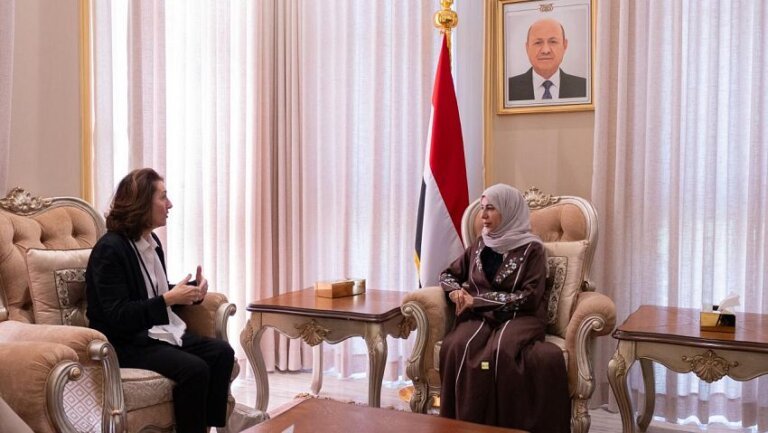
Rashad al-Alimi, chairman of Yemen’s Presidential Leadership Council, briefed the United States charge d’affaires to Yemen, Neil Hop, on the developments the same day. According to a statement from his office, al-Alimi argued that the international community, and Washington in particular, needed to move beyond containing the Houthi threat to addressing its sources and instruments.
The maritime dimension is what gives the crisis its global reach. The Bab al-Mandab Strait, which links the Red Sea to the Gulf of Aden, carries roughly 30 percent of the world’s container traffic and between 12 and 15 percent of global trade. Saudi Arabia announced in late July that it was assembling an international coalition to protect Red Sea shipping, and said 13 countries had agreed to take part. Brent crude, already volatile since the start of the year, rose above 83 dollars a barrel as the attacks intensified.
Analysts have linked the escalation to the wider regional confrontation. Ahmed Nagi, senior Yemen analyst at the International Crisis Group, told Al Jazeera that the stalling of the political track had convinced the Houthis they could apply more pressure on Riyadh, and that tensions between the United States and Iran had shaped the timing.
The war itself is now more than a decade old. The Houthis seized Sanaa in 2014; a Saudi-led Arab coalition intervened the following year and fought until a truce took hold in 2022. Hundreds of thousands of people have been killed, and the group still controls the capital and much of the north.
For Japan, which imports the overwhelming majority of its crude oil from the Gulf, the security of the Red Sea and Bab al-Mandab is a direct economic concern as well as a diplomatic one. Tokyo maintains relations with Yemen’s internationally recognised government and has consistently backed a negotiated settlement. The Houthis had not publicly responded to the Japanese statement.
About the Author