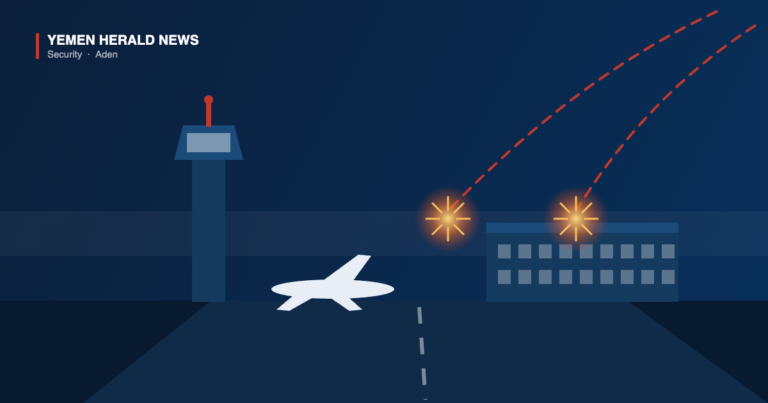
Drones Strike Kuwait International Airport, Causing Material Damage
 Yemen Herald News
Drones struck Kuwait International Airport, causing material damage to airport property, Kuwaiti authorities said. The attack forms part of a sustained campaign of drone and missile launches that has repeatedly reached Kuwaiti territory since the regional conflict escalated.
Airport infrastructure occupies a particular place in that campaign. A civil airport is a dual-use asset in practice, handling commercial passenger traffic while also serving as a logistics node, and strikes against one carry consequences that extend well beyond the damage inflicted. Even limited physical damage can suspend operations while runways and taxiways are inspected for debris, since a fragment on a runway surface is enough to destroy an aircraft engine on take-off.
Kuwait International is the country’s only major commercial airport, which makes the disruption more acute than it would be in a state with alternative fields. Kuwait has a large expatriate population and depends on air links for the movement of workers, for medical evacuation and for a substantial share of high-value freight. Interruptions to the airport therefore reach into ordinary life quickly. Perishable imports, pharmaceutical shipments and courier freight all move through the same facility, and there is no domestic road or rail alternative that reaches beyond Kuwait’s immediate neighbours.
The strike fits a pattern Kuwaiti forces have described in some detail. The armed forces reported one 24-hour period in which they intercepted nine ballistic missiles, four cruise missiles and 31 hostile unmanned aerial vehicles over the country. Authorities said drone attacks caused direct damage to two electricity generation and water desalination facilities, to several installations belonging to the Kuwait National Petroleum Company, to a residential compound in the oil sector and to a building within a ministerial complex. Separately, a drone strike started a fire in a residential building in the south of the country that injured two people.
Air defence over an airport presents a specific difficulty. Interceptors and anti-aircraft fire generate falling debris, and an airport is one of the few environments where debris on the surface is itself a hazard capable of causing a catastrophe. Authorities across the Gulf have had to weigh the benefit of engaging a target against the risk created by the engagement, and civil aviation authorities have responded by closing airspace pre-emptively rather than attempting to operate through an attack. Clearing and re-inspecting a runway after an engagement can take hours, and the inspection has to be repeated after each subsequent alert.
Those closures have had wide effects. Airspace over the Gulf normally carries a dense flow of traffic between Europe, Asia and Africa, and the region’s carriers have built their business models on connecting passengers through Gulf hubs. Repeated closures have forced diversions, cancellations and long re-routings, and have stranded residents abroad. The United Arab Emirates found it necessary to allow residents whose residency permits expired while they were outside the country because of airspace closures to return without obtaining fresh entry visas, an indication of how many people were caught out by the disruption.
The broader escalation dates to 28 February 2026, when a crisis centred on the Strait of Hormuz drew in Iran, the United States, Israel and international shipping companies. A United States-led aerial campaign against Iranian targets followed, alongside a naval blockade of Iran, and disruption to energy shipments through the strait has produced a global fuel crisis. Gulf states that are not parties to the fighting have nonetheless had their airspace crossed and their air defences engaged.
Kuwait has consistently said it is not a participant in the hostilities and has called for de-escalation while defending its airspace. The government has attributed the wider campaign against its territory to Iranian forces, in line with statements from other Gulf capitals, though it has not always assigned attribution for individual incidents. Iran has generally framed its operations as retaliation for strikes on its own territory and has warned states hosting foreign military facilities that those facilities may be treated as legitimate targets.
That warning is the crux of the exposure for Kuwait and its neighbours. Several Gulf states host United States military personnel and installations, and Kuwait has been a significant logistics hub for American forces in the region for more than three decades. A state can declare itself a non-belligerent, but it cannot easily separate its civilian infrastructure from military infrastructure that an adversary has declared a target, particularly where both sit within a small national territory.
Authorities did not publish a detailed account of what at the airport was damaged, whether operations were suspended and for how long, or whether anyone was injured. Damage described as material rather than structural generally indicates harm to property without casualties, though the term leaves considerable range. Assessments of this kind are often revised once engineers have examined systems that are not visible from the apron, including fuel lines, lighting circuits and navigation aids.
Aviation authorities in the Gulf have issued repeated notices to airmen during the conflict, and several carriers have suspended or rerouted services to the region. Insurance costs for aircraft operating into affected airports have risen, which compounds the commercial pressure created by the closures themselves and has made some routes uneconomic to maintain even when the airspace is open.
About the Author