Six Vessels Attacked in the Gulf and Strait of Hormuz as Traffic Falls to a Trickle
 Yemen Herald News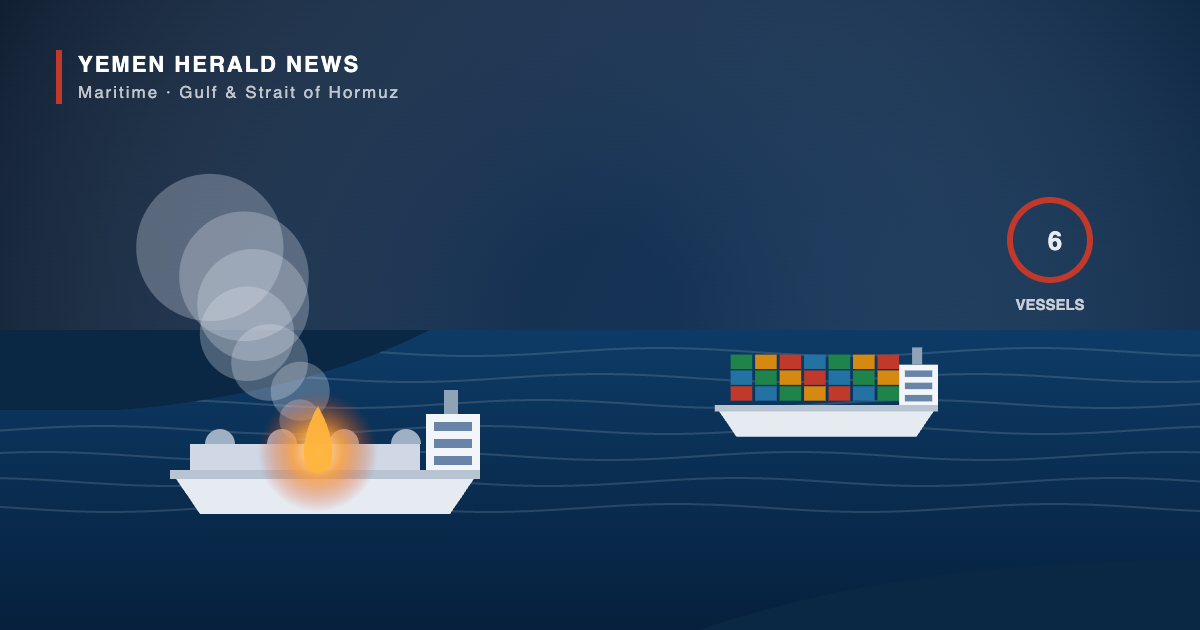
Six merchant vessels have been attacked in the Gulf and the Strait of Hormuz, in an escalation that has placed commercial shipping directly on the front line of the regional conflict and driven transits through the strait down to a trickle.
Four vessels were struck by projectiles in the strait itself. Separately, two fuel tankers were attacked in Iraqi waters by explosive-laden boats, a method that requires proximity and suggests a deliberate close-quarters operation rather than a stand-off strike. One crew member was killed in that attack and fires broke out aboard the ships. The incidents bring the number of vessels targeted since hostilities escalated to at least sixteen.
The Strait of Hormuz is the most consequential maritime chokepoint in the energy trade, carrying close to a fifth of the world’s oil supply. At its narrowest it is around 33 kilometres wide, with shipping lanes narrower still, and every vessel transiting it passes within range of the Iranian coast. There is no alternative sea route out of the Gulf, and the pipeline capacity that bypasses the strait can absorb only a fraction of normal volumes. Saudi Arabia’s east-west pipeline to the Red Sea and the Emirati line to Fujairah were built precisely for this contingency, but together they fall well short of the throughput the strait handles in normal conditions.
Traffic has fallen sharply. Observable transits have been reduced to a trickle as owners and charterers weigh the risk to crews and hulls against the freight on offer, and as Iranian threats against shipping have continued. Vessels that do transit have altered their practices, with some crossing in daylight, some in convoy and some choosing to keep transponders active near the Iranian coast in the hope that visible identification reduces the chance of being mistaken for a hostile contact.
The crisis dates to 28 February 2026, when confrontation over the strait drew in Iran, the United States, Israel and the shipping industry. A United States-led aerial campaign against Iranian targets followed, together with a naval blockade of Iran. The combination of a blockade and attacks on merchant traffic has produced a global fuel crisis, with prices and freight rates responding to the reduction in volumes leaving the Gulf.
Iranian state media has also reported interdictions short of attack. Tehran said that on 26 July six vessels attempting to transit the strait by a route other than the designated traffic lanes were stopped by the Revolutionary Guard Corps navy with warning shots and turned back. Iran has asserted the right to police transits through waters it considers within its jurisdiction, a claim contested by the United States and by shipping states that regard the strait as subject to the right of transit passage under the law of the sea.
The burden of the escalation falls disproportionately on seafarers, most of them nationals of countries with no involvement in the dispute. Crews on bulk carriers, tankers and gas ships are typically drawn from the Philippines, India, Indonesia and China, and they have limited practical ability to refuse a voyage without losing their employment. Maritime unions and shipowner associations have pressed for the strait to be treated as a high-risk area with corresponding protections, and for crews to retain the right to decline transits. Insurers have extended additional compensation terms for voyages into the area, though such terms address the consequences of an attack rather than reducing the likelihood of one.
Commercially, the effects run through insurance first. War risk premiums for Gulf transits have risen steeply, and underwriters have in some cases declined cover altogether for particular routes or flags. Where cover is available, the additional premium is charged per voyage and can amount to a substantial share of the freight, which pushes marginal cargoes off the water entirely. Charterers have responded by seeking supply from outside the Gulf where they can, which lengthens voyages and ties up tonnage.
Naval escorts have offered partial mitigation. Warships can deter some forms of attack and can respond to distress calls, but they cannot protect every vessel across a strait that carries heavy traffic, and they are of limited use against small explosive-laden craft that can approach from the shore at short notice. The attack on the two tankers in Iraqi waters illustrates that difficulty, since it took place away from the strait itself in an area where escorting is thinner.
For Gulf producers, the constraint is on exports rather than on production. Crude that cannot be loaded and moved accumulates in storage until storage fills, at which point production has to be curtailed. Several regional economies depend on hydrocarbon export revenue for the bulk of government income, so a sustained reduction in transits translates fairly directly into fiscal pressure. The states best placed to absorb that pressure are those with large sovereign reserves; smaller producers have far less room before spending has to be cut.
Neither Iran nor any other party claimed responsibility for the individual attacks on the six vessels, and the projectiles that struck the four ships in the strait were not publicly identified. Attribution in the maritime domain is frequently slow and contested, resting on fragment analysis and on tracking data that is not always released. What is not in dispute is the trend: the number of vessels hit continues to rise, and the volume of traffic willing to make the passage continues to fall.
About the Author