Kuwait Says Drones Struck Fuel Tanks at Kuwait International Airport
 Yemen Herald News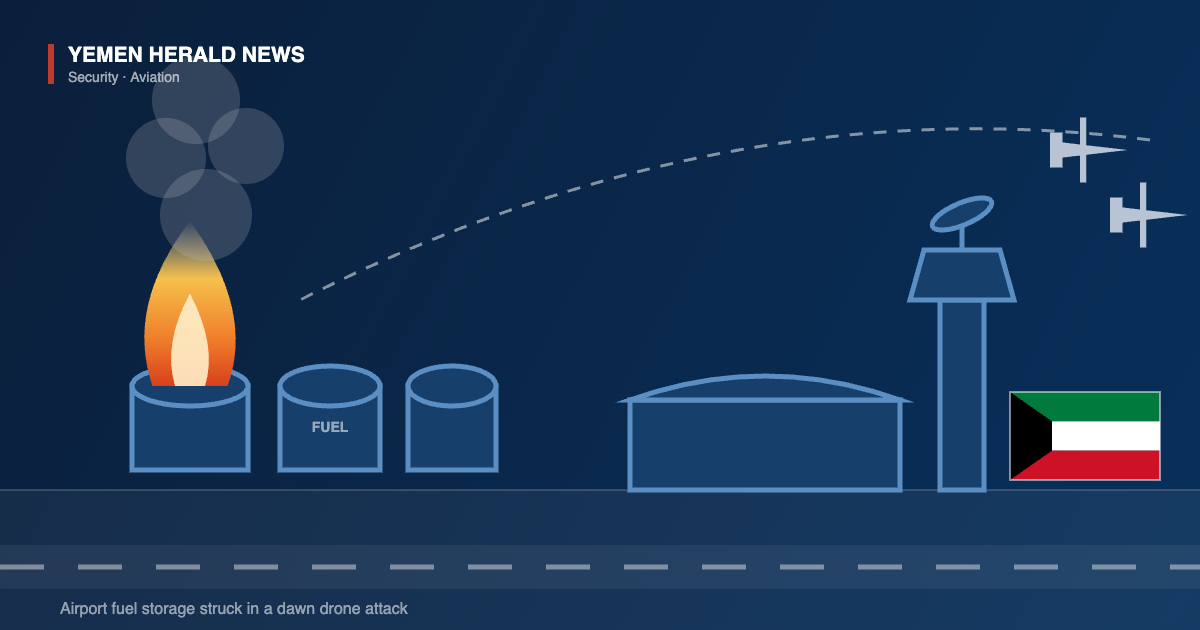
Kuwait’s Ministry of Defence said drones struck fuel storage tanks at Kuwait International Airport at dawn on 8 March 2026, describing the strike as direct targeting of vital infrastructure. In a statement on its official account on X, the ministry said the armed forces had dealt with a wave of hostile drones that breached Kuwaiti airspace overnight.
The attack set fuel tanks alight, and reporting at the time described a substantial blaze at one of them. The ministry said the strike was aimed specifically at the airport’s fuel storage facilities rather than at terminals or aircraft, a distinction that mattered operationally: fuel farms are static, easy to locate and, when damaged, capable of grounding an airport without any damage to the runway itself.
The ministry said the armed forces had intercepted seven drones over northern and southern parts of the country the previous day. Those engagements caused material damage from falling debris but no injuries. It also clarified that explosions heard across several areas were the sound of air defence engagements rather than impacts — a clarification Gulf defence ministries issued repeatedly during this period to head off panic and rumour.
Aviation fuel farms are among the more difficult assets to protect. They sit in the open on airport perimeters, are impossible to conceal, and hold large volumes of a highly flammable product in a small number of tanks. Fire crews at major airports train for exactly this scenario, but a tank fire draws down the airport’s own emergency capacity for as long as it burns, which is why a single successful strike on a fuel farm can suspend operations well beyond the physical damage caused.
The airport was struck repeatedly over the following weeks. Kuwait’s civil aviation authority and defence ministry reported further attacks through March: on 12 March drone debris severed power lines near the site, on the night of 14 March drones hit the airport’s primary surveillance radar, and on 24 March a fuel depot at the airport was struck again, with smoke visible across parts of Kuwait into late morning. Attacks on the airport continued into April.
The pattern indicates deliberate and sustained targeting of a single piece of national infrastructure. Kuwait International is the country’s principal civil aviation hub and the main route in and out for passengers and air freight. Damage to its radar, power supply and fuel storage degrades the airport’s ability to operate even when the runways and terminals are intact, and it forces a level of caution from airlines and insurers that outlasts any individual strike.
Radar and navigation systems are a particularly awkward target to lose. They are specialised, long-lead items that cannot be improvised, and their loss constrains traffic volumes and operating conditions until replacements are installed. Airlines serving the Gulf adjusted schedules and routings through this period, and some suspended services to affected airports entirely.
Radar and navigation systems are a particularly awkward loss. They are specialised, long-lead items that cannot be improvised, and their absence constrains traffic volumes until replacements are installed. Airlines serving the Gulf adjusted schedules and routings through this period, and some suspended services to affected airports.
Kuwait was one of several Gulf states under attack. The United Arab Emirates reported strikes on the Habshan gas facility and the Bab oil field, Qatar dealt with missile damage and fires at the Ras Laffan liquefied natural gas complex, and Saudi Arabia, Bahrain and Jordan all reported attacks over the same weeks. Each published its own interception figures, and each framed its response as defensive.
Kuwait was one of several Gulf states under attack. The UAE reported strikes on the Habshan gas facility and the Bab oil field, Qatar dealt with missile damage and fires at the Ras Laffan LNG complex, and Saudi Arabia, Bahrain and Jordan all reported attacks over the same weeks.
The wider war had begun in late February 2026, when the United States and Israel launched a joint offensive against Iran and Tehran began striking American and allied targets across the region. Attacks on Kuwait International Airport ran from the opening days of that campaign, making it one of the earliest and most persistently targeted civilian sites in the Gulf.
Diplomatically, the Gulf states took the matter to the Security Council, which adopted Resolution 2817 on 11 March 2026 condemning in the strongest terms what it described as unprovoked missile and drone attacks by Iran against Gulf Cooperation Council states and Jordan. The airport was hit again the day after its adoption, and Gulf officials cited that sequence as evidence the resolution had not changed Tehran’s behaviour.
For Yemen, attacks on Gulf aviation infrastructure carry a specific significance. Yemeni civil aviation has itself operated under severe constraint for years, with limited routes and heavy dependence on a small number of regional hubs for onward connections, medical travel and the movement of aid personnel. Disruption at Gulf airports narrows an already narrow set of options for Yemeni travellers.
The fighting ran for another month. The United States and Iran agreed a ceasefire on 7 and 8 April 2026 that also covered Israel, ending more than five weeks of open conflict, though Gulf states reported drone activity within hours of the announcement and the truce frayed repeatedly through the months that followed. Repair and replacement of damaged airport systems continued well beyond the formal end of hostilities.
About the Author