Yemen’s Leadership Pushes for Stronger EU Partnership Amid Security and Economic Challenges
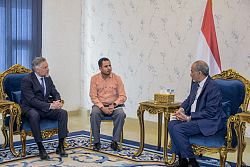
A high-level meeting in Aden between Lieutenant General Mahmoud Salem al-Subaihi, a member of Yemen’s Presidential Leadership Council, and Patrick Simonnet, Ambassador of the European Union, reflects growing efforts to deepen international cooperation as Yemen navigates a complex phase of political and economic transition.
The discussions centered on the evolving situation in Yemen and the role international partnerships can play in reinforcing stability and institutional recovery.
Stabilization Efforts and Institutional Reform
During the meeting, al-Subaihi outlined the government’s ongoing efforts to reestablish stability across the country. Central to these efforts is the work of the Presidential Leadership Council, which has been focusing on restructuring key state institutions and improving coordination within the security and military apparatus.
Unifying decision-making across security forces remains a critical objective, particularly in a fragmented environment where multiple actors have historically operated with limited coordination. Strengthening governance structures is also seen as essential for restoring public confidence and ensuring more effective service delivery.
Economic Pressures and Public Service Gaps
Beyond security concerns, Yemen continues to face significant economic challenges that directly impact daily life. Limited access to essential services, combined with broader financial constraints, has placed additional strain on communities.
Al-Subaihi emphasized that addressing these issues requires not only domestic reforms but also sustained support from international partners. Economic stabilization, improved infrastructure, and better service provision are all interconnected priorities that depend heavily on external cooperation.
Expanding Cooperation with the European Union
The European Union remains one of Yemen’s key partners in development and humanitarian support. During the talks, Yemeni officials expressed interest in expanding this relationship beyond immediate assistance to include long-term initiatives such as:
- Institutional capacity building
- Sustainable development programs
- Economic recovery strategies
Such efforts are viewed as crucial for creating a more resilient foundation for future growth.
Security Concerns and Regional Implications
A significant portion of the discussion also addressed ongoing security threats, particularly those linked to the Houthis. Al-Subaihi warned that these challenges extend beyond Yemen’s borders, carrying implications for regional stability and international security.
He called for a more coordinated global response to support the government’s efforts in restoring control and maintaining order. The issue underscores the broader geopolitical dimension of Yemen’s conflict, where local developments often intersect with regional dynamics.
EU Reaffirms Commitment
In response, Ambassador Patrick Simonnet reiterated the European Union’s commitment to supporting Yemen during this critical period. He emphasized the importance of continued collaboration with the Presidential Leadership Council to advance security, governance, and development objectives.
The EU’s position reflects an ongoing strategy to balance immediate humanitarian needs with longer-term institutional support.
Looking Ahead
The meeting highlights a shared recognition that Yemen’s recovery will depend on both internal reforms and sustained international engagement. While progress remains gradual, strengthening partnerships with global actors like the European Union could play a pivotal role in shaping the country’s path forward.
As Yemen works to stabilize its political and economic landscape, cooperation with international partners is becoming increasingly vital. The dialogue in Aden signals a continued commitment to building that cooperation, to address immediate challenges while laying the groundwork for long-term recovery.
About the Author