
Al-Subaihi and EU Ambassador Discuss Stability and Institutional Reform
 Yemen Herald News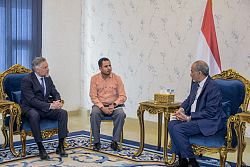
Yemen’s al-Subaihi and the EU ambassador have discussed stability and institutional reform, in talks that reflected continuing efforts to deepen international cooperation as the country navigates a difficult phase of political and economic transition. Lieutenant General Mahmoud Salem al-Subaihi, a member of the Presidential Leadership Council, met Patrick Simonnet, the Ambassador of the European Union, in Aden, focusing on the evolving situation in the country and on the role that international partnerships can play in reinforcing stability and institutional recovery.
During the meeting, al-Subaihi outlined the government’s ongoing efforts to re-establish stability across the country. Central to these efforts, he indicated, is the work of the Presidential Leadership Council, which has focused on restructuring key state institutions and improving coordination within the security and military apparatus, an undertaking regarded as essential to the government’s capacity to function and to maintain order.
Unifying decision-making across the security forces remains a critical objective, particularly in an environment where authority has been fragmented and multiple actors operate. Bringing greater coherence to the command and coordination of security institutions is seen as central to their effectiveness and to the broader effort to strengthen the state and assert its authority.
The Presidential Leadership Council, established in 2022, was created to unify the various anti-Houthi factions under a single leadership structure. Its efforts to restructure institutions and improve coordination reflect the challenges of governing a fragmented environment, in which building coherent and effective institutions is both essential and difficult.
The European Union has been among the more prominent international partners engaged with Yemen, providing humanitarian, development and political support over the course of the conflict. Its engagement on questions of stability and institutional reform reflects a recognition that capable institutions are important to the country’s recovery and to the prospects for a durable peace.
The emphasis on institutional recovery speaks to a central challenge facing Yemen. Years of conflict have weakened the institutions of the state, and rebuilding their capacity is a prerequisite for effective governance, the delivery of services and the restoration of public confidence, making it a priority for the government and its partners alike.
The focus on the security and military apparatus reflects the importance of these institutions to stability. Coherent and effective security forces are essential to maintaining order and countering threats, and efforts to improve their coordination and unify decision-making are central to the government’s ability to provide security across the areas under its authority.
The fragmented environment referenced in the discussions poses significant challenges to these efforts. With authority dispersed among various forces and actors, achieving coordination and coherence is difficult, and overcoming this fragmentation is among the central tasks facing the government as it seeks to strengthen the state and its institutions.
International partnerships, highlighted by al-Subaihi, can support these efforts by providing resources, expertise and backing. The engagement of partners such as the European Union can complement the government’s own efforts to strengthen institutions and to advance stability, contributing to the broader endeavour of recovery.
The political and economic transition that Yemen is navigating adds to the complexity of the situation. The country faces interlocking challenges across multiple domains, and progress in one area is often bound up with progress in others, requiring a comprehensive approach that international partners can help support.
The role of the European Union in supporting stability reflects its broader interest in Yemen and in the region. The bloc has engaged with the country across various dimensions, and its support for institutional reform and stability aligns with its wider objectives of fostering recovery and contributing to the prospects for peace.
The engagement between al-Subaihi and Simonnet forms part of the ongoing dialogue between Yemen’s leadership and its international partners. Sustained engagement at senior levels helps maintain and strengthen these relationships, and it provides opportunities to coordinate on the challenges facing the country and on the support required to address them.
The challenges of re-establishing stability and reforming institutions are formidable, and progress is likely to be gradual. Building coherent institutions and unifying decision-making amid fragmentation are demanding tasks, and their success will depend on sustained effort, resources and the evolution of the broader situation in the country.
The government’s emphasis on these efforts reflects its recognition of their importance to its objectives. Strengthening institutions and improving the coordination of security forces are central to the government’s capacity to govern and to provide security, and the priority attached to them reflects an awareness of their significance to stability and recovery.
The support of international partners will remain important to these efforts. With its own resources constrained, the government relies on the backing of partners such as the European Union to advance its agenda, making the cultivation and maintenance of these relationships a continual priority as it pursues stability and reform.
For now, the meeting reaffirmed the shared interest of Yemen’s leadership and the European Union in advancing stability and institutional recovery. As the country navigates its complex transition, cooperation of this kind remains an important element of the effort to strengthen the state, improve the coordination of its institutions and lay the foundations for a more stable future.
About the Author




