Masam removes 863 mines in a week and passes 589,000 cleared since 2018
 Yemen Herald News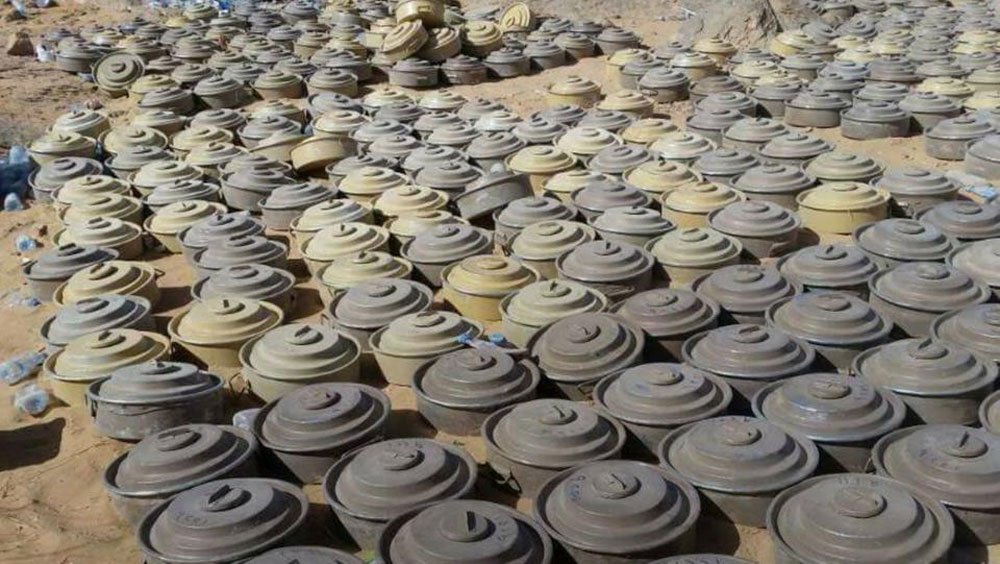
ADEN, Yemen — The Saudi-funded Masam demining project said it removed 863 mines and explosive devices across Yemen during the first week of September, the state news agency Saba reported.
Teams cleared 194,994 square metres of land over the period, the project said.
The tally comprised 384 pieces of unexploded ordnance, 470 anti-tank mines, six anti-personnel mines and three explosive devices, according to the figures carried by Saba.
In Midi district of Hajjah governorate, Masam has removed 13,036 mines and explosive remnants and cleared 4,749,003 square metres since it began work there, the project said.
Masam director Osama al-Qusaibi said the project has removed 589,188 mines and explosive remnants and cleared more than 85 million square metres across the country since it started in late June 2018.
The figures rest on Masam’s own reporting, relayed by Saba. No independent survey of the project’s clearance has been published, and Yemen Herald could not verify the totals separately.
Masam is run under the King Salman Humanitarian Aid and Relief Centre, the Saudi state aid agency. It works in government-held governorates and in areas recovered from Houthi control.
The project publishes a weekly tally. Saba reported on 2 September that teams had removed 819 mines and explosive devices in the preceding week.
Anti-tank mines make up the largest share of most weekly totals. They are laid on roads and farm tracks and are set off by vehicles rather than by people walking.
The King Salman centre was established by royal decree in 2015 and is Saudi Arabia’s main channel for humanitarian funding. Yemen has been its largest single programme.
Masam employs Yemeni deminers trained and supervised by international specialists, and works with mechanical clearance equipment as well as manual teams.
Human Rights Watch and demining organisations have documented improvised anti-personnel mines in Yemen, including devices disguised as rocks and pressure-plate charges laid on footpaths.
Naval mines have also been reported off Yemen’s west coast, near Mokha and south of Hodeidah, and have been cited as a hazard to fishing boats and to shipping approaching the ports.
Landmine Monitor, which tracks casualties worldwide, has placed Yemen among the countries recording the highest annual numbers of deaths and injuries from mines and explosive remnants.
Clearance figures are usually reported as devices removed and square metres released. The second measure matters more for farmers, because land cannot be worked until it is formally released.
Yemen is among the countries most heavily contaminated by mines and explosive remnants of war. Contamination dates from the 1962-70 civil war, the 1994 conflict between north and south, and the fighting that followed the Houthi seizure of Sanaa in 2014.
Yemen acceded to the Anti-Personnel Mine Ban Convention in 1998 and declared its stockpiles destroyed in 2002. Fresh laying of mines since 2015 has been documented by rights groups, which have attributed most of it to Houthi forces. The movement denies laying mines in civilian areas.
Midi lies on the Red Sea coast near the Saudi border and was a front line for years. Farmland and fishing grounds there have remained closed because of contamination.
Clearance is slow and dangerous work. Masam has reported deminers killed and wounded in explosions during operations.
The National Mine Action Programme, a Yemeni government body, coordinates survey and clearance alongside Masam and the UN Development Programme.
Mines and unexploded ordnance restrict farming, block roads and delay the return of displaced families to their villages. Clearance is a condition for reopening land in recovered districts.
The work continues while fighting has resumed. Houthi forces launched simultaneous ground assaults in southern Hodeidah and in three districts west of Taiz on Thursday, according to Al Jazeera and Arab News, which described the attack as the largest since the UN-brokered truce of April 2022.
Government troops recaptured a hilltop in Jabal Habashi the following day, Arab News reported. The National reported that government forces counted 14 ballistic missiles fired at rural areas of Taiz and Hodeidah.
At least four civilians were killed and nine wounded in a missile strike on the Heijah al-Abd road south of Taiz on Saturday, Al Jazeera and The National reported. Both outlets attributed the attack to Houthi forces.
Hans Grundberg, the UN special envoy for Yemen, called the escalation extremely alarming and urged the parties to halt hostilities, his office said.
New fighting adds fresh contamination. Front lines that move leave behind unexploded shells and rockets that have to be surveyed before land can be released.
The UN Office for the Coordination of Humanitarian Affairs said nearly 1,800 families fled in less than 48 hours and that several displacement camps in Maqbanah and Jabal Habashi emptied under shelling. It said emergency stocks were severely depleted.
The United Nations humanitarian plan for 2026 counts more than 22 million people in Yemen needing assistance, of whom 18.3 million are acutely food insecure. It records 5.2 million people displaced inside the country.
The plan seeks 2.16 billion dollars to reach 12 million people. Mine action sits within its protection component.
Saba did not say how many teams Masam has deployed or in which governorates they worked last week.
About the Author