Masam teams clear 7,444 mines and unexploded ordnance across Yemen in two weeks
 Yemen Herald News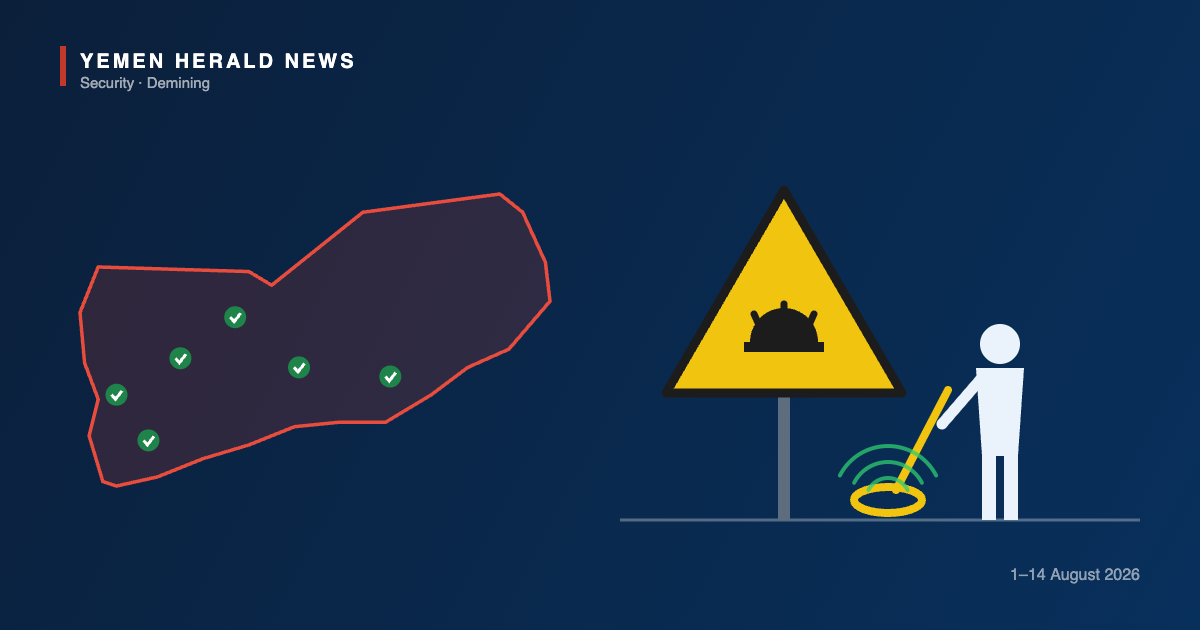
Teams working for the Saudi-funded Masam demining project cleared 7,444 landmines, items of unexploded ordnance and improvised explosive devices across Yemen during the first two weeks of August, in one of the programme’s heaviest fortnights of the year. The haul was made up of 7,226 items of unexploded ordnance, 137 anti-tank mines, 35 anti-personnel mines and 46 improvised explosive devices, according to figures released by the project.
The weighting of that total towards unexploded ordnance rather than laid mines reflects where Masam’s teams have been concentrating their effort. Much of the current work is on former front lines and coastal districts where artillery, mortar and air-delivered munitions failed to detonate and have since been buried by sand, floodwater or farming. Anti-tank mines, laid deliberately and far harder to locate, remain the deadliest category for civilians because a car or tractor is heavy enough to trigger them.
Masam is run by the King Salman Humanitarian Aid and Relief Centre, the Saudi government’s aid arm, and has operated in Yemen since June 2018. It is delivered by Saudi and international explosive ordnance disposal specialists working alongside trained Yemeni demining teams, and its managing director is Ousama Algosaibi. The project has expanded steadily as the scale of contamination has become clearer, and now fields 42 operational teams across the areas where it works.
The August figures sit within a run of unusually productive weeks. The project reported removing 1,448 devices in the final week of July, then 5,287 in a week reported on 11 August, a total that included 5,151 items of unexploded ordnance, 69 anti-tank mines, 24 anti-personnel mines and 43 improvised explosive devices. Individual operations have been larger still: teams destroyed 4,141 mines and remnants of war in Midi district in the north-western governorate of Hajjah, and more than 4,200 in the southern coastal governorate of Abyan.
Cumulatively, Masam puts the number of devices it has cleared and destroyed since 2018 at 585,670. The trajectory of its own reporting supports the scale of that claim: the project recorded 568,961 devices as of 19 June, 578,226 in early August and 583,513 in the report published on 11 August. Alongside the device count, Masam says it had cleared more than 83.7 million square metres of Yemeni land by the end of July, a measure that speaks more directly to how much ground has actually been returned to use.
Yemen is among the most heavily mine-affected countries in the world, and contamination has been identified across 14 governorates. The internationally recognised government accuses the Houthi movement of laying roughly two million mines and improvised devices indiscriminately during the war, a figure the Houthis reject and which independent monitors have not been able to verify. What is less disputed is the effect. Human Rights Watch has documented civilian deaths and lost livelihoods caused by mines in areas that changed hands during the fighting, and mine action agencies describe explosive remnants as one of the largest single causes of civilian casualties in the country.
The consequences outlast the fighting by years. Mines and unexploded ordnance close roads that aid convoys need, keep displaced families from returning to villages they left, and take farmland and grazing land out of production in a country where food insecurity is already acute. Survivors carry the cost permanently; a large share of those injured are left with amputations or other lifelong disabilities in a health system that has limited capacity to provide prosthetics or rehabilitation. Children, who are less likely to recognise a device for what it is, are consistently over-represented among casualties.
Yemen’s wider humanitarian picture gives that contamination its weight. United Nations assessments have put the number of Yemenis requiring some form of humanitarian assistance at more than 18 million, with millions displaced from their homes since the conflict escalated in 2015. Aid agencies have repeatedly identified mine clearance as a precondition for reaching populations that have been effectively cut off, and the UN has treated demining as an enabling activity for the rest of the humanitarian response rather than a separate technical exercise.
Funding for the project has been renewed. KSrelief extended Masam’s contract for a further year with financing of just over 52.5 million dollars, taking the programme into a ninth year of operations. The renewal matters because demining is slow, sequential work that loses value if it stops and starts: teams that are stood down lose accreditation and local knowledge, and cleared corridors can be re-contaminated if survey and follow-up are interrupted.
Clearance figures also need to be read carefully. A device count measures what has been found and destroyed, not what remains, and there is no agreed national survey of total contamination in Yemen against which progress can be checked. Risk education, marking of suspected hazardous areas and victim assistance are counted differently again, and are widely regarded as being under-resourced relative to clearance itself.
For now the immediate significance of the August total is practical rather than symbolic. Every device lifted from a road, a field or a schoolyard is one that cannot kill a farmer or a returning family, and the districts where Masam has been working this month are among those to which displaced Yemenis are most likely to return. Whether that progress compounds will depend on funding continuity, on access to areas still outside government control, and on whether a political settlement eventually removes the incentive to lay new devices.
About the Author