Morocco Move On From AFCON Title Row as Senegal Take Case to Sports Court
 Yemen Herald News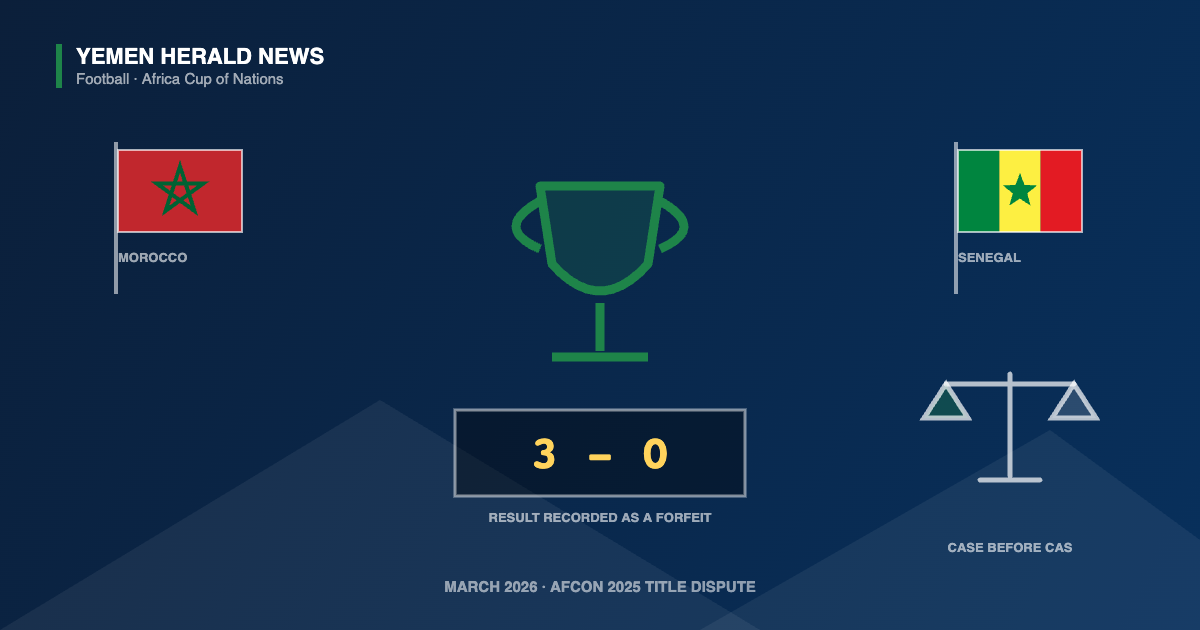
Morocco treated the 2025 Africa Cup of Nations title as settled at the end of March 2026, even as Senegal pursued the matter through the Court of Arbitration for Sport. The Moroccan squad had been declared continental champions by an administrative ruling rather than a result on the pitch, and the players and coaching staff spent the following weeks pointedly directing attention towards the World Cup instead.
The dispute began with the final itself, played in Rabat on 18 January 2026, which Senegal won 1-0 in extra time. In stoppage time at the end of normal play a Senegalese goal was disallowed and a penalty awarded to Morocco moments later. Several Senegal players left the pitch in protest before returning, and it was that departure, rather than the disputed refereeing decisions, that became the basis of everything which followed.
On 17 March 2026 the appeals board of the Confederation of African Football overturned the outcome of the final. It found that Senegal had forfeited the match and directed that the result be recorded as a 3-0 win for Morocco, the standard forfeit scoreline. Morocco were declared champions of a tournament they had lost on the field two months earlier.
The Senegalese Football Federation rejected the ruling and took the case to the Court of Arbitration for Sport, lodging its appeal on 25 March 2026. CAS confirmed that the appeal had been registered and that an arbitration panel had been appointed, while stating at that stage that it was too early either to set a hearing date or to indicate when a decision might follow. The court subsequently fixed a hearing for 8 October 2026.
The decision drew substantial criticism, not all of it from Senegal. Legal commentary at the time accepted that CAF had acted within its own regulations while arguing that awarding a continental championship in an appeal room carried a reputational cost for the confederation that outweighed the procedural correctness of the outcome. A tournament decided by administrative sanction is difficult to present as a sporting result, whatever the rulebook says.
Morocco’s answer was to keep playing. Their first fixture after the final was a friendly against Ecuador at the Riyadh Air Metropolitano in Madrid on 27 March 2026, which ended 1-1. John Yeboah put Ecuador ahead in the 48th minute, beating the Morocco goalkeeper Yassine Bounou, and Neil El Aynaoui headed an equaliser in the 88th. The match was played as a warm-up for the World Cup in North America.
It was also an early outing for a new head coach. Mohamed Ouahbi had been promoted from Morocco’s under-20 set-up on 5 March 2026, succeeding Walid Regragui, who had taken the senior side to the semi-finals of the 2022 World Cup. Ouahbi arrived with a reputation built on youth-level success and with very little time to prepare a squad for a tournament that was only months away.
The change of coach so close to a World Cup was itself unusual. Regragui had been the most successful Morocco manager of the modern era, and replacing him weeks after a disputed continental final left Ouahbi to manage two things at once: the practical business of settling on a squad and a system, and the atmosphere around a team whose most recent trophy had arrived by post rather than on the pitch.
Bounou, speaking after the Ecuador match, stressed that the squad was concentrating on what lay ahead rather than on the controversy behind it. That framing was consistent across Moroccan statements through the period. Publicly accepting the CAF ruling while declining to dwell on it allowed the federation to hold the title without appearing to celebrate the manner in which it had been obtained.
What was at stake extended past the trophy itself. Continental titles feed into confederation rankings and seeding, into commercial arrangements, and into the standing a federation carries within CAF. For Senegal, having won on the field and then lost in an appeal, the reversal touched all of those and carried a public dimension at home that no legal argument could easily address.
Senegal’s position throughout was that the players’ brief departure from the pitch was a spontaneous reaction to a contentious refereeing sequence, that they returned and completed the match, and that a forfeit finding was disproportionate to what actually occurred. CAF’s position was that the regulations do not distinguish between a temporary and a permanent withdrawal once a team leaves the field of play during a match.
Cases of this kind rarely move quickly. CAS proceedings involve written submissions from both federations, from CAF as the body whose decision is under review, and often from third parties with an interest in the outcome. A hearing set for October, more than eight months after the final was played, was in that context a normal rather than a slow timetable.
The result of all this was a title held in one place and contested in another. Through the spring and summer of 2026 Morocco appeared in records as African champions while the question of whether they would remain so sat with an arbitration panel in Lausanne. For a competition whose value rests almost entirely on the clarity of its outcome, that was an uncomfortable position for everyone concerned.
About the Author