IOM records more than 10,000 people displaced across Yemen since January, over half in Marib
 Yemen Herald News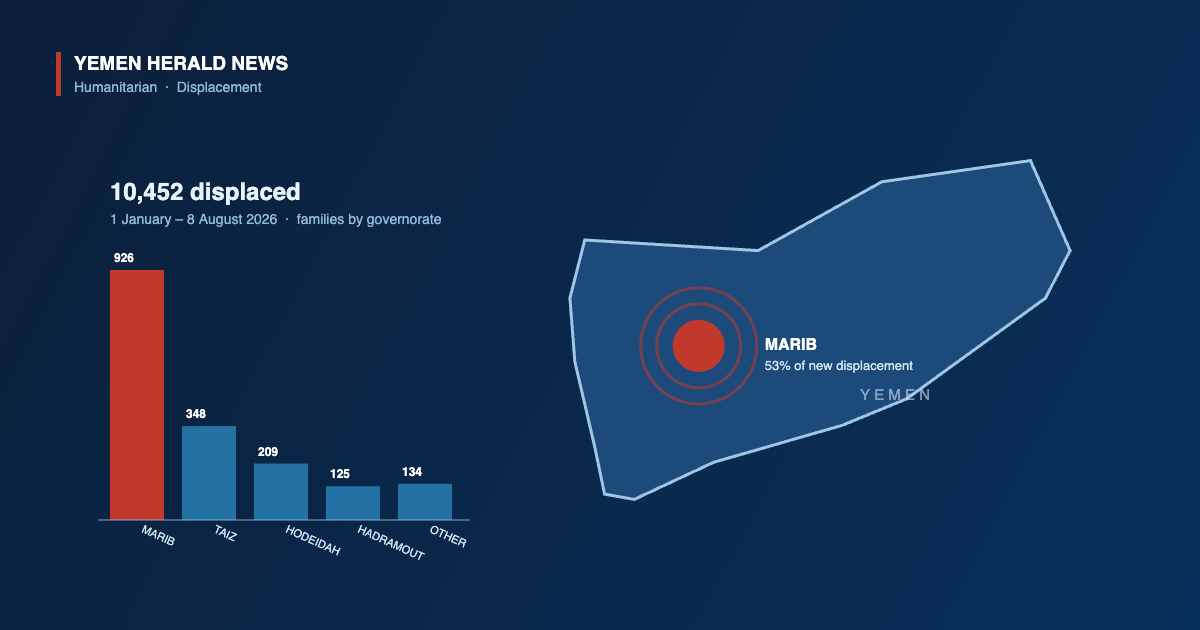
More than 10,000 people have been displaced inside Yemen since the start of 2026, and over half of them fled within a single governorate, Marib, according to the latest displacement tracking figures published by the International Organization for Migration. The tally, covering the period from 1 January to 8 August, records 1,742 families totalling 10,452 individuals who left their homes at least once during the first seven months of the year.
Marib alone accounted for 53 per cent of the new displacements, with 926 families registered. Taiz followed at some distance with 348 families, then Hodeidah with 209 and Hadramout with 125. The remaining cases were spread thinly across the rest of the country: 46 families in Lahj, 33 in al-Dhalea, 22 in Shabwa, 18 in al-Jawf, 12 in Aden and four in al-Mahra.
The concentration in Marib is not incidental. The governorate sits on the eastern edge of the highlands and holds Yemen’s most significant onshore oil and gas infrastructure, which has made it the single most contested piece of territory of the war. It has also absorbed one of the largest displaced populations in the country, and IOM said that escalating tensions, in particular Houthi attacks on Marib, have continued to drive people from their homes there.
Weekly figures show the tempo fluctuating rather than climbing steadily. Between 2 and 8 August the agency recorded 50 families, or roughly 300 people, displaced across the country, a drop of 28 per cent from the 69 families, some 414 people, logged the week before. Marib again led with 20 families, most of them arriving from Ibb and Sanaa, followed by Taiz with 14, Lahj with eight, Shabwa with seven and Hodeidah with one.
The pattern of movement in that week is telling. Families arriving in Marib from Ibb and Sanaa are moving from Houthi-controlled territory into a government-held governorate that is itself under attack, a calculation that speaks to how narrow the available options have become. Others were moving within governorates, shifting a few dozen kilometres to escape a specific front line rather than leaving the region entirely.
IOM’s Displacement Tracking Matrix also asked households why they moved. Security concerns were cited in 54 per cent of cases, natural disasters in 35 per cent and economic hardship in 24 per cent, with a single family reporting displacement for health reasons. The figures add to more than one hundred because households can give more than one reason, and in practice the categories overlap: a family driven out by shelling often cannot return because the local economy has collapsed.
The prominence of natural disasters in the data reflects a hazard that receives far less attention than the fighting. Yemen’s rainy seasons bring flash floods that tear through valleys and wash away the improvised shelters that displaced families build on marginal land. Camps sited on floodplains, often the only ground available, are repeatedly inundated, and the same households appear in the record year after year.
A further detail in the report points to displacement within displacement. IOM estimated that 60 families left existing displacement sites during the reporting period in search of safer areas, meaning they had already fled once and were moving again. Secondary displacement of this kind erodes what little stability people have rebuilt, and it complicates aid delivery, because assistance is usually registered against a fixed location.
The numbers should be read as a floor rather than a ceiling. The Displacement Tracking Matrix relies on a network of field monitors and community focal points, and coverage is uneven across areas controlled by different authorities. Movements that do not pass a monitored point, or that occur in districts where access is restricted, are unlikely to be captured, and short-distance flight within a village is rarely recorded at all.
Even so, the trend is legible against the wider situation. Yemen has seen intermittent fighting despite the relative lull that followed the United Nations-brokered truce of April 2022, and renewed clashes since July have pushed humanitarian needs upward in what remains one of the world’s most severe crises. More than 22 million people, roughly half the population, are estimated to need humanitarian assistance this year.
Displacement in Yemen is also overwhelmingly a long-term condition rather than a temporary one. Millions of people displaced in earlier phases of the war have never gone home, and the new arrivals recorded this year are joining settlements that have existed for the better part of a decade, competing for the same water points, the same overstretched clinics and the same shrinking rations.
Funding is the constraint that shapes everything else. The 2026 humanitarian response plan for Yemen remains financed at less than a fifth of what it requires, according to the International Rescue Committee, which forces agencies to ration shelter kits, cash assistance and clean water among people who have just lost their homes. Aid officials say that when a family arrives at a site and receives nothing, the practical consequence is another move, and another entry in next week’s displacement figures.
What happens next in Marib will largely determine the shape of the rest of the year’s figures. A sustained assault on the governorate would displace people on a scale far beyond the weekly totals now being recorded, and the humanitarian system that would have to absorb them is currently funded at a fraction of what it has requested.
About the Author