Houthi media acknowledges 84 fighters killed, including 28 field commanders
 Yemen Herald News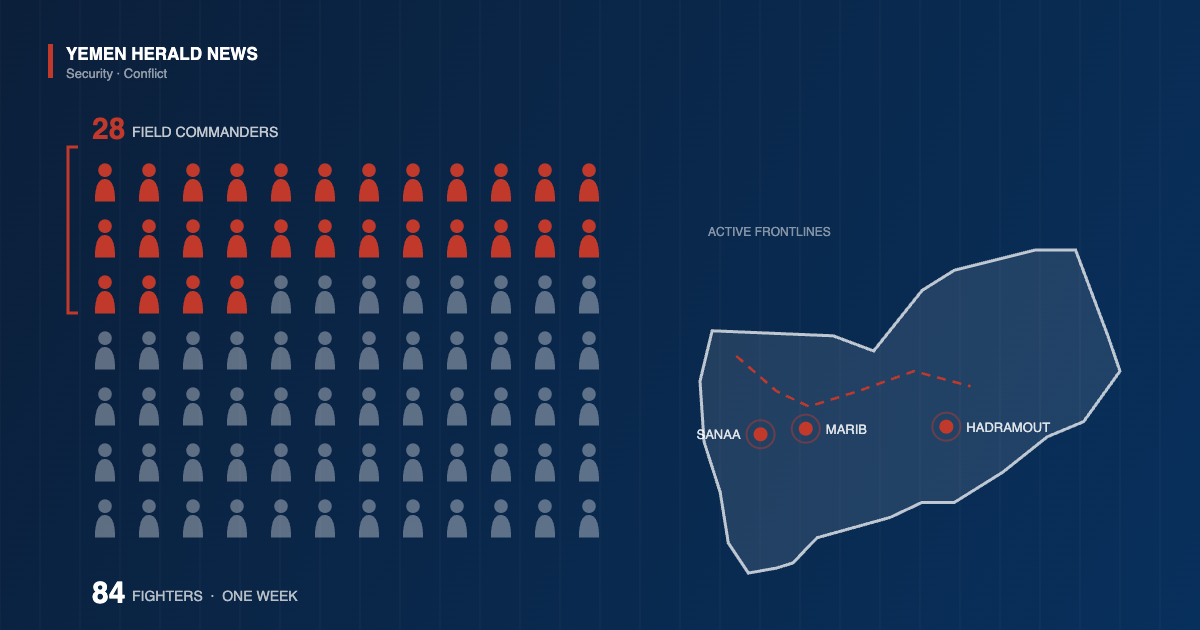
Houthi-aligned media has acknowledged the deaths of 84 of the group’s fighters over roughly a week, among them 28 field commanders, in one of the franker admissions of battlefield losses the movement has made since fighting along Yemen’s frontlines intensified in early August 2026. The figure did not come from a formal casualty statement. It was assembled from funeral notices, obituaries and commemorative coverage carried by outlets aligned with the group, and it has not been independently verified by the Yemeni government, the United Nations or international monitors.
According to that reporting, 47 of the dead were buried in ceremonies held over two consecutive days, including 14 officers. Forty of the men were from Sanaa province, with the remainder drawn from Dhamar, Amran, Hajjah, Saada, Mahwit and Ibb. The geographic spread is telling: it points to losses accumulating across several separate fronts over a short period rather than to a single catastrophic engagement, and it draws almost entirely on the northern highland provinces that form the movement’s core recruiting base.
The proportion of commanders among the dead is the detail that has drawn most attention. Twenty-eight field commanders out of eighty-four fighters is roughly one in three, a ratio far above what a conventional force would expect to lose. Military analysts generally read such a figure one of two ways: either senior personnel are being deployed unusually far forward, or the fighting has been concentrated in engagements where command posts themselves were exposed. Neither reading suggests a movement at ease.
The acknowledgement lands in the middle of the sharpest escalation Yemen has seen since the United Nations-mediated truce of 2022. On 6 August, Houthi forces launched missile attacks on Yemeni government military camps in the governorates of Hadramout and Marib. Yemeni military sources said eight missiles were fired from al-Jawf governorate, north of Marib, striking al-Thiniya and al-Abr in Hadramout and al-Rouk in Marib. Reported death tolls varied: Al Jazeera put the number of soldiers killed at a minimum of 30, with 15 wounded, while other outlets reported as many as 45 dead.
A day later, the government said a Houthi strike on Marib killed two civilians and wounded 14 others. Marib city is among the most sensitive targets in the country: it hosts more than two million of Yemen’s roughly five million internally displaced people, many of them living in camps on the city’s outskirts with limited protection from shelling. Aid agencies have repeatedly warned that sustained bombardment there would produce displacement on a scale the humanitarian response is not funded to absorb.
On 8 August the Yemeni Armed Forces announced a broad military operation against Houthi positions along multiple frontlines, presenting it as a direct response to the attacks in Marib and Hadramout. It was the first time in months that government forces had publicly announced a counteroffensive, and it marked a shift away from the largely defensive posture they had held through the long stalemate that followed the truce. Commanders also issued warnings against further escalation, a formulation that leaves room for de-escalation if the other side stands down.
The losses the Houthi movement has now acknowledged are consistent with that sequence of events, though the group has not linked them publicly to any particular operation. Attributing casualties to specific battles remains difficult. Neither side publishes verifiable battlefield data, both have clear incentives to shape the numbers, and independent access to the frontlines is minimal. What is clearer is that the tempo of fighting has risen sharply and that both sides are absorbing costs they had largely avoided for three years.
The maritime dimension compounds the risk. The Bab al-Mandab strait, at Yemen’s south-western tip, remains one of the world’s most heavily used shipping corridors, and attacks on commercial vessels transiting the Red Sea and the Gulf of Aden have drawn external navies and interests into what began as a domestic conflict. That entanglement makes the ground war harder to contain and harder to mediate, because the parties with leverage are no longer only Yemeni.
Briefing the Security Council on 13 August, the UN Special Envoy for Yemen, Hans Grundberg, warned that the country faces a more serious risk of a return to large-scale conflict than at any point since the 2022 truce. He said attacks on shipping were placing regional trade and energy flows under extreme pressure and risked drawing Yemen further into the wider confrontation across the Middle East, and he called for attacks and threats against vessels to stop, for freedom of navigation to be upheld and for cross-border attacks to end.
Whether the acknowledged losses change Houthi calculations is an open question. The movement has historically absorbed heavy casualties without altering its strategic course, and its command structure has proved able to replace field-level leaders. But the concentration of deaths among commanders, and the visibility of funerals held across the northern provinces in quick succession, carries a domestic political cost that raw numbers alone do not capture.
For now the trajectory points toward more fighting rather than less. The truce framework that held imperfectly since 2022 has not formally collapsed, but the assumptions underpinning it have. Diplomatic efforts continue, and both Yemeni and international actors have signalled they would prefer a negotiated path. What is missing is a mechanism to halt the current exchange long enough for talks to be convened, and neither side has shown willingness to move first.
About the Author