President al-Alimi emphasizes that lasting peace requires disarming militias.
 Yemen Herald News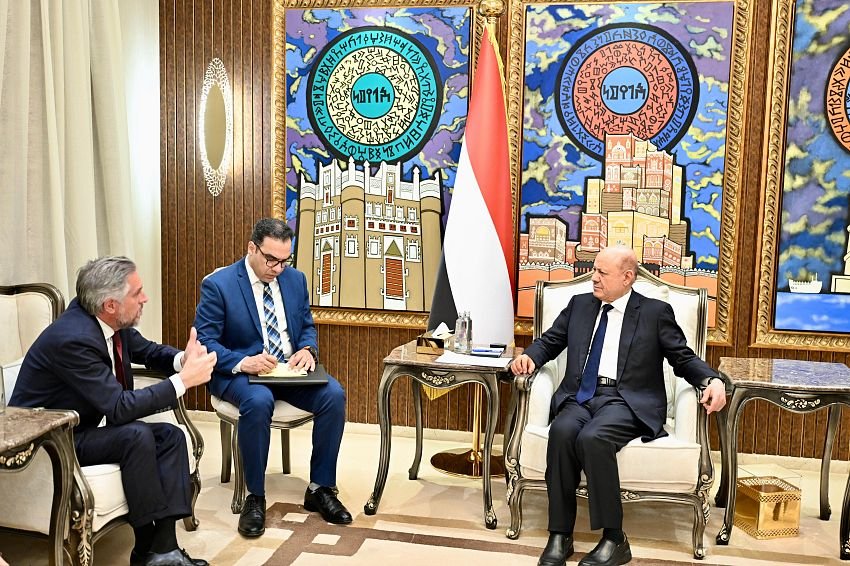
The conflict in Yemen, which erupted in 2015, has spiraled into a multifaceted civil war that has significantly altered the socio-political landscape of the country. The war primarily involves the Iran-backed Houthis and the internationally recognized government, currently led by President Dr. Rashad al-Alimi, who heads the Presidential Leadership Council based in Aden. The Saudi-led coalition, which intervened to support Yemen’s government, has played a pivotal role throughout the conflict, while the United Arab Emirates has also been a significant player with its own interests in the region.
As the fighting continues, Yemen suffers from one of the world’s most devastating humanitarian crises, with over 18 million people in critical need of assistance. The country faces widespread malnutrition, recurrent health crises, and the displacement of more than 4.5 million citizens from their homes. The dire humanitarian situation has been compounded by a healthcare infrastructure that has all but collapsed due to the endemic violence, leading to outbreaks of diseases such as cholera and measles among vulnerable populations.
The geopolitical ramifications of the Yemen conflict extend beyond its borders, particularly affecting the security of the Red Sea and the Bab al-Mandab Strait, critical maritime routes for global trade. This ongoing instability has drawn in regional powers, with Iran supporting the Houthis, complicating the situation for Gulf Arab states and their allies in the West. As the conflict persists, the quest for a political resolution remains paramount not only for Yemenis but for the security interests of many nations involved in the region.
In a recent meeting, President Dr. Rashad al-Alimi convened with Patrick Simonnet, the head of the European Union Mission to Yemen, to explore avenues for bolstering cooperation between Yemen and the EU. This encounter underscored the significance of international partnerships in supporting vital government reforms and development initiatives in Yemen. During the discussion, Simonnet elaborated on ongoing EU programs in several liberated regions, spotlighting potential interventions in crucial sectors such as water, energy, and livelihoods.
Al-Alimi expressed gratitude for the EU’s unwavering support in political, humanitarian, and developmental spheres. He acknowledged the EU mission’s pivotal role in aiding Yemen during these tumultuous times. The meeting highlighted the mutual recognition of the need for comprehensive political solutions to address the underlying causes of conflict, particularly concerning the influence of Iran-backed entities on security in the region.
A significant portion of the dialogue focused on ensuring maritime security in light of threats from Houthi proxies. Al-Alimi emphasized that achieving a sustainable peace is contingent upon dismantling militia forces that operate outside the government’s control. He urged EU member states to take decisive action, calling for the designation of the Houthis as a security threat and advocating for enhanced sanctions against arms trafficking, financial mobilization, and money laundering linked to these groups.
Key stakeholders in the Yemen conflict include the Yemeni government, represented by President al-Alimi and the Presidential Leadership Council, the Houthis, which controls significant territories in the north, and the Saudi-led coalition that intervened in support of the government. The United Nations and various international organizations are also crucial players, working to mediate peace talks and facilitate humanitarian assistance amid a deteriorating situation.
The European Union has emerged as a central actor in providing support for reforms and humanitarian aid in Yemen. Their mission aims to strengthen governance structures and promote development projects across liberated areas, a reflection of the EU’s commitment to stability in the region. Ambassador Simonnet’s engagement with the Yemeni President illustrates the EU’s willingness to collaborate on issues critical to both Yemen’s recovery and broader regional security interests.
At the local level, Yemeni society is deeply affected by the conflict, with civilians suffering the most from the ongoing hostilities. Displaced populations continue to live in precarious conditions, relying heavily on international aid to meet their most basic needs. Furthermore, local governance structures are often undermined by the conflict, delaying development efforts and diminishing public trust in state institutions.
The ongoing conflict in Yemen has far-reaching implications for the geopolitical dynamics of the Middle East. The presence of Iranian-backed militias not only poses a direct threat to Yemeni sovereignty but also threatens the security of vital shipping lanes in the Red Sea, a route that carries a significant portion of global trade. The European Union and Gulf states recognize that stability in Yemen is intrinsically linked to the security of maritime routes, making collaborative efforts to address the conflict imperative for regional safety.
The potential escalation of tensions linked to the Houthis’ militaristic actions has heightened security concerns for neighboring countries, particularly Saudi Arabia and the United Arab Emirates. Both nations fear the fallout from a protracted conflict that could further embolden Iran’s influence in the Arabian Peninsula and escalate proxy conflicts across the region. The presence of these proxies challenges not only local governments but also international entities aiming to stabilize the area.
Additionally, the humanitarian crisis has prompted regional and international actors to reconsider their strategies for intervention. The need to assist millions affected by the war is critical, with many countries pledging support to alleviate the suffering and enable access to essential services. As the conflict drags on, the international community’s focus on humanitarian relief efforts becomes increasingly vital to prevent further destabilization in the region.
The dialogue between President al-Alimi and Ambassador Simonnet signals a critical juncture for Yemen as it grapples with the enormous challenges of governance, security, and humanitarian needs. The Yemeni government’s ability to establish effective public institutions while countering armed groups remains a crucial determinant of the conflict’s trajectory. Without a robust and capable state apparatus, any peace achieved may be fleeting, as evidenced by previous ceasefires that have collapsed under persistent violence.
Al-Alimi’s call for the disarmament of non-state actors encapsulates a pivotal issue in peacemaking efforts. For Yemen to move towards stability, significant international pressure must be exerted on militia groups operating outside the state’s authority. This step will require coordinated efforts from various stakeholders, including the EU and UN, alongside regional players, to cultivate a comprehensive strategy for disarmament and reconciliation. Fostering state legitimacy and strengthening governance can help mitigate the appeal of armed groups among disenfranchised communities.
Moreover, the emphasis on maritime security is a reflection of the broader strategic interests at play. Yemen’s location near vital shipping lanes makes it a focal point for international security; thus, enhancing Yemen’s coastal security capabilities aligns with global safety objectives. Al-Alimi’s awareness of this interconnectedness indicates a sophisticated understanding of the need for cooperative security efforts to ensure both local and international maritime safety.
Looking ahead, continued dialogue and collaboration between Yemen and the European Union are essential. The upcoming engagements should focus not only on immediate humanitarian relief but also on sustainable development initiatives that can lay the groundwork for lasting peace. Investment in crucial sectors, such as water, energy, and infrastructure, must be prioritized to rebuild the war-torn nation while ensuring that these resources are equitably distributed amongst all segments of society.
Implementation of effective sanctions against Houthi officials and supporters will also be pivotal in disrupting their supply chains and curbing their activities in the region. International efforts to designate the group as a legitimate threat can foster stronger unity among regional partners aiming to counter Iranian influence in Yemen. A concerted approach will be necessary to counter the destabilizing actions that have plagued the nation and the broader region.
Additionally, as local and international actors work towards resolving the crisis, fostering an environment conducive to dialogue among Yemeni factions will be crucial. Initiatives that promote reconciliation and inclusivity can facilitate a breakthrough in ongoing peace negotiations. The path to peace in Yemen will not be straightforward, but through coordinated efforts, there remains hope for a future where the citizens of Yemen can live in safety and dignity.
The upcoming months will be critical to gauging the effectiveness of these strategies and determining whether Yemen can emerge from its cycle of conflict, transforming crisis into an opportunity for renewal and resilience in the face of adversity.
About the Author