New Governors of Lahj, Abyan and al-Dhalea Sworn In Before al-Alimi
 Yemen Herald News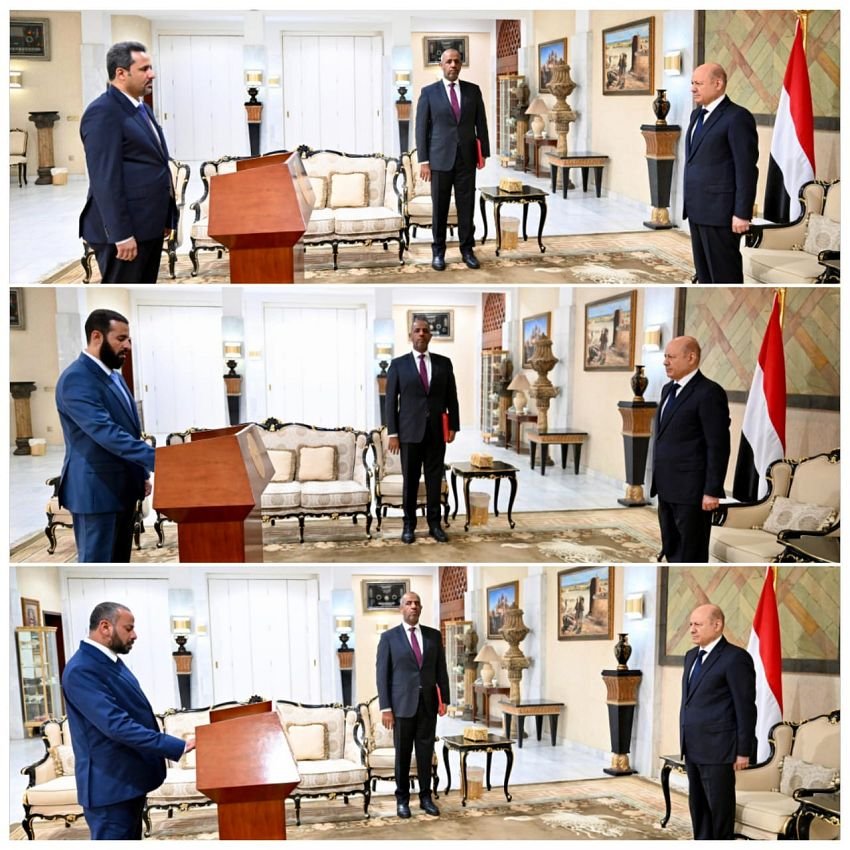
Three new Yemeni governors of Lahj, Abyan and al-Dhalea took their constitutional oaths before President Dr. Rashad al-Alimi, the Chairman of the Presidential Leadership Council, in a ceremony on Saturday. The swearing-in marked a significant step in the administration of the three southern governorates, formalising the appointment of officials tasked with leading regions that face considerable challenges.
The new governors are Murad al-Halimi for Lahj, Dr. Mukhtar al-Rabbash for Abyan and Major General Ahmed al-Qubba for al-Dhalea. Their appointment brings fresh leadership to governorates that, like much of the country, have contended with the strains of conflict, insecurity and the disruption of services over years of war.
Following the oath-taking, President al-Alimi held separate meetings with each governor to outline key priorities for their respective regions. He emphasised the need for the governors to intensify efforts to strengthen the presence of state institutions and to improve basic services, which he described as crucial to establishing security and stability in their areas.
The president highlighted the importance of collaboration among the governors, the government and central authorities in implementing an economic and administrative reform programme. He called for increased transparency, framing it as essential to effective governance and to building the trust of citizens in the institutions meant to serve them.
The swearing-in of governors before the head of the Presidential Leadership Council reflects the formal processes through which the government administers the territories under its authority. Such ceremonies mark the orderly assumption of office and underscore the lines of authority connecting local leadership to the national leadership of the state.
The three governorates involved occupy important positions in southern Yemen. Lahj, Abyan and al-Dhalea have each experienced the effects of the conflict and the broader instability that has afflicted the south, and their effective administration is significant both for their own populations and for the wider stability of the region.
The emphasis on strengthening the presence of state institutions speaks to a central challenge facing the government. In many areas, the reach and capacity of state institutions have been eroded by conflict, and rebuilding their presence is essential to restoring governance, delivering services and asserting the authority of the state.
Improving basic services, another priority highlighted by the president, addresses one of the most pressing concerns of citizens. Services such as water, electricity, health and education are among the most tangible measures of governance, and their improvement is central to relieving hardship and to demonstrating the government’s capacity to serve the population.
The linkage of services and institutions to security and stability reflects an understanding of their interconnection. Functioning institutions and reliable services contribute to stability by meeting the needs of citizens and reducing grievances, while stability in turn provides the conditions in which governance and service delivery can be sustained and improved.
The call for collaboration among different levels of government points to the importance of coordination in a fragmented context. Aligning the efforts of local governors, the government and central authorities can enhance the coherence and effectiveness of administration, particularly in pursuing reform programmes that span multiple levels of the state.
The economic and administrative reform programme referenced by the president reflects the government’s broader agenda of strengthening governance and improving the functioning of the state. Reform in these areas is central to the country’s recovery, and the engagement of the new governors in implementing it is important to its success at the local level.
The emphasis on transparency underscores a principle regarded as essential to good governance. Transparency can enhance accountability, reduce opportunities for corruption and build public trust, and its inclusion among the president’s priorities reflects an awareness of its importance to the credibility and effectiveness of government.
The appointment of new governors also offers an opportunity for renewal in the administration of the governorates. Fresh leadership can bring new energy and approaches to the challenges facing these regions, though the extent to which it translates into tangible improvements will depend on the capacity, commitment and support of the new officials.
The challenges facing the new governors are considerable. Administering governorates affected by conflict, with limited resources and amid ongoing instability, is a demanding task, and success will require effective leadership, adequate support and coordination with national authorities, as well as the engagement of local communities.
Appointments in the southern governorates carry an added layer of sensitivity given the region’s complex politics. The south has its own distinct history and a range of political currents, and the selection and conduct of governors can bear on the delicate balances among the various forces that make up the anti-Houthi camp. Ensuring that local leadership commands legitimacy and functions effectively is therefore important not only for administration but for social cohesion.
The tasks awaiting the three governors are formidable and immediate. Residents of Lahj, Abyan and al-Dhalea have endured shortages of electricity and water, damaged infrastructure and economic hardship, and their patience with promises of improvement has been tested by years of disappointment. Whether the new officials can translate the priorities set out by the president into visible gains, in services restored, institutions strengthened and governance made more transparent, will ultimately determine how their tenure is judged by the communities they have been appointed to serve.
For now, the swearing-in of the governors of Lahj, Abyan and al-Dhalea marked a step in the ongoing administration of Yemen’s governorates and the government’s efforts to strengthen governance and services. As the new officials take up their responsibilities, the priorities outlined by the president will shape the expectations placed upon them in the period ahead.
About the Author