Qatar Intercepts Two Waves of Missiles Over Doha and Evacuates Central Districts
 Yemen Herald News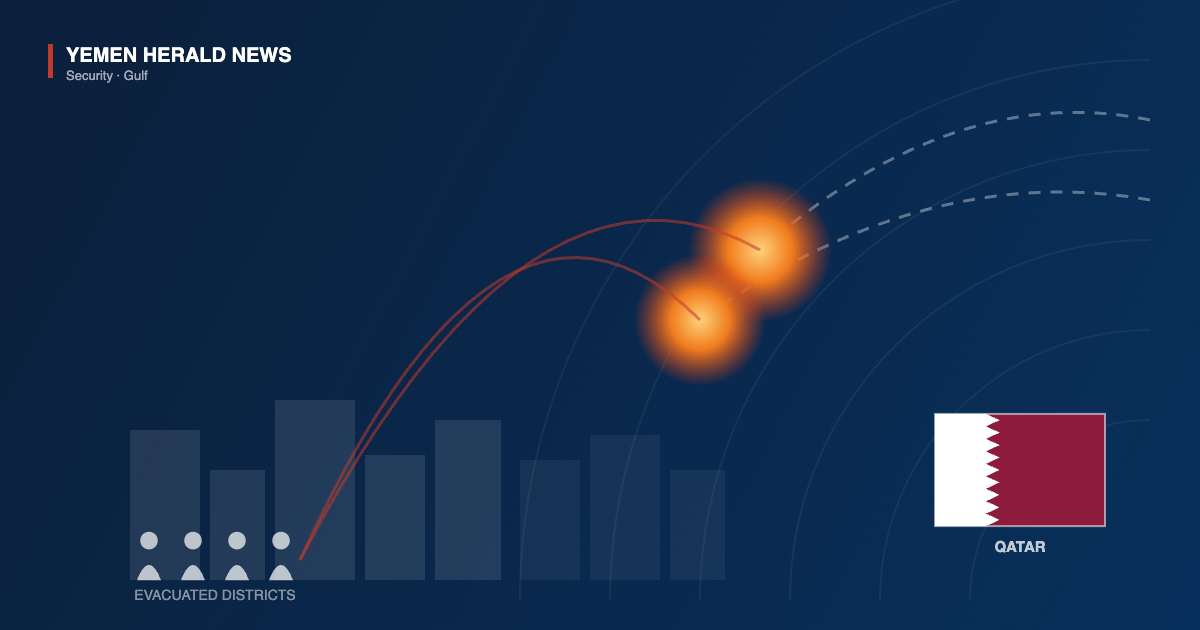
Qatar’s air defences intercepted missiles over the country in two separate waves during a single night in March 2026, and the authorities ordered precautionary evacuations of several central districts of Doha while the threat persisted. The defence ministry said at the time that the interceptions took place at about 2am and again at about 5.45am, and residents of the capital reported loud explosions overhead at both points.
The interior ministry issued evacuation notices through Qatar’s National Alert System, advising people in the affected areas to move to alternative accommodation until the danger had passed. Officials described the measure as temporary and precautionary rather than a response to any confirmed impact. Among the areas cleared were parts of Msheireb Downtown Doha, a redeveloped central district that houses government offices and a Google hub, and sections of Education City, the research and higher education campus on the edge of the capital that hosts satellite campuses of six American universities. Reporting at the time indicated that Education City was evacuated shortly before 2am.
Qatari authorities did not publish the precise locations of the interceptions or the debris fields, a standard practice among Gulf governments during the campaign, intended to avoid disclosing the positioning and performance of air defence systems. Nor did they identify the launch sites in their initial statements.
The episode formed part of a sustained Iranian air campaign against Gulf states through the first months of 2026. Qatar’s armed forces reported intercepting a combined attack earlier in March that involved aircraft, ballistic missiles and drones, and by the end of the month the country said it had brought down more than sixty ballistic missiles along with multiple waves of drones. Qatari officials reported a small number of injuries caused by falling debris and limited structural damage in civilian areas — a low casualty figure relative to the volume of munitions, which the government attributed to the layered interception network and to the alert and evacuation procedures.
Qatar was not alone. Saudi Arabia, the United Arab Emirates, Bahrain and Jordan all reported intercepting Iranian missiles and drones during the same period, and air raid sirens became a routine feature of life in several Gulf capitals. The campaign followed United States and Israeli strikes on Iran, and Tehran framed its launches as retaliation. Gulf governments, most of which had spent the preceding years rebuilding working relations with Iran, found themselves absorbing attacks they had not sought and had limited means to deter.
The evacuation of Education City had consequences beyond the immediate security response. The complex hosts branch campuses of American institutions including Georgetown, Northwestern, Carnegie Mellon, Texas A&M, Cornell’s medical school and Virginia Commonwealth University, together with Qatari institutions and research bodies. Several universities moved teaching online, and some sent students home or offered them the option to leave the country. For a project conceived as a demonstration of Qatar’s stability and its value as a partner to Western institutions, an overnight evacuation carried a symbolic weight beyond the disruption itself.
Msheireb Downtown Doha carried a comparable significance. Built as a flagship regeneration of the old commercial centre, it concentrates ministries, corporate offices and residential blocks in a compact area, and it sits close to infrastructure that any state would treat as sensitive. Clearing it, even temporarily, meant interrupting the working centre of the capital.
Qatar occupies an awkward position in the confrontation. It hosts Al Udeid Air Base, the largest United States military installation in the Middle East and the forward headquarters of US Central Command, which makes it a target of obvious interest during a campaign aimed at American regional presence. At the same time it shares the world’s largest natural gas field with Iran and has spent years cultivating a role as a mediator acceptable to both Washington and Tehran. Doha has consistently argued that de-escalation serves its interests better than alignment.
The economic exposure is equally direct. Qatar is among the world’s largest exporters of liquefied natural gas, and its shipments transit the Strait of Hormuz. Any sustained disruption to that corridor would affect not only Qatari revenue but energy supply to importers across Asia and Europe, which gives a considerable number of governments an interest in the confrontation not widening further.
The National Alert System itself became one of the more visible instruments of the Qatari state during this period. It pushes notifications to mobile phones within defined geographic zones, letting the interior ministry issue targeted instructions to the residents who need them rather than a general warning. Officials credited it, alongside public guidance on shelter, with keeping casualties low on nights when interceptions took place above populated districts.
Government messaging in the same period stressed the resilience of supply chains, with officials outlining stocks of food, fuel and medicine and urging residents not to stockpile. That combination — visible air defence, targeted evacuation and reassurance about supplies — became the standard template of the Gulf response as the campaign continued.
Because the details of that night came almost entirely from Qatari government statements and from reporting based on them, they should be read as the authorities’ account rather than as independently verified fact. What is not in dispute is the pattern: through March 2026 the Qatari state repeatedly activated its national alert system, cleared populated districts of its capital in the early hours, and told residents that interceptions overhead were the reason.
About the Author