Houthi Threats to Bab al-Mandab Deepen a Shipping Crisis Already Worsened by the Closure of Hormuz
 Yemen Herald News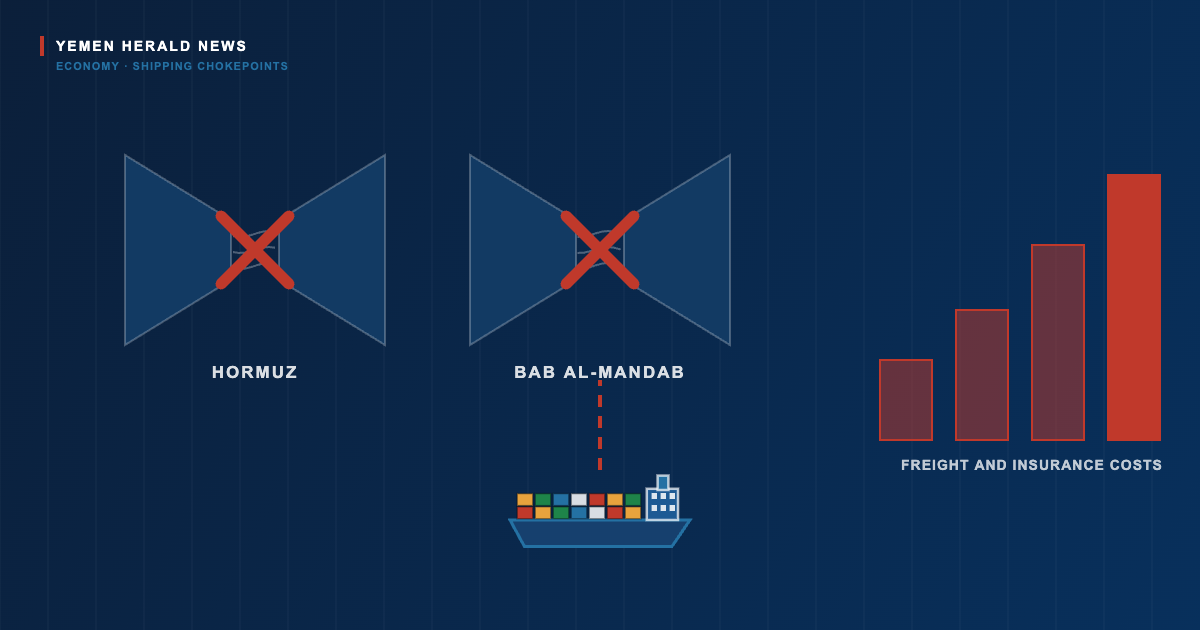
The alignment of Yemen’s Houthi movement with Iran has added a second and potentially decisive pressure point to a global shipping system already under severe strain. With the Strait of Hormuz effectively closed to foreign traffic since late February, attention has shifted to the Bab al-Mandab, the narrow passage between Yemen and the Horn of Africa that Houthi forces are in a position to threaten. Between them, the two chokepoints frame the sea routes that carry a substantial share of the world’s traded oil and gas.
The Bab al-Mandab is roughly 29 kilometres wide at its narrowest, separating Yemen from Djibouti and Eritrea and linking the Red Sea to the Gulf of Aden and the Indian Ocean beyond. Its Arabic name is usually rendered in English as the Gate of Tears, a reference to the hazards of the passage. In commercial terms it is the southern gate to the Suez Canal: cargo that cannot transit the strait cannot use the canal either, and must take a far longer route around Africa.
The volumes involved are considerable. About 4.1 billion barrels of crude oil and refined petroleum products moved through the strait in 2024, close to five per cent of global seaborne petroleum trade, alongside liquefied natural gas cargoes and the container traffic that links Asian manufacturing to European markets.
Hormuz has been the more immediate problem. Iran closed the strait to foreign shipping after the United States and Israel began an air campaign against it on 28 February 2026, with the Islamic Revolutionary Guard Corps broadcasting warnings over VHF radio that no vessel was permitted to pass. Analysts have estimated that shutting the Bab al-Mandab as well would place roughly a quarter of the world’s oil and gas supply beyond the reach of normal shipping routes.
According to reporting on the deployments, Iran has asked the Houthis to stand ready to close the southern strait, and the group has moved missiles and drones capable of reaching ships in the Red Sea into position while awaiting instructions. Houthi officials have said publicly that blocking the passage is among the options under consideration. The group’s military spokesman, Yahya Saree, has announced the renewal of a naval blockade on Israel and the closure of the Bab al-Mandab to Israeli-linked vessels, and on 20 July the movement declared a naval blockade of Saudi Arabia.
The Houthis also entered the war directly. On 28 March they fired a barrage of ballistic missiles at Israel, their first such attack since the conflict with Iran began a month earlier. Saree said the salvo was aimed at what he described as sensitive Israeli military sites in the south of the country. Israel has struck Houthi positions in Yemen in response to attacks on merchant shipping, including after an assault on a Liberian-flagged bulk carrier in the Red Sea.
Shipowners have not waited for a formal closure. Ship tracking data indicate that daily transits through the southern Red Sea corridor have fallen to roughly 30 to 35 vessels, against a normal figure closer to 70. In late July, vessels were reported turning back in the Red Sea rather than continuing south towards the strait, which suggests operators are pricing in the threat rather than testing it.
Most of the diverted traffic is going around the Cape of Good Hope, which adds between ten and fourteen days to an Asia to Europe voyage and raises fuel, crew and charter costs accordingly. War risk insurance for the corridor has become markedly more expensive. Peter Sand, chief analyst at the freight rate platform Xeneta, has said carriers are unlikely to return to the Red Sea in any meaningful way this year if the Houthis follow through on their pledge to resume strikes.
Egypt is among the clearest losers. Suez Canal transits have declined for successive months, cutting into one of the country’s most reliable sources of foreign currency at a time when it can least afford the loss.
For Yemen itself, the escalation carries risks that have little to do with global freight rates. United Nations agencies estimate that more than eighteen million people in the country need humanitarian assistance, and several million remain displaced from their homes. Recurrent outbreaks of cholera and measles have compounded the strain on a health system already weakened by years of conflict. Almost all of Yemen’s food, fuel and medicine arrives by sea, so disruption around the Bab al-Mandab and the port of Hodeidah pushes up prices for the people least able to absorb them.
Yemen’s internationally recognised government, which does not control the Red Sea coastline north of Hodeidah, argues that Houthi control of that shoreline gives the movement leverage far beyond Yemen’s borders. The Houthis seized the capital Sanaa in 2014, and a Saudi-led coalition intervened the following year. The group’s present ability to reach commercial shipping and to strike Israel represents a substantial expansion of that reach.
What happens next depends less on Yemen than on the wider war. If Hormuz reopens, pressure on the southern route eases and the calculation for shipowners changes quickly. If it does not, and if the order to close the Bab al-Mandab is given, the world’s two most important energy chokepoints would be shut at the same time. For now the strait remains open, but it is carrying roughly half as many ships as it once did.
About the Author