Salem al-Khanbashi Reviews Action for Humanity Projects During Mukalla Briefing
 Yemen Herald News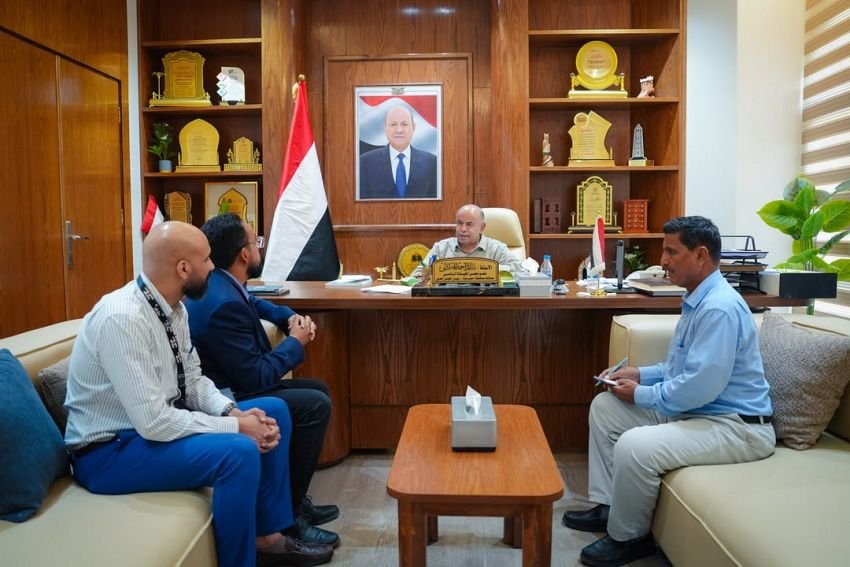
Salem al-Khanbashi, a member of Yemen’s Presidential Leadership Council and governor of Hadramout governorate, was briefed on Thursday on the projects and programmes run by the international organisation Action for Humanity across the governorate, the state news agency Saba reported from Mukalla. The briefing was delivered by the organisation’s country director, Mohamed Bahshwa, during a meeting at which al-Khanbashi praised its humanitarian and development work.
According to the agency’s account, the discussion centred on an ongoing project to construct a building intended to host enterprises founded by young people and by graduates of Hadramout University. The readout gave no construction timetable, cost figure or completion date, and did not indicate how many businesses the facility is expected to accommodate once finished.
The emphasis on graduate enterprise reflects a problem that has grown steadily more acute across Yemen. More than a decade of conflict has hollowed out formal employment, and university graduates in particular have faced a labour market in which public-sector hiring has largely stalled and private investment has been constrained by insecurity, currency instability and unreliable electricity. Business incubation projects of the kind described offer one of the few structured routes into work for that cohort.
Hadramout is Yemen’s largest governorate by area, extending from the Arabian Sea coast deep into the interior, and Mukalla serves as its capital and principal port. The governorate has been comparatively insulated from the front-line fighting that has affected Marib, Taiz and the Red Sea coast, though it has faced its own security difficulties and periodic disputes over the distribution of revenue from its oil fields.
That relative stability has made Hadramout one of the more workable environments for humanitarian and development organisations operating in Yemen. Agencies that cannot reach contested areas have concentrated resources where access is more dependable, which has produced a visible concentration of projects in the governorate and along the southern coast more generally.
Action for Humanity has been active in more than one part of the country. Saba has separately reported the governor of Lahj discussing the expansion of humanitarian interventions with the same organisation, indicating a programme that extends beyond Hadramout into other southern governorates. The organisation’s Yemen operations are led by Bahshwa as country director.
Al-Khanbashi occupies an unusual dual position. He is one of the members of the Presidential Leadership Council, the eight-member executive body formed in April 2022 under the chairmanship of Rashad al-Alimi to consolidate the anti-Houthi political and military factions under a single authority, and he simultaneously holds the governorship of Hadramout. That combination gives him a direct role both in national decision-making and in the administration of the governorate.
His schedule in recent days has reflected the governorate portfolio. Saba reported that he also examined the condition of customs facilities and stalled projects in Hadramout, a pairing of subjects that points to the revenue and delivery problems facing local administration. Customs receipts at ports and land crossings are among the more reliable sources of government income, and stalled infrastructure projects are a persistent complaint across areas nominally under government control.
The humanitarian backdrop against which such meetings take place remains severe. The United Nations Office for the Coordination of Humanitarian Affairs estimated in its March 2026 response plan that more than 22 million people in Yemen require assistance, with 18.3 million acutely food insecure and more than 2.2 million children under five acutely malnourished, of whom 516,157 are severely malnourished. Around 5.2 million people remain internally displaced.
Funding has not kept pace with those figures. The 2026 plan seeks 2.16 billion US dollars to reach 12 million of the people identified as most in need, a target that already represents a substantial narrowing from the total caseload. Appeals for Yemen have been persistently underfunded in recent years, obliging agencies to reduce rations, close programmes or concentrate assistance on the smallest and most vulnerable groups.
Against that constraint, projects that create durable local capacity rather than recurring relief have attracted growing interest from both officials and donors. A building housing graduate enterprises is a modest intervention measured against a caseload of 22 million, but it belongs to a category of work that does not depend on annual replenishment of an appeal, and that is part of its appeal to a local administration.
Hadramout University, whose graduates the planned facility is intended to serve, is among the larger public universities in southern Yemen and one of the few that has continued to produce graduates in significant numbers throughout the conflict. Its output has consistently exceeded what the local economy can absorb, and the resulting gap between qualification and employment has been cited repeatedly by officials in the governorate as a source of both economic loss and social strain, particularly among young men who might otherwise be drawn towards armed groups offering regular pay.
Saba’s report offered no indication of what commitments, if any, either side made during the meeting. Briefings of this kind form a routine part of the relationship between governorate authorities and the organisations working in their territory, and they typically serve to maintain official awareness and consent rather than to announce new funding. Whether the enterprise building progresses will depend on financing and construction conditions that were not addressed in the account of the meeting.
About the Author