French researcher questions Saudi response to Houthi capture of Mokha
 Yemen Herald News
PARIS, France — Saudi Arabia’s limited response to the Houthi capture of Mokha raises questions about Riyadh’s calculations, a French political scientist wrote in a Paris report.
François Frison-Roche set out the argument. The International Agency for Journalism and Strategic Studies, a Paris-based body known as AIJES, published it under the title “Saudi Arabia Is Playing with Fire in Yemen: Behind the Fall of Mokha.”
Frison-Roche holds a doctorate in political science and is a researcher at France’s National Centre for Scientific Research, the CNRS. He has specialised in Yemen for years and carried out fieldwork there between 2012 and 2014.
Yemen Herald could not independently verify the report’s account of Saudi decision-making. It rests on Frison-Roche’s own assessment, and no second organisation has published a matching analysis.
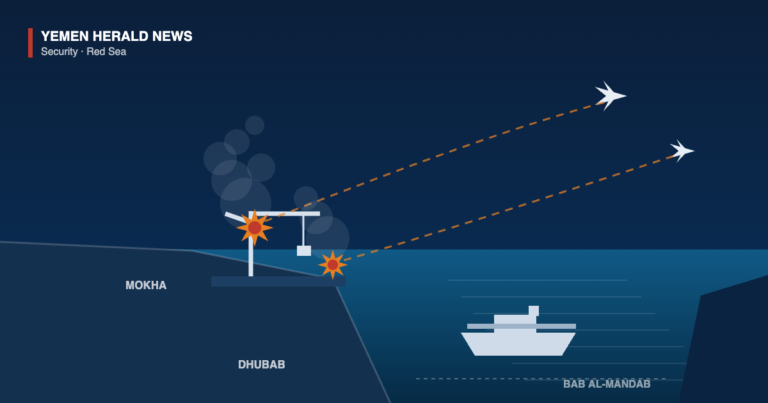
The events behind it are documented. Houthi forces took the Red Sea port of Mokha and the island of Mayyun in September, Al Jazeera reported. Anti-Houthi units backed by the United Arab Emirates had held the port since 2017.
The seizure opened a new front in the war, The Associated Press reported at the time. The National reported that it came as Houthi attacks on Saudi Arabia were increasing.
Al Jazeera reported the seizure of Mokha on Sept. 10. It described the port as a strategic foothold on the Red Sea coast.
Frison-Roche wrote that the takeover marks a military and geopolitical shift reaching beyond Yemen, given the port’s position near the Bab al-Mandab strait.
He questioned why Riyadh did not act more forcefully to stop the advance. Saudi involvement was confined largely to intelligence and logistical support while anti-Houthi forces faced a sustained offensive, according to his account.
He suggested Riyadh wants to avoid being drawn back into open confrontation with the Houthis after years of war. He also raised the possibility that wider political calculations shaped the response.
The report points to the speed with which positions on the western coast gave way. Those formations had received training, weapons and support from the Emirates, and had years of combat experience against the Houthis.
It cites statements by military officials about withdrawals and retreat orders, and mutual accusations among Yemeni factions over who was responsible. It does not name the officials.
Frison-Roche wrote that Houthi military strength alone does not explain what happened at Mokha. Command structure, coordination and the decisions taken before the front gave way should be examined, he wrote.
He set out three readings of Saudi policy. He presented them as interpretations rather than established fact.
The first concerns Egypt. A Houthi advance toward Bab al-Mandab puts pressure on Cairo’s interests in Red Sea security and Suez Canal traffic, and could push Egypt toward a larger part in regional security arrangements, he wrote.
The second is internationalisation. On that reading the confrontation stops being a Yemeni or Saudi matter and becomes a question of global trade, energy supply and navigation, drawing the United States and European states into a wider role.
The third concerns rivalry inside the anti-Houthi camp. The report asks whether the weakening of Emirati-backed forces on the western coast reduces Abu Dhabi’s influence while strengthening Yemeni units closer to Riyadh.
The report offers no evidence for any of the three. Frison-Roche framed them as open questions.
He wrote that the military centre of gravity is shifting toward Bab al-Mandab, the southern entrance to the Red Sea and the approach to the Suez Canal.
A long disruption there could force commercial vessels around the Cape of Good Hope, he wrote, lengthening voyages and raising freight and insurance costs.
He concluded that any attempt to use the Houthi threat to reshape regional balances, if that is what is happening, could prove harder to contain than those pursuing it expect.
Saudi Arabia has not responded publicly to the report. The Emirates has not commented on it, and neither have the Houthis.
Hans Grundberg, the United Nations special envoy for Yemen, said on Thursday he was alarmed by intensified fighting, citing reports of casualties, damage to infrastructure and road closures. He did not address the Mokha report.
The HALO Trust, a demining organisation, suspended mine clearance in Taiz and Mokha after the fighting and warned of risks to civilians returning to the area.
Mokha lies on Yemen’s western coast, south of Hodeidah. Mayyun, also called Perim, sits in the Bab al-Mandab strait between Yemen and Djibouti. The strait links the Red Sea to the Gulf of Aden and carries traffic bound for the Suez Canal.
The port changed hands in 2017 when anti-Houthi forces advancing up the coast took it from the movement. It stayed outside Houthi control for eight years.
The United Nations humanitarian plan for 2026 put the number of Yemenis needing aid at more than 22 million, with 18.3 million acutely food insecure. It counted 5.2 million people already displaced inside the country.
That plan sought 2.16 billion dollars to reach 12 million people.
The report reached Yemeni readers through Yemen Online, which published a summary of it in English. AIJES has published earlier assessments of Saudi policy in Yemen.
AIJES describes itself as a research and journalism body based in Paris. The report carries no publication date on the version circulated in Yemeni media.
About the Author