Yemeni rights group says Houthi summer camps enrolled 461,000 students this year
 Yemen Herald News
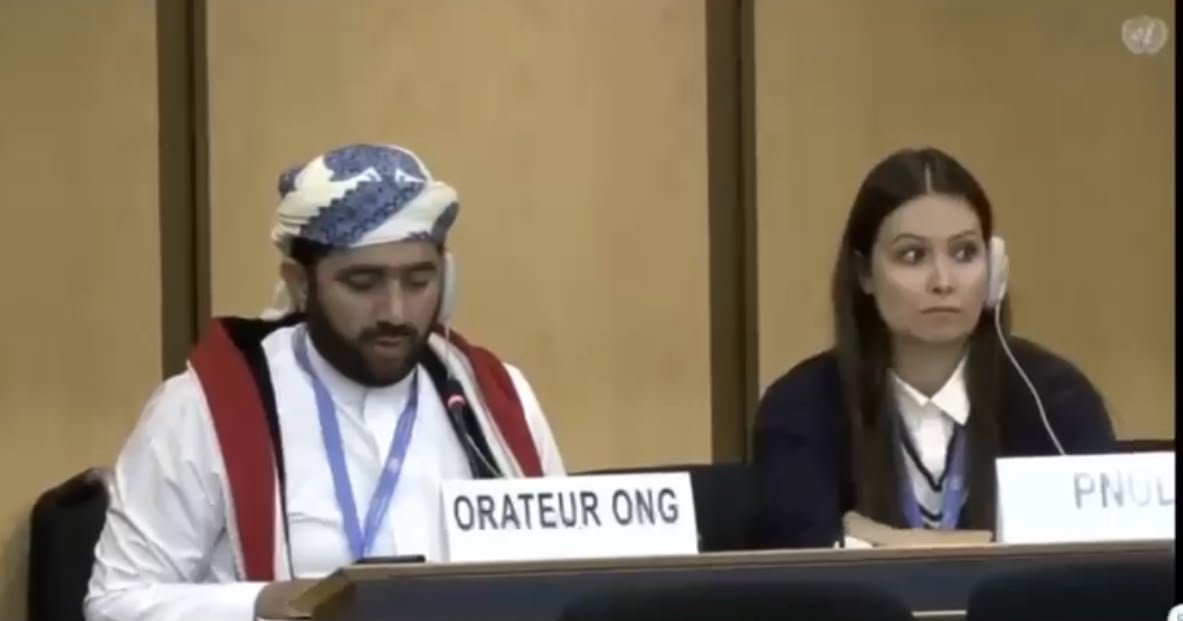
GENEVA, Switzerland — Houthi summer camps enrolled about 461,000 students this year, the head of a Yemeni rights group told the UN Human Rights Council, the state news agency Saba reported Thursday.
Jamal al-Maamari leads the Irada Organization Against Torture and Enforced Disappearance.
He spoke under Item 9, the Council’s standing agenda item on racism and racial discrimination.
The Council’s 63rd regular session opened on Sept. 7 and runs to Oct. 7 at the Palais des Nations in Geneva.
Al-Maamari said the camps are designed to turn children into fighters.
He said they indoctrinate pupils with Twelver Shiite ideology imported from Iran and push them toward attacks on Yemeni cities and abuses against civilians.
He asked the Council to condemn the practice and to hold those responsible to account.
He described the camps as part of what he called a systematic destruction of childhood and of Yemeni society.
Yemen Herald could not independently verify the enrolment figure. It rests on al-Maamari’s account, and no second organisation has published a matching count.
He did not say how the figure was compiled.
The Houthi authorities in Sanaa had made no public response to his remarks at the time of writing.
Al-Maamari said the group has imposed racial and sectarian discrimination founded on a claim of divine right.
He said it treats Yemenis as subjects rather than citizens.
He put the number of students targeted through curriculum changes in areas under Houthi control at about 1.6 million.
He said that since the Houthis seized power in 2014 the group has dismantled state institutions and abducted academics, politicians, activists and journalists.
He said more than 500,000 Yemenis have been killed in that period.
That figure exceeds the most widely cited UN estimate. The UN Development Programme projected in 2021 that the war would have caused about 377,000 deaths by the end of that year, around 60 percent of them from indirect causes such as hunger and untreated disease.
No UN body has published a toll of 500,000.
Al-Maamari said UN personnel and humanitarian workers have also been targeted.
He said some are held in prisons in Sanaa alongside thousands of civilian detainees.
The Houthi authorities describe the programmes as summer centres rather than camps.
Asharq Al-Awsat reported in April that they are presented as educational support, intended to make up for schooling lost to the war and to instil what organisers call Quranic culture.
The newspaper said organisers cast them as a defence against what they term soft war and cultural invasion.
It said the centres are run through a Supreme Committee for Summer Courses and Activities chaired by the prime minister of the Sanaa administration, drawing in the ministries of education, youth and sports, endowments and interior.
Provincial governors and education offices handle local enrolment, according to the same report.
It said participation had fallen recently, and that recruiting pupils required sustained persuasion and financial incentives.
Child recruitment in Yemen is documented independently of the claims made in Geneva.
The UN secretary-general’s annual report on children and armed conflict, released in June, verified 742 grave violations against 652 children in Yemen during 2025.
That was a rise of 27.3 percent on the 583 violations documented in 2024.
The report verified the recruitment and use of 262 children over the year, 259 boys and three girls.
It found 188 of them had been used in combat roles.
It attributed 23 percent of incidents of killing and maiming to the Houthis.
The report did not give a separate figure for how many recruitment cases it attributed to the group.
The Houthi movement, which calls itself Ansar Allah, has appeared in the annexes to that report since 2011.
It is listed there for the recruitment and use of children, for killing and maiming them, and for attacks on schools and hospitals.
Yemeni government forces have been listed since 2013 for recruitment and use and for killing and maiming.
Pro-government militias, among them Salafist units and the Popular Committees, have been listed since 2012 for recruitment and use.
Across 2021 to 2023 the UN verified 5,539 grave violations against 2,422 children in Yemen.
Recruitment and use accounted for 564 of those incidents.
Denial of humanitarian access was the most frequent violation over that period, at 2,806 incidents, followed by killing and maiming at 1,941.
Item 9 debates draw statements from governments and from accredited non-governmental organisations, which speak in their own name.
Irada is a Yemeni organisation whose stated focus is torture and enforced disappearance.
Saba filed the report from Geneva. The agency is run by the internationally recognised government and is based in Aden. An agency of the same name operates from Sanaa under Houthi control.
The UN Office for the Coordination of Humanitarian Affairs said in its March humanitarian plan that more than 22 million people in Yemen need assistance.
It put the number who are acutely food insecure at 18.3 million.
It said more than 2.2 million children under five are acutely malnourished, 516,157 of them severely.
The plan recorded 5.2 million people displaced inside the country.
It sought 2.16 billion dollars to reach 12 million people.
The Council’s Item 9 sits under follow-up to the Durban Declaration, adopted in 2001.
About the Author