Saudi-led coalition says it downed missiles over Riyadh a day after pipeline attack
 Yemen Herald News
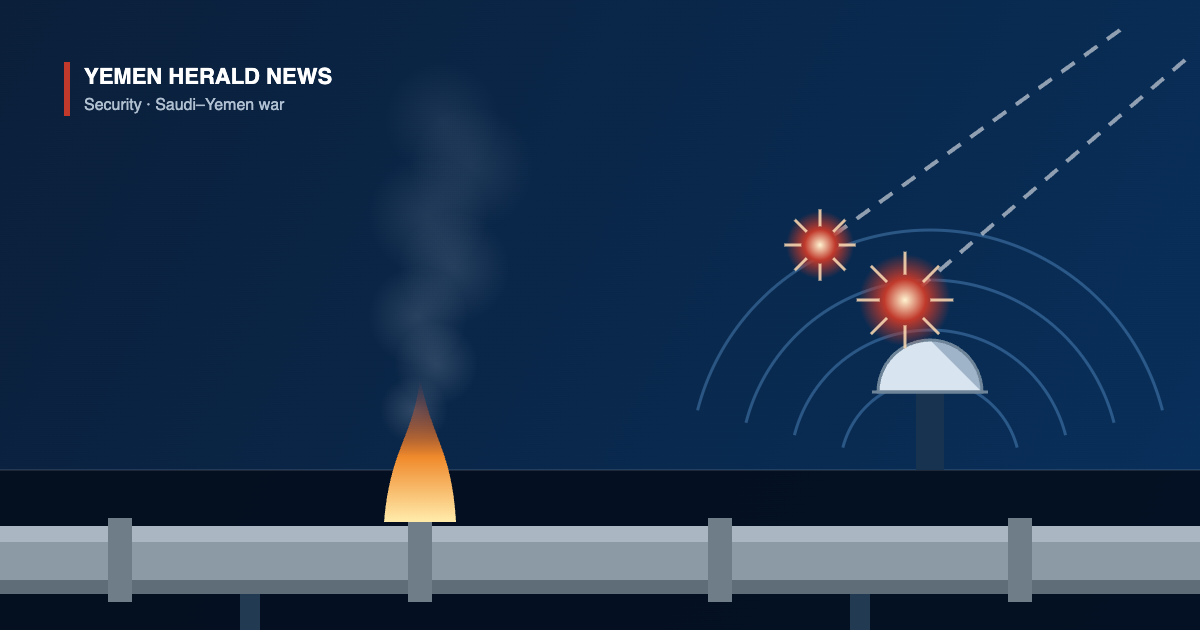
RIYADH, Saudi Arabia — Saudi air defences intercepted two missiles fired toward Riyadh early Tuesday and a third over the country’s south, the Saudi-led coalition fighting Yemen’s Houthis said.
Maj. Gen. Turki al-Maliki, the coalition’s spokesman, said in a series of posts on X that a ballistic missile and a cruise missile were destroyed over the capital. A second ballistic missile was brought down over southern Saudi Arabia, he said.
Al-Maliki said a drone was also intercepted over the kingdom’s Eastern Region.
Multiple explosions were heard in Riyadh, according to AFP. Residents received text-message alerts telling them to take shelter from an aerial threat.
Saudi civil defence raised warnings for Riyadh, Abha and Khamis Mushait, then lifted them a short time later. A later message from the agency said the danger had passed.
No injuries or deaths were reported.
Neither the coalition nor Saudi authorities said who fired Tuesday’s missiles. The Houthis made no immediate claim of responsibility.
The interceptions followed an attack a day earlier on the East-West pipeline in the Medina region. An official at the Saudi Ministry of Energy told the state Saudi Press Agency that the strike caused a limited fire, which was put out.
The official said no one was hurt and that pipeline operations were unaffected. The report did not identify who carried out the attack.
The line runs about 1,200 kilometres across the Arabian Peninsula to Yanbu on the Red Sea. Riyadh has rerouted about 4 million barrels of crude a day through it, roughly 4 percent of global supply, since traffic through the Strait of Hormuz was constricted by the war on Iran.
The pipeline was shut for several days in September after drone attacks that Saudi Arabia said were launched from Iraq.
On Sunday, Saudi officials said falling debris from an attempted attack caused minor damage to the Aramco Tower in Riyadh’s business district. Images released by the Saudi Press Agency showed the deputy governor of the Riyadh region inspecting damage on several floors.
The Houthis claimed that attack. Yahya Saree, the group’s military spokesman, said on Nov. 8 that it had carried out six operations against Saudi installations using ballistic missiles, cruise missiles and drones.
Saree named King Khalid International Airport, oil storage tanks and an Aramco distillation tower in Riyadh, Aramco facilities at Khurais, Pumping Station No. 8 near Dawadmi and a National Guard camp in Najran. He also claimed strikes on government troop positions in al-Jawf and Marib. Those claims were not independently verified.
The coalition said on Monday that it had destroyed three Houthi facilities: a plant assembling missile components, a chemical works producing solid propellant and an electronics laboratory.
Al-Maliki gave no locations for those sites and no date for the strikes, and reported no casualties. The coalition said the operation answered repeated attacks on civilians and civilian infrastructure in Saudi Arabia and Yemen, and that it would go on dismantling the Houthi missile network.
The Houthis have not responded to that account, and Yemen Herald found no independent confirmation of it.
Fighting inside Yemen has run in parallel. Yemen’s military said on Monday that it had carried out 982 strikes over the preceding hours in an offensive it calls Dawn of Yemen — 17 air raids, 123 drone sorties, 60 rocket-launcher strikes and 782 artillery attacks.
A military spokesman, who was not named in the statement, put initial field estimates at about 127 Houthi commanders and fighters killed or wounded, and said about 158 vehicles and pieces of engineering equipment were destroyed or disabled. Yemen Herald could not independently verify those figures, and the Houthis have not commented on them.
The military also said its forces had taken high ground on the al-Jawf front, repelled attacks around Taiz alongside Popular Resistance units, and recovered positions on southern and southwestern fronts. The Houthis dispute government accounts of territorial gains.
Saree gave a competing account of the same days. He said Saudi forces carried out 105 air and missile strikes in Yemen in 24 hours, leaving dozens of civilians dead and wounded, and put the total since the escalation began at 4,369 strikes. Yemen Herald found no independent confirmation of those figures either.
The UN human rights office has verified 69 civilian deaths in Yemen since the escalation began in August. UNICEF said last week that more than 200,000 people had been displaced since September, 110,000 of them children.
Houthi forces have struck Saudi oil infrastructure repeatedly through the escalation, including refineries and storage sites, using drones and missiles. Middle East Eye reported that the group had hit the East-West pipeline earlier in the campaign.
The coalition has backed the Yemeni government offensive with air strikes, according to Al Jazeera.
The foreign ministers of Saudi Arabia and Oman called in a telephone call on Monday for continued diplomacy to contain the regional crisis and to protect the security of navigation.
Yemen’s internationally recognised government has pressed European states to designate the Houthis a terrorist organisation. Foreign Minister Afrah al-Zouba put that case to German lawmakers in Berlin last week.
Satellite imagery taken in late September showed repair work and a bypass near al-Dhekra in Medina province, where the earlier drone attacks struck.
About the Author


 Adel Haddad