Security Council extended Yemen sanctions to 2027 after five redrafts removed a terrorist label
 Adel Haddad

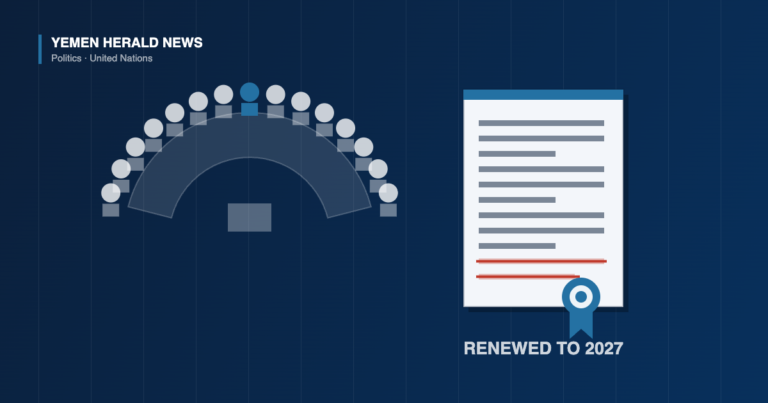
UNITED NATIONS — The Security Council extended its Yemen sanctions regime for a year on Nov. 12, adopting a text five redrafts had stripped of a terrorist label for the Houthis.
Resolution 2837 passed unanimously at the Council’s 10270th meeting. It extends the asset freeze and travel ban created by Resolution 2140 of 2014 until Nov. 14, 2027.
The resolution also extends the mandate of the Panel of Experts that supports the Yemen sanctions committee until Dec. 15, 2027, and asks the secretary-general to enlarge the panel to six members.
Britain, which holds the pen on Yemen at the Council, circulated its first draft on Oct. 29 and held consultations on Nov. 2, according to Security Council Report, an organisation that tracks the Council’s negotiations.
Revised drafts followed on Nov. 3 and Nov. 5. A third revision was put under silence procedure on Nov. 9, and Russia and China broke silence the next day.
Bahrain and China broke silence on a fourth revision, and that procedure concluded on the morning of Nov. 11. A fifth revision cleared silence procedure that evening.
The successive drafts shed several of Britain’s original provisions. Security Council Report said the description of the Houthis as a terrorist group, present in the first draft and in several later ones, was deleted from the fourth after Russia objected.
Bahrain, supported by the United States, sought to restore the description in the final stage of negotiations and did not succeed.
Immediate restrictions on dual-use imports were also dropped. In their place the Council undertook to decide by Jan. 11, 2027, on measures to prevent the supply, sale, transfer or diversion of specified materials.
China, supported by Russia, opposed immediate measures drawn from the panel’s list of such materials, according to Security Council Report. The panel had described that list as preliminary.
References to precursor chemicals and their use in military manufacturing were removed after Chinese objections. Provisions on dual-use components remained.
Language on flag-state capacity and related capacity-building measures was removed after Russian objections.
A provision concerning alleged Houthi links to al-Shabaab was dropped. Russia and China objected to it, as did Somalia, Liberia and the Democratic Republic of the Congo, which called the wording overly broad.
Two British proposals survived. The panel’s expansion to include maritime security expertise was kept over Russian and Chinese opposition, and France and Greece welcomed it.
The Council also widened the criteria for designating individuals and entities to cover the arbitrary detention of UN, diplomatic and humanitarian personnel. Bahrain proposed that addition with American support.
Anna Evstigneeva, Russia’s chargé d’affaires at the United Nations, addressed the Council after the vote, as did the representatives of Yemen, the United States and Bahrain.
The unanimity contrasts with last year’s vote. Resolution 2801, adopted on Nov. 14, 2025, carried 13 votes in favour, with China and Russia abstaining.
In its explanation of vote then, the United States said the renewal lacked provisions on dual-use imports, oil smuggling and maritime interdictions, and imposed no asset freeze on the Houthis.
Russia and China have resisted assigning sole blame to the Houthis or implicating Iran, and argue that the regime’s shortcomings lie in implementation.
China questioned the panel’s independence at a committee meeting on Oct. 22 and rejects the panel’s references to China as a source of dual-use items.
The panel presented its final report and recommendations to the committee at that October meeting. The report had not been published as of early November.
Resolution 2801 had required the panel to produce two additional reports by April 15. The panel delivered them to the committee in July, after an extension.
Security Council Report said the panel found Houthi military capabilities growing through local manufacturing and diversified supply chains, and the arms embargo insufficient.
It also reported limited implementation of the travel ban and asset freeze, Houthi revenue retained from several economic sectors, and indications of systematic human rights violations.
The targeted arms embargo on the Houthis, imposed by Resolution 2216 in 2015, carries no expiry date and was not part of the November vote.
The renewal followed a Council meeting on Oct. 9 at which Hans Grundberg, the UN special envoy for Yemen, said battlefield gains could not substitute for the negotiations needed to settle the conflict.
Grundberg told that meeting 72 UN colleagues remained in detention, with no meaningful progress toward their release.
The United States told that same October meeting that when the Council renewed the regime in mid-November it should act on the panel’s recommendations to cut the flow of dual-use components and precursor chemicals to the Houthis.
The Council adopted a presidential statement on Oct. 15 condemning Houthi attacks on Saudi Arabia and on shipping in the Red Sea and Bab al-Mandab. It had issued press statements on Aug. 7 and Sept. 18 and held two emergency meetings in September.
The sanctions committee met three times during 2026, on May 28, Aug. 31 and Oct. 22, chaired in each case by the Council president for that month.
As of early November the committee had no appointed chair, because Council members had not agreed this year’s allocation of subsidiary bodies, Security Council Report said. Latvia held the Council presidency for the month.
About the Author