Taiz drug official asks for medicine airdrops as aid groups give differing accounts of access
 Adel Haddad
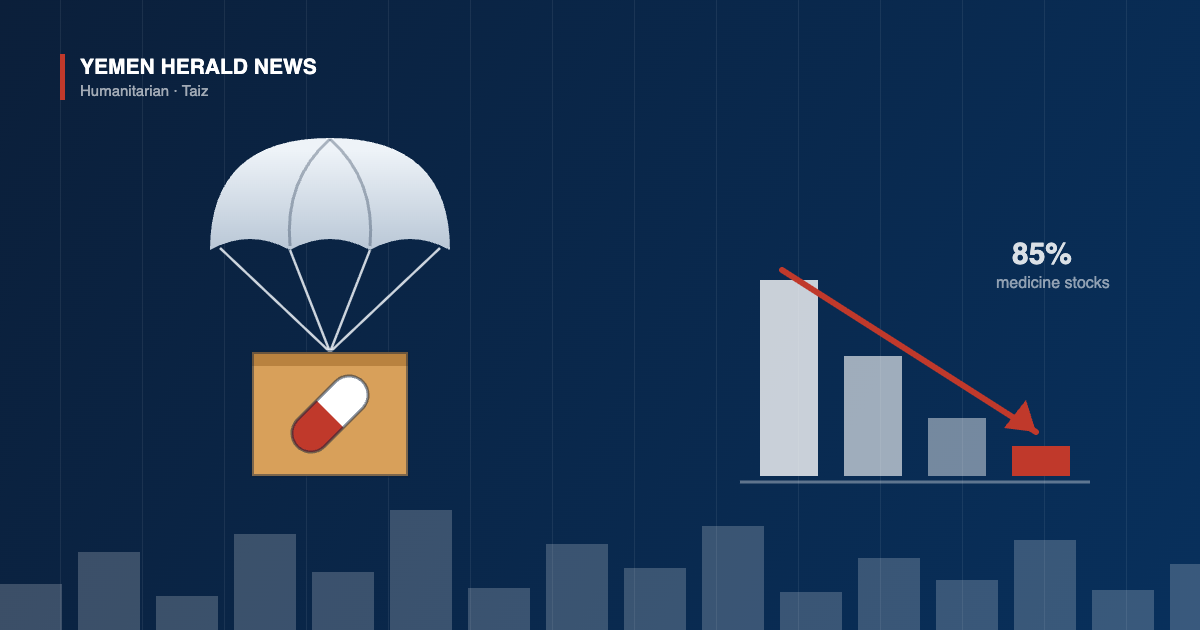
TAIZ, Yemen — A Yemeni government drug official asked for medicines to be flown into Taiz, saying the governorate’s pharmaceutical stocks have fallen 85 percent below normal.
Mohammed Al-Sufi, director of the Supreme Board of Drugs and Medical Appliances branch in Taiz governorate, said demand for medicines had risen by more than 200 percent, according to Yemen Monitor, which reported his statement on Friday.
He attributed the increase to displacement, a rising number of injuries and the spread of epidemics.
Al-Sufi asked the United Nations to set up what he called a safe and direct mechanism to move medicines into the city. He urged donors to deliver aid by air and the Yemeni government to fund the health sector.
He said operating theatres could be suspended. Organ-transplant patients have no medicines, he said, and the governorate has run short of antivenoms and serums for snake and dog bites.
His figures covered more than 10,000 diabetic patients who need free insulin and about 16,500 patients registered at the governorate’s oncology centre.
More than 700 patients with kidney failure require dialysis, he said. He also counted 11,500 psychiatric patients who need medication for chronic conditions, and about 500,000 women of reproductive age.
Al-Sufi did not say where or when he made the statement. Yemen Herald could not independently verify his figures, and no international agency has published matching numbers.
Aid organisations working in Taiz have described shortages of the same kind. Their accounts of access to the city differ from one another.
The International Committee of the Red Cross said it delivered four trucks of medical supplies, including surgical kits, to Taiz city on 4 November.
Hachem Osseiran, an ICRC spokesman, told Agence France-Presse that it was the organisation’s first delivery to hospitals in the city since 23 September, a gap of about six weeks. He said the shipment could not meet all of the population’s needs.
The World Health Organization said hospitals in Taiz governorate faced critical shortages of fuel, oxygen, medicine and medical supplies.
Tom Fletcher, the UN humanitarian chief, said on 2 November that roads were closed and supplies were running out. He said water production in the city had halved and food prices had risen by at least 50 percent.
Doctors Without Borders gave a different account of access. The organisation said on 4 November that it had delivered medical supplies to Al-Thawra hospital in Taiz city without restrictions, according to the Houthi-run Yemen Press Agency.
That agency said the organisation had also treated wounded patients over the previous two weeks at a general hospital in Dhi al-Sufal district, near Taiz. It quoted no named representative of the organisation.
Doctors Without Borders said care depended on safe passage for patients, ambulances, health workers and medicines, according to the same report. The agency separately cited unnamed local residents who said traffic and goods were still entering the city.
The Houthis deny imposing a siege on Taiz. The Yemeni government and the Taiz authorities say the group encircled the city in early October and closed the road to Aden.
UNICEF said on 18 November that at least 28 health facilities had been damaged since the escalation began, five of them supported by the agency.
Water production in Taiz had fallen by nearly half, UNICEF said, and more than 800,000 people in the governorate were reported to have been cut off from aid by late October.
About one in three children screened by the agency’s mobile health teams were acutely malnourished, it said.
UNICEF said an attack on 2 November on the Al-Suqyah Health Centre in Lahj, which the agency supports, was reported to have killed five people, including three health workers.
The ICRC said in October that Marib, Taiz and the Red Sea coast carried some of the heaviest burdens of weapon-wounded patients in the country. Some front-line facilities recorded more than 700 admissions in a single week, it said.
Feras Abusamra, the ICRC health coordinator, said front-line hospitals had limited supplies of surgical materials, anaesthesia, oxygen and medicines.
Christine Cipolla, who heads the ICRC delegation in Yemen, said the health system might have little capacity left to absorb a large surge in casualties.
The organisation said it had moved more than 500 tonnes of medical supplies to Sanaa and Aden by chartered aircraft and truck since the escalation began.
It supports more than 40 health facilities across the country, including more than 10 in Taiz on both sides of the front lines, and more than 20 casualty collection points.
In Aden, Taiz, Al-Dhale and Lahj, the organisation said it covered major hospitals, eight public health care centres and the casualty collection points.
It named Aboud Hospital and Al-Jumhuriya Hospital in Aden, Al Talh Hospital in Saada and Zabid Rural Hospital in Hodeidah among the facilities it supports.
An ICRC mobile surgical team has worked at Marib General Hospital since August, the organisation said.
More than 60 ambulances operate with ICRC support alongside the Yemen Red Crescent, the organisation said.
Yemen Monitor said government forces launched an offensive on 5 October with Saudi-led coalition support.
The report did not say whether the health ministry in Aden had endorsed Al-Sufi’s request for an air bridge.
About the Author