Shabwa Ground Forces Restate Loyalty to the Southern Transitional Council on Aden Declaration Anniversary
 Yemen Herald News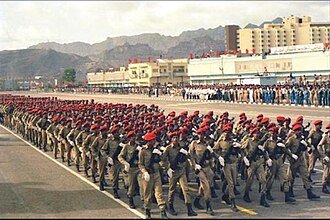
The Ground Forces Command in Shabwa governorate publicly reaffirmed its loyalty to the Southern Transitional Council and to the council’s president, Aidarous al-Zubaidi, in early May 2026, as southern Yemen marked the ninth anniversary of the Aden Declaration. The statement was one of a series issued by units and local bodies across the south during the anniversary period, and it matters less as a change of position than as a public restatement of where a significant armed formation considers its political allegiance to lie.
The Aden Declaration was issued on 4 May 2017 and led to the formation of the Southern Transitional Council the following week, with al-Zubaidi, then the recently dismissed governor of Aden, at its head. The council presented itself as the political and military representative of southern interests, arguing that the south had been marginalised within the unified state established in 1990 and, later, within the internationally recognised government that the war had displaced to Aden and Riyadh.
Nine years on, the anniversary was marked by large rallies. Thousands of supporters gathered in Aden to renew what the council describes as a popular mandate for al-Zubaidi and to press for southern representation in any future political settlement, and a further mass gathering was held in Mukalla, in Hadramout, in commemoration of the declaration. During the anniversary the council also announced a change of name, rebranding itself as the Arab South Transitional Council, a formulation intended to emphasise the Arab identity of its political project.
The Shabwa statement carries particular weight because of where the governorate sits. Shabwa contains oil infrastructure and the routes connecting Marib and Hadramout to the coast, and control of its security forces has been contested between the council and other components of the anti-Houthi camp for years. Command arrangements there have shifted more than once, and each shift has been read locally as a signal about the balance between the council and the government in Aden.
That balance is formally managed inside the Presidential Leadership Council, the eight-member body established in April 2022 and chaired by Rashad al-Alimi, on which al-Zubaidi sits as a vice-chairman. The arrangement placed the council’s leadership inside the internationally recognised government while leaving its stated objective, the restoration of an independent southern state, formally unresolved. Declarations of loyalty by armed units to a party rather than to the state are a direct expression of that unresolved question.
The council’s own account of its position is that it represents the settled will of southerners and that its forces have carried the main burden of fighting in the south. Rival southern figures, and officials aligned with the government, dispute both the scope of that mandate and the council’s claim to speak for governorates such as Hadramout and Mahra, where distinct local movements exist and where the council’s support is more contested than in Aden or Lahj. These are competing political claims rather than established facts, and they are best read as such.
Yemen’s wider war has been comparatively static on the main front lines in recent years, without a formal end to hostilities. That relative quiet has shifted attention within the anti-Houthi camp toward internal questions: who administers the territory it holds, who pays and commands the forces defending it, and who would represent the south in any negotiated settlement. Anniversary statements of the kind issued in Shabwa are one of the few public instruments through which those questions are contested.
The forces themselves are a product of the war rather than of the pre-war state. Units raised locally from 2015 onward, funded and trained outside the ordinary defence budget, were absorbed into overlapping command structures without ever being fully integrated into a single national army. That legacy is why questions of loyalty in the south are answered by formation rather than by rank, and why any eventual settlement will require a security arrangement as much as a political one. Successive United Nations envoys have identified that integration problem as among the hardest elements of a durable agreement, precisely because it touches salaries, weapons and local authority at the same time.
Economic conditions form the backdrop. The southern governorates have carried a severe currency depreciation, irregular payment of public salaries and prolonged electricity shortages, particularly through the summer months, and popular anger over services has periodically produced protests that are not aligned with any one faction. Both the council and the government have an interest in being seen to respond, and both have accused the other of responsibility for the failures.
External actors are part of the picture without being decisive in it. Saudi Arabia and the United Arab Emirates have both maintained relationships with different components of the anti-Houthi camp, and the council has historically been the closest to Abu Dhabi. Attributing every local decision to those relationships, however, tends to understate the extent to which southern factional politics is driven by local rivalries over resources, appointments and command.
What the Shabwa declaration signals is continuity rather than rupture. It confirms that a formation with responsibility for security in a strategically placed governorate identifies its chain of political loyalty as running to the council rather than to the government it nominally serves, and it does so at a moment when the council is publicly restating a maximalist objective. Neither the loyalty nor the objective is new; the significance lies in both being asserted openly at the same time.
About the Author