Shura Council Speaker and EU Ambassador Discuss Yemen’s Peace Track in Amman
 Yemen Herald News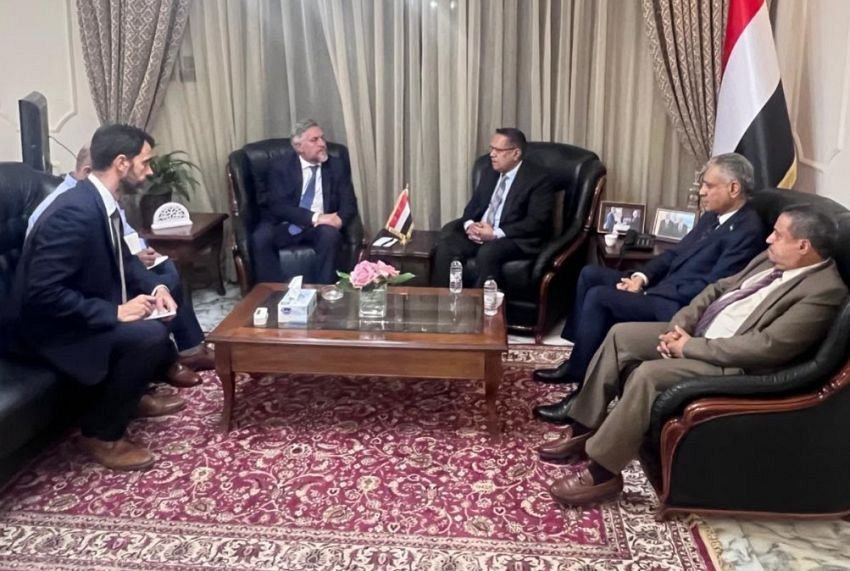
The Speaker of Yemen’s Shura Council, Dr Ahmed Obaid bin Daghr, has met the European Union’s Ambassador to Yemen, Patrick Simonnet, in the Jordanian capital Amman for talks on the country’s political and humanitarian situation. According to Yemeni official accounts of the meeting, the two men reviewed the prospects for ending a conflict now in its second decade and discussed what continued European engagement could do to ease what remains one of the world’s largest humanitarian emergencies.
Bin Daghr is among the more senior figures in the internationally recognised government’s political establishment. He served as prime minister from 2016 to 2018 before taking up the leadership of the Shura Council, the appointed upper chamber of Yemen’s parliament, in 2021. Simonnet, a career European diplomat, assumed his post as head of the EU delegation to Yemen on 1 September 2025 and presented his credentials to President Rashad al-Alimi, chairman of the Presidential Leadership Council. He delivered the delegation’s Europe Day address in the interim capital, Aden, in May.
The Speaker used the meeting to restate the government’s declared position that it remains committed to a fair and inclusive settlement built on the agreed terms of reference it has consistently invoked: the Gulf Initiative, the outcomes of the National Dialogue Conference and United Nations Security Council resolution 2216. He also pressed for sustained European political and economic support, an appeal that reflects how heavily the government in Aden depends on outside partners for both diplomatic weight and budgetary relief, with public salaries, fuel imports and basic services all under strain from a depreciating currency and reduced revenues.
Yemen’s war has run since the Houthi movement seized the capital, Sanaa, in late 2014, prompting a Saudi-led military intervention the following March. The government accuses the Houthis of continuing to build up their forces and of obstructing progress towards a negotiated settlement, and describes the group as a terrorist organisation. The Houthis reject that characterisation and present their own operations as defensive. Independent verification of battlefield claims from either side remains difficult, and much of the front line has been broadly static for several years.
Ambassador Simonnet, for his part, reaffirmed the European Union’s backing for the United Nations-led effort to reach a comprehensive political solution. That support is both diplomatic and financial. The European Commission announced a global humanitarian aid budget of 1.9 billion euros for 2026, of which 448 million euros is earmarked for the Middle East, covering Yemen alongside Gaza, Iraq, Syria and Lebanon. EU-funded partners deliver health, nutrition and protection services inside Yemen, with one implementing agency alone reporting that it reached more than 300,000 people.
The scale of the need is difficult to overstate. The United Nations humanitarian needs and response plan for 2026 estimates that more than 22 million people in Yemen require assistance and protection, among them 5.2 million internally displaced people, around 329,000 migrants and some 63,000 refugees and asylum seekers. Aid agencies have appealed for 2.16 billion dollars to reach 12 million people this year, prioritising the 9.4 million living in the districts assessed as most severely affected, because available resources fall well short of the full caseload.
Food security has continued to deteriorate. The most recent integrated phase classification analysis puts 18.3 million people in acute food insecurity, with some districts moving from crisis to emergency levels and pockets of catastrophic conditions in the most fragile communities. More than 2.2 million children under five are acutely malnourished, including over half a million with severe acute malnutrition. A further 14.4 million people need water, sanitation and hygiene support, a shortfall that has repeatedly translated into cholera and measles outbreaks among displaced and host communities alike.
The conflict’s maritime dimension has given it consequences far beyond Yemen’s borders. The Red Sea and the Bab al-Mandab Strait, through which a substantial share of global seaborne trade passes, have become a theatre of attacks on commercial shipping, pushing up insurance costs and rerouting vessels around southern Africa. Neighbouring states, the Saudi-led coalition and the United Arab Emirates all retain interests in the outcome, while Iran’s support for the Houthis, which Tehran characterises as political rather than military, adds a further layer of regional competition.
On the diplomatic track, the UN Special Envoy for Yemen, Hans Grundberg, has continued shuttle visits to Aden and regional capitals and has convened a series of dialogues bringing together Yemeni political parties, civil society figures and independent experts, with an emphasis on the participation of women and young people. His office has been explicit that these consultations are preparatory: the central objective, a direct and inclusive negotiation between the parties under UN auspices, has not yet been achieved. No formal nationwide truce is currently in force, and the two-month truce arrangements brokered in 2022 have not been formally reinstated, although front-line fighting has remained below its earlier peaks.
That gap between preparatory diplomacy and substantive negotiation is what meetings such as the one in Amman are intended to narrow. For the Yemeni government, European backing carries practical value in sustaining international attention and in funding services that the state cannot presently deliver. For the European Union, engagement is tied to the security of shipping lanes and to the risk that a collapsing economy deepens displacement and migration. Neither side described the talks as producing new commitments, and the outlook for a political breakthrough remains uncertain.
About the Author