Israel’s Finance Minister Smotrich Calls for Annexing Southern Lebanon up to the Litani
 Yemen Herald News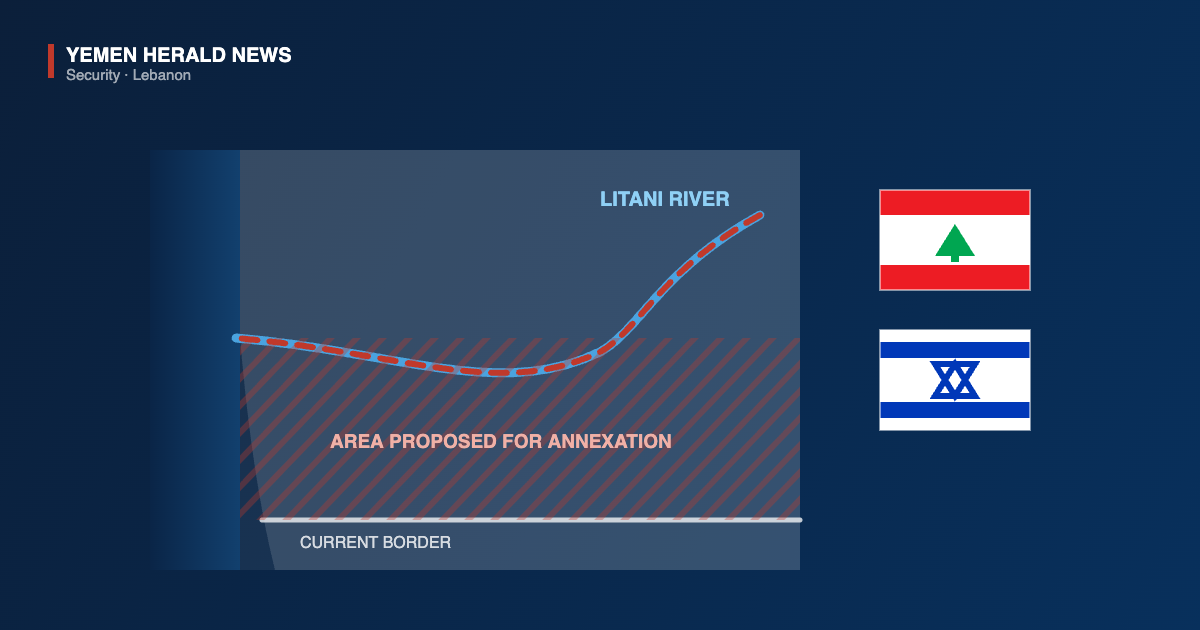
Israel’s finance minister, Bezalel Smotrich, called in March 2026 for the annexation of southern Lebanon, saying the Litani River should become Israel’s new border. He made the remarks in an Israeli radio interview on 23 March, as Israeli operations in Lebanon intensified.
Smotrich said the military campaign in Lebanon needed to end with what he described as a different reality entirely, covering both the question of Hezbollah and a change to Israel’s borders. He stated directly that the new Israeli border must be the Litani.
The Litani rises in the Bekaa Valley and runs through southern Lebanon before turning west to the Mediterranean. At its closest it lies roughly 30 kilometres north of the Israeli border, and the territory between the river and the frontier covers the bulk of Lebanon’s southern governorates.
The comments were reported at the time as the most explicit statement yet by a senior Israeli official on seizing Lebanese territory. Israel has described its campaign as directed at Hezbollah, the Iran-backed movement that holds substantial military and political power in Lebanon.
Lebanon was drawn into the wider regional war on 2 March 2026, when Hezbollah fired missiles into Israel. Israeli forces subsequently ordered residents to leave the area south of the Litani and conducted sustained air strikes across the region, which Israel regards as a Hezbollah stronghold.
Lebanese authorities and humanitarian organisations reported substantial civilian casualties and damage to residential areas and infrastructure during that period. Accounts of individual strikes were contested, with Israeli statements and Lebanese reporting frequently differing on the identity of those killed.
The Litani has a long history in discussions of Israel’s northern frontier. Proposals placing a boundary at the river date back to the negotiations that shaped the region’s borders after the First World War, when Zionist representatives argued for access to its waters as part of a future state.
Water is central to that history. The Litani is Lebanon’s largest river lying wholly within its territory, and it supplies irrigation and hydroelectric power across the south and the Bekaa. Any change to control of the basin would carry economic consequences well beyond the security question.
The river also features in the modern legal framework. United Nations Security Council Resolution 1701, which ended the 2006 war, established an area between the Blue Line and the Litani in which only Lebanese state forces and UN peacekeepers were to be armed, a provision that has never been fully implemented.
Annexation of occupied territory is prohibited under international law, and states have consistently declined to recognise territorial changes achieved by force. Israel’s earlier annexations of East Jerusalem and the Golan Heights were rejected by the Security Council and are not recognised by most governments.
Smotrich, who leads the Religious Zionism party, has been among the most outspoken members of the Israeli cabinet on territorial questions, and has previously advocated positions that other ministers declined to endorse. His statements are not automatically government policy.
The distinction matters for how the remarks were read. A finance minister’s call for annexation reflects a position within the governing coalition rather than a formal decision, though in this case it followed operational developments on the ground that gave it added weight.
Israel had by then announced measures concerning territory up to the Litani, and the combination of the evacuation orders, the scale of the strikes and the ministerial statement was read regionally as evidence of intent to establish lasting control rather than a temporary security zone.
Israel maintained an occupation of a strip of southern Lebanon from 1985 until 2000, administered in part through an allied local militia. That period ended with a withdrawal to the Blue Line, and the experience shapes Lebanese assessments of what a renewed occupation would involve.
For Lebanon, the prospect touched an already fragile state. The country has spent years in a severe economic crisis, with a collapsed banking sector, a depreciated currency and a government whose capacity to deliver services has been sharply reduced.
Displacement was the immediate humanitarian consequence. Evacuation orders covering the area south of the Litani affected a large population, and those who left moved north towards Beirut and the coastal cities, adding pressure to housing and services in areas already hosting displaced people.
Regional reaction to the remarks was uniformly critical. Arab governments rejected the idea of annexation, and international officials restated the position that borders cannot be altered by force, though statements of that kind have not in the past changed outcomes on the ground.
Hezbollah’s own position complicated any settlement. The movement holds seats in the Lebanese parliament and has participated in governments, while maintaining an armed wing that the Lebanese state has never been able to disarm. That dual character has repeatedly frustrated attempts to apply Resolution 1701 as written.
The United Nations Interim Force in Lebanon, deployed along the Blue Line since 1978, found its position increasingly difficult as the fighting escalated. Peacekeepers there operate under a mandate that assumes a degree of cooperation from both sides, a condition that has not held during periods of open hostilities.
The account above reflects reporting from March 2026, including the text of Smotrich’s radio remarks as quoted by Israeli and international outlets. Assessments of civilian casualties and of Israel’s intentions were contested at the time and are attributed here to the parties that made them.
About the Author