Strike on Manama Residential Building Kills One Woman and Injures Eight
 Yemen Herald News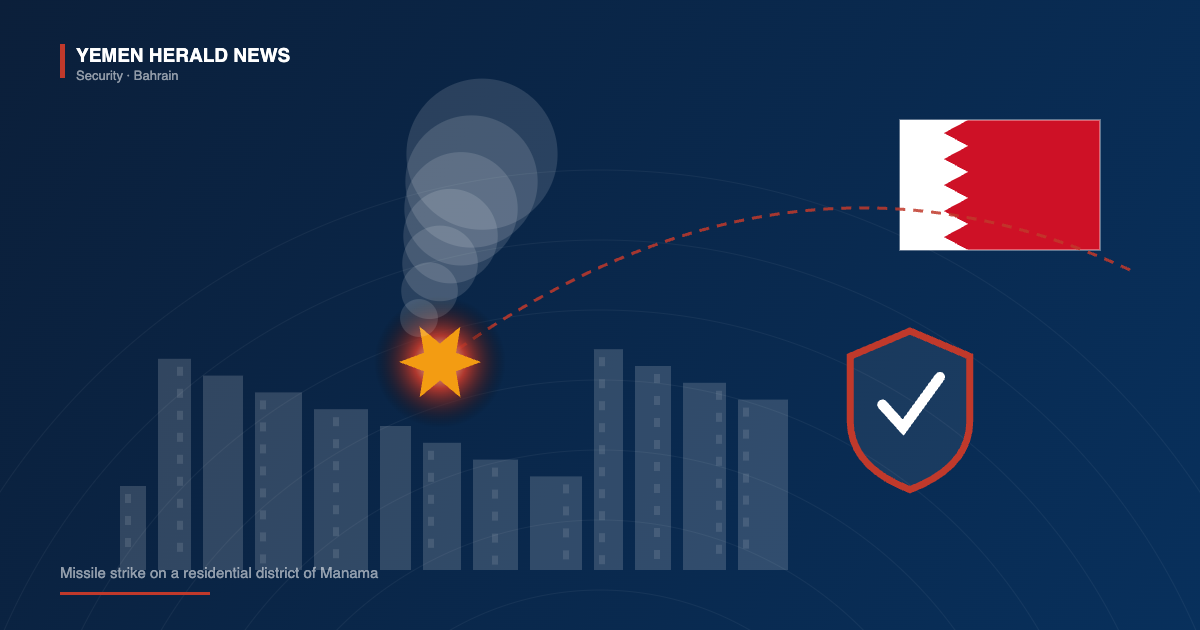
A strike attributed to Iranian forces hit a residential building in the Bahraini capital, Manama, on the morning of Tuesday 10 March 2026, killing one woman and injuring eight other people. Bahrain’s Ministry of Interior confirmed the casualties and described the attack in an official statement as blatant Iranian aggression against the country.
Reporting at the time identified the woman killed as twenty-nine years old. Emergency services reached the building shortly after the impact, and the ministry said local authorities had responded immediately to secure the site and treat the wounded. Bahrain said the country had been targeted that day by three missiles and one drone.
The General Command of the Bahrain Defence Force added that its air defence systems had engaged multiple waves of incoming Iranian fire. It said that since the attacks on the kingdom began, its defences had destroyed ninety-five missiles and one hundred and sixty-four drones directed at targets across Bahraini territory. Later government figures raised those running totals to one hundred and two missiles and one hundred and seventy-three drones.
The command condemned the targeting of civilian sites and private property, calling such attacks violations of international humanitarian law and of the United Nations Charter. It said the strikes constituted a direct threat to regional peace and security and called for accountability and for adherence to international norms governing the conduct of hostilities.
By the following day, 11 March, cumulative reporting put the toll in Bahrain at two people killed and more than fifty injured since the start of the campaign. The kingdom is the smallest of the Gulf states by area, and its dense urban geography means that a missile or a piece of falling debris has a high probability of coming down near housing.
Bahrain had been under attack since late February. Iran began launching drones and missiles at Gulf Cooperation Council states on 28 February 2026, after American and Israeli strikes on Iranian territory, and Bahrain was among the first to report impacts. Residential buildings near the American naval installation on the island were struck in the opening days of the campaign.
That installation is central to Bahrain’s position. Naval Support Activity Bahrain hosts the United States Navy’s Fifth Fleet, the command responsible for American naval operations across the Gulf, the Red Sea and the western Indian Ocean. Its presence has long made the kingdom a probable target in any confrontation between Iran and the United States.
Bahraini officials nonetheless maintained through the campaign that the country was not a belligerent. Like the other Gulf states, Bahrain framed its air defence operations as protective rather than participatory, and avoided announcing any offensive role in the American and Israeli campaign against Iran.
Air defence performance became a recurring theme in official statements across the region. On 12 March, Bahrain said Gulf Cooperation Council states had between them intercepted more than nine hundred Iranian missiles, around two and a half thousand drones and seventeen aircraft since the campaign opened. On 21 March, Bahrain reported that a Patriot battery had brought down a drone directly over a residential area.
Interceptions above populated ground carry their own hazard. Debris from a destroyed missile or drone falls somewhere, and across the Gulf a share of the injuries recorded during the campaign was caused by falling fragments rather than by warheads reaching their targets. Several of the deaths reported in the United Arab Emirates were attributed to debris.
Human Rights Watch published a report on 17 March arguing that Iranian strikes across the Gulf had endangered civilians and that many had hit civilian objects, including residential buildings, hotels, civilian airports, embassies and financial centres. The organisation said attacks directed at such targets were unlawful regardless of the strategic argument advanced for them.
Iran did not publicly acknowledge striking residential buildings in Manama. Its statements during the campaign described its targets as American military assets and the states hosting them, a framing Gulf governments rejected as an attempt to justify strikes that were landing in city centres well away from any base.
Across the region the casualty pattern was uneven. The heaviest toll fell on the United Arab Emirates, where at least three people were killed and dozens injured, while thirty-two people were reported injured in Kuwait, sixteen in Qatar, five in Oman and four in Bahrain over comparable periods of the campaign.
The economic consequences reached beyond the immediate damage. Aviation and marine insurers repriced Gulf risk sharply, airspace closures disrupted flight schedules across the region’s hubs, and the cost of moving goods through Gulf ports rose accordingly. Those costs were passed along the supply chains that serve the wider Middle East.
For Yemen, the Manama strike echoed a pattern the country knows well. Attacks on residential districts, disputed accounts of who was targeted and rising counts of intercepted munitions have been features of the Yemeni war since 2015. The Bahraini case placed the same dynamic in one of the region’s wealthiest and most heavily defended states.
Bahrain’s government said it was continuing to monitor the security situation and had raised its level of vigilance against further attacks. It did not announce evacuations or shelter orders for the affected district, and said residents should follow instructions issued through official channels rather than accounts circulating on social media.
About the Author