Trump called off planned US strikes on Houthi targets, US media report
 Yemen Herald News
WASHINGTON, United States — President Donald Trump called off a planned US air attack on Houthi targets in Yemen on Sunday, hours before the first wave was due to begin.
The New York Times first reported the deliberations. Reuters and Axios reported separately that strikes had been prepared and then cancelled.
Commanders had approved target lists and crews were loading bombs onto aircraft when the order to stand down reached them, according to those accounts.
Trump made the decision by midday on Sunday, Axios reported.
The White House has not commented publicly on the reporting. The Pentagon has not confirmed that a strike package existed.
Trump had told advisers on Wednesday that he did not favour striking the Houthis, Axios reported.
He changed position after a telephone call with Saudi Crown Prince Mohammed bin Salman the following day and instructed the Pentagon to prepare an operation, according to the same account.
By Sunday he had changed his mind again.
One official told Axios that Trump did not want to open a Pandora’s box. Striking the group could lead it to put the Bab al-Mandab strait at risk and create a second chokepoint for shipping, the official said.
Traffic through the Strait of Hormuz has already been disrupted during this year’s conflict between the United States, Israel and Iran.
The Houthis reached the Bab al-Mandab approaches this month.
Fighters took the Red Sea port city of Mocha on Sept. 10, Euronews reported.
Within days the group held the remainder of Yemen’s Red Sea coastline and the island of Mayyun, also known as Perim, in the middle of the strait, according to Al Jazeera and the Times of Israel.
Houthi units also moved onto the Hanish Islands, the Times of Israel said. The group’s forces now sit about 20 kilometres from the African shore, Al Jazeera reported.
The Guardian reported that Houthi fighters were pushing for high ground inland that would separate the coast from areas held by forces aligned with Yemen’s internationally recognised government.
Neither side’s account of the inland fighting has been independently confirmed. The Houthis and the government routinely dispute each other’s claims about who holds which ground.
Bab al-Mandab links the Red Sea to the Gulf of Aden. Most shipping using the Suez Canal passes through it.
The UN Security Council held an emergency meeting on the advance on Sept. 15, its second on Yemen in under a week.
An assistant secretary-general told the Council that the push toward the chokepoint raised the risk of a wider conflict, according to the UN record of the session.
The Council said navigational rights and freedoms in the Red Sea and the strait must be restored and respected by all, consistent with resolution 2722, adopted in 2024.
G7 foreign ministers issued a statement describing the situation in Yemen as an unacceptable threat to regional stability and security, to global energy security and to navigational rights.
The ministers of Canada, France, Germany, Italy, Japan, the United Kingdom and the United States, with the European Union’s high representative, called on the Houthis to stop military action and attacks on civilian shipping.
They called on Iran to end its arming of and support for the group, which they said breaches Security Council resolutions 1747, 2140 and 2216.
Trump has said more than once this month that the Houthis do not want to fight the United States.
Fox News reported on Sunday that he had said the group undertook not to attack American forces or interests and that Washington was in constant contact with it. The Houthis have issued no public comment on that account.
The decision came days after the Houthis widened their attacks on Saudi Arabia.
The group claimed missile and drone attacks on sites in Riyadh and on an Aramco facility in Yanbu on Saturday, hours after a fire was put out at a fuel depot near King Khalid International Airport.
Houthi military spokesman Yahya Saree said ballistic missiles, cruise missiles and drones were used in two operations. Saudi authorities warned residents overnight of a hostile aerial threat, and sirens sounded in Riyadh and al-Kharj.
Saudi Arabia confirmed that the group had tried to hit the capital with a ballistic missile, NBC News reported.
Security Council members condemned the attacks in a joint statement, saying they had affected civilian and energy infrastructure and caused civilian casualties, including women and children.
They called on the Houthis to cease the escalation and said Saudi Arabia has an inherent right to self-defence under international law.
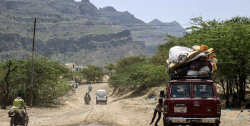
The fighting on the ground has displaced large numbers of people.
The International Organization for Migration recorded 104,796 people newly displaced inside Yemen by Sept. 16, across 17,461 households. It counted 18,500 in the first 72 hours after hostilities escalated on Sept. 3.
Taiz governorate was worst affected, with about 8,300 households displaced, the agency said. A further 2,776 people had crossed to Djibouti by that date.
The UN refugee agency allocated $2 million in emergency funding for Yemen on Sept. 21 and said its Yemen operation was 18 percent funded for the year.
Bab al-Mandab is about 30 kilometres wide at its narrowest point. Mayyun island sits in the middle of it and splits the passage into two channels.
About the Author