Yemen delivers protest note to Libya over al-Ghariani’s remarks on the war
 Yemen Herald News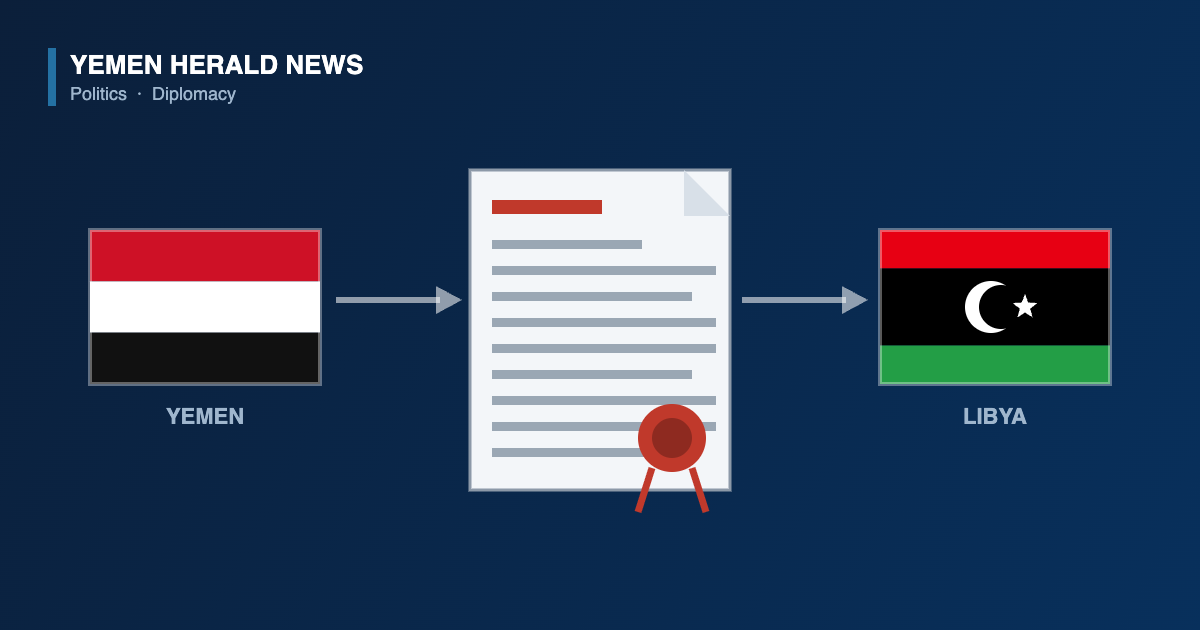
TRIPOLI, Libya — Yemen’s ambassador to Libya handed a protest note to the Libyan government on Monday over a cleric’s remarks about the war in Yemen.
Ambassador Hassan al-Hard gave a copy of the note to Deputy Prime Minister Salem al-Zadma, the Yemeni state news agency Saba reported. The note is addressed to Libya’s foreign ministry.
The account of the meeting rests on Saba, which is run by Yemen’s internationally recognised government. The Libyan government has not published its own account, and no independent confirmation has appeared.
The note concerns remarks made on Sept. 16 by Sadiq al-Ghariani, Saba said.
Al-Ghariani called on Muslims to back Houthi control of the Bab al-Mandab strait, the Libyan outlet Libya Update reported.
He was removed as Libya’s grand mufti by the country’s parliament and has continued to issue religious rulings since.
Saba did not publish the text of the note or say what response Yemen expects.
Yemen’s government said the remarks gave an inaccurate and distorted account of the situation, according to Saba. It restated its position on the war and on the Houthi movement.
Al-Hard and al-Zadma also discussed developments in Yemen and the humanitarian effects of the Houthi advance along the western coast, the agency said.
Al-Ghariani’s comments drew objections in both countries.
Yemen’s Religious Endowments Authority, headed by Sheikh Turki al-Wadi’i, asked him to reconsider and to work with Yemeni scholars, Libya Update reported. It said he should instead condemn attacks on Islamic holy sites. The authority said his position gave legitimacy to Houthi actions and misled opinion.
Libya’s Supreme Fatwa Committee condemned the remarks, accusing him of inciting unrest, according to the same report.
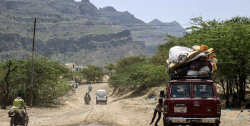
The dispute follows three weeks of Houthi gains in western Yemen.
The group launched its offensive on Sept. 3. Fighters took the Red Sea port of Mocha on Sept. 10, Euronews reported.
Within days the Houthis held the remainder of Yemen’s Red Sea coastline and the island of Mayyun, also called Perim, in the middle of the Bab al-Mandab strait, according to Al Jazeera and the Times of Israel.
Houthi units also moved onto the Hanish Islands, the Times of Israel said. The group’s forces now sit about 20 kilometres from the African shore, Al Jazeera reported.
Bab al-Mandab links the Red Sea to the Gulf of Aden. It is about 30 kilometres wide at its narrowest point, and most shipping bound for the Suez Canal passes through it.
The UN Security Council held an emergency meeting on the advance on Sept. 15, its second on Yemen in under a week. An assistant secretary-general told members the push toward the chokepoint raised the risk of a wider conflict.
The Council said navigational rights and freedoms in the Red Sea and the strait must be restored and respected by all, consistent with resolution 2722, adopted in 2024.
G7 foreign ministers described the situation in Yemen as an unacceptable threat to regional stability and security, to global energy security and to navigational rights.
The ministers of Canada, France, Germany, Italy, Japan, the United Kingdom and the United States, with the European Union’s high representative, called on the Houthis to stop military action and attacks on civilian shipping.
They called on Iran to end its arming of and support for the group, which they said breaches Security Council resolutions 1747, 2140 and 2216.
The Houthis widened their attacks on Saudi Arabia over the same period. They claimed missile and drone attacks on sites in Riyadh and on an Aramco facility in Yanbu on Saturday.
Saudi Arabia confirmed the group had tried to hit the capital with a ballistic missile, NBC News reported. Security Council members condemned the attacks in a joint statement and said Saudi Arabia has an inherent right to self-defence.
The fighting has driven the largest displacement wave Yemen has recorded this year.
The International Organization for Migration counted 18,500 people displaced in Taiz and Hodeidah governorates in the 72 hours after hostilities escalated on Sept. 3.
By Sept. 16 the figure had reached 104,796 people, across 17,461 households, the agency said. Taiz was worst affected, with about 8,300 households displaced.
A further 2,776 people had crossed from Yemen into Djibouti by that date.
The UN refugee agency allocated $2 million in emergency funding for Yemen on Sept. 21. It said its Yemen operation was 18 percent funded for the year and that it needed $25 million to reach about 231,000 people.
More than 22 million people in Yemen need assistance this year, according to the UN humanitarian office’s response plan published in March. The plan puts the number of acutely food insecure at 18.3 million.
The plan counts more than 2.2 million acutely malnourished children under five, including 516,157 severe cases, and 5.2 million internally displaced people. It seeks $2.16 billion to reach 12 million people.
Yemen’s war began in 2014, when the Houthis took Sanaa. It widened in March 2015, when a Saudi-led coalition intervened on the government’s side.
Libya has had competing administrations since 2014. The Tripoli-based government is one of two claiming authority in the country.
Saba did not say when the Libyan foreign ministry received the note itself, or whether Tripoli had replied.
About the Author